
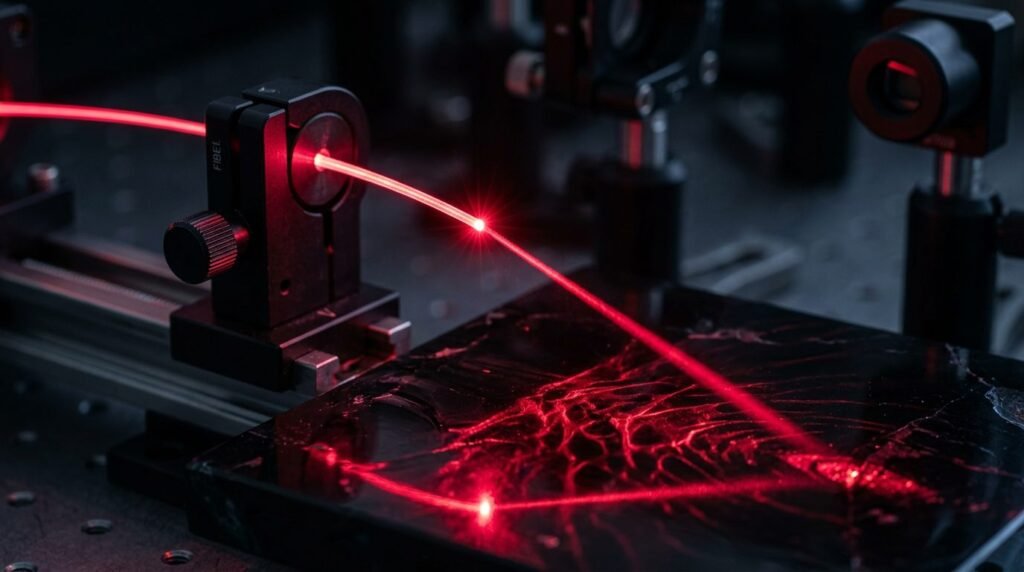
Diode lasers operating at near-infrared wavelengths between 810 nm and 980 nm represent an adjunctive disinfection tool rather than an autonomous replacement for standard chemomechanical debridement during secondary root canal interventions. Persistent apical periodontitis following primary endodontic therapy stems predominantly from polymicrobial communities dominated by Enterococcus faecalis, Candida albicans, and actinomycetes sheltered within anatomical complexities, lateral canals, apical deltas, and deep dentinal tubules. Conventional sodium hypochlorite irrigation and ultrasonic activation demonstrate limited penetration depths, typically reaching fewer than one hundred micrometers into tubular dentin. In contrast, bacterial invasion routinely exceeds one thousand micrometers. The optical transmission of near-infrared diode radiation through hydrated hydroxyapatite matrix enables thermal decontamination up to depths of one thousand micrometers. However, unmonitored thermal accumulation along the root surface creates catastrophic risks of periodontal ligament ankylosis, root resorption, and crestal bone necrosis. Safe implementation requires exact dosimetric thresholds, pulsed emission cycles, continuous helicoidal retraction speeds, and rigid clinical criteria.
Enterococcus faecalis exhibits distinct phenotypic adaptations that account for its clinical resistance to traditional intracanal medicaments such as calcium hydroxide. Its proton pump mechanism maintains intracellular pH homeostasis within intensely alkaline environments up to pH 11.5. Furthermore, its capacity to form mature, extracellular polysaccharide-encased biofilms and enter a viable but non-culturable state allows long-term survival under severe starvation conditions. When primary guttapercha and sealer obturations are mechanically cleared during retreatment, residual biofilms remain sequestered within isthmuses and accessory ramifications that nickel-titanium rotary files cannot physically contact. The optical penetration of near-infrared photons addresses this mechanical limitation. Photons at 810 nm and 980 nm possess lower absorption coefficients in pure water compared to mid-infrared wavelengths, enabling deep scattering through the mineralized peritubular and intertubular dentin. Chromophores within bacterial cell walls and intracellular pigments absorb this radiant energy, inducing photothermal lysis and structural denaturation of bacterial membrane proteins.
Thermal collateral damage defines the strict boundary of safe clinical application. In vitro and animal investigations establish that an external root surface temperature elevation exceeding seven degrees Celsius induces cellular death in periodontal ligament fibroblasts, microvascular thrombosis, and subsequent external root resorption. A sustained temperature elevation beyond ten degrees Celsius causes direct osseous necrosis and permanent ankylosis. Consequently, deploying high-power continuous wave emissions inside dry root canals represents clinical malpractice. The 980 nm wavelength exhibits moderate absorption in water and hemoglobin, whereas the 810 nm wavelength exhibits slightly lower water absorption and higher melanin affinity. Because root dentin contains negligible endogenous melanin and limited free water once dried, photonic energy converts directly into localized thermal spikes within remaining moist organic debris and bacterial clusters.
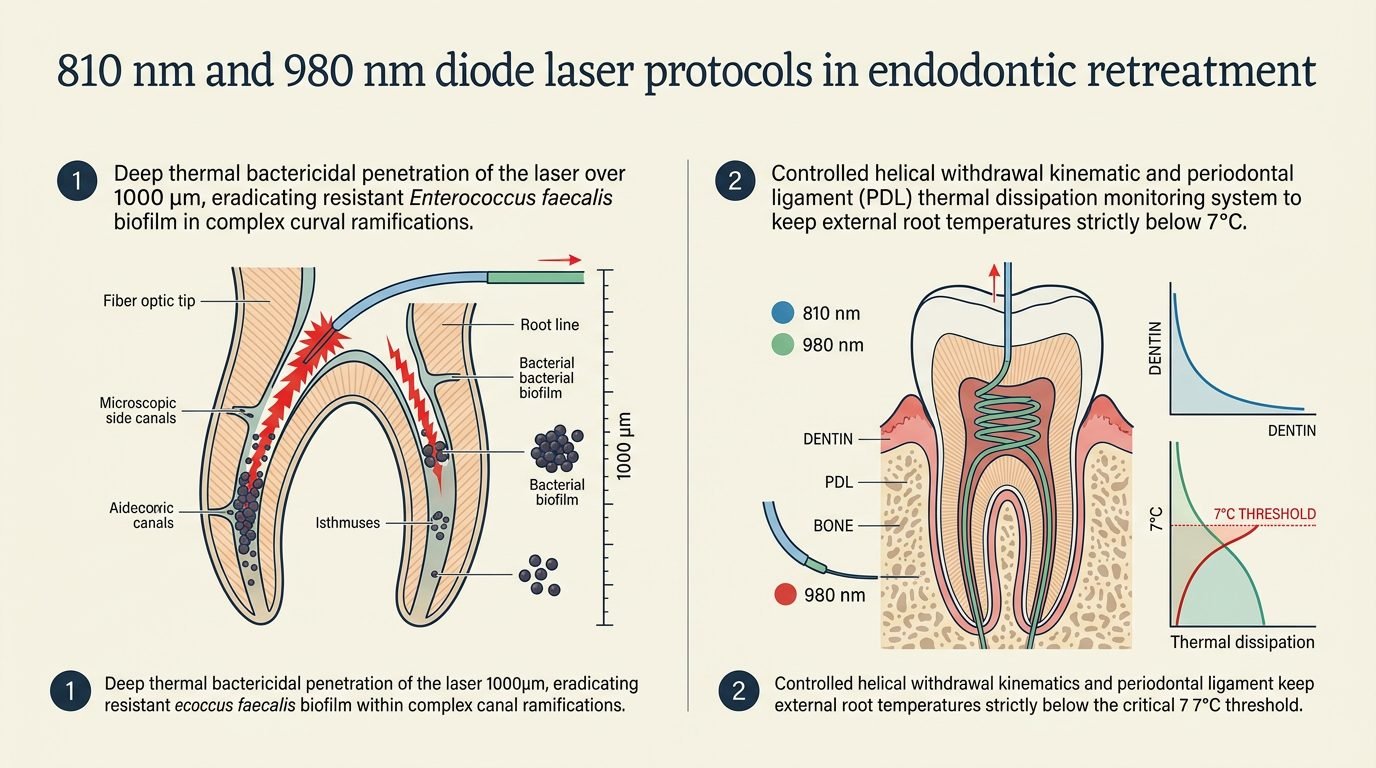
Achieving reproducible decontamination without triggering destructive periradicular thermal spikes demands adherence to precise physical parameters. Clinicians must utilize calibrated thin optical fibers, ideally two hundred micrometers in diameter, equipped with flexible cladding to negotiate apical root curvature without creating canal ledges or apical perforations. The fiber tip must never be held static at working length. Activation must occur exclusively during continuous, active coronal withdrawal at a constant linear rate of no less than two millimeters per second. Movement should follow a slow helicoidal trajectory against the canal walls. Power settings must remain conservative. Clinical trials confirm that average power settings between 0.8 watts and 1.5 watts in pulsed mode (for example, pulse durations of twenty milliseconds coupled with pulse intervals of twenty milliseconds, yielding a fifty percent duty cycle) limit external root surface thermal elevation to fewer than 5.2 degrees Celsius while achieving significant log reductions in microbial viability.
Clinical steps require rigorous sequencing during retreatment protocols. Mechanical removal of prior filling materials with solvent-free rotary desobturators and hand instruments constitutes the mandatory initial phase. Complete elimination of residual zinc oxide-eugenol or epoxy resin sealer remnants along the dentinal walls is essential, as retained sealer flakes scatter optical beams erratically and produce localized carbonization points. Following mechanical instrumentation and thorough ultrasonic irrigation with 2.5 to 5.25 percent sodium hypochlorite, canals must be rinsed with 17 percent ethylenediaminetetraacetic acid (EDTA) to strip away the newly formed smear layer. Removing the inorganic smear layer opens tubular orifices, permitting unobstructed photon penetration into the tubular lumina. Canals must be gently blotted with absorbent paper points until moist, but not desiccated; complete desiccation accelerates thermal rise, whereas excessive pooled liquid causes erratic boiling and fiber tip degradation.
Irrigant boiling represents an alternative modality known as laser-activated irrigation or photon-induced acoustic agitation. When using near-infrared diodes, explosive vapor cavitation is substantially less pronounced than with Er:YAG systems. Instead, diode laser activation inside a canal filled with sodium hypochlorite primarily drives rapid fluid warming. Elevated temperatures accelerate the chemical tissue dissolution capacity and antimicrobial reactivity of hypochlorite ions. Nevertheless, direct dry-canal irradiation remains the primary method for deep photothermal tubular sterilization. During dry-canal irradiation, clinicians must execute four passes per canal, each pass lasting no longer than five to ten seconds, interspersed with fifteen to twenty seconds of rest and chilled sterile saline flushes to dissipate residual intracanal heat before re-irradiating.
Quantitative microbiologic assays demonstrate that combining chemomechanical instrumentation with pulsed 980 nm or 810 nm diode protocols yields a 99.8 percent reduction in recoverable Enterococcus faecalis colony-forming units. Despite these impressive laboratory metrics, clinical outcome assessments must avoid promotional overstatement. Longitudinal radiographic and cone-beam computed tomography studies show that periapical bone remineralization rates following diode-assisted retreatment parallel those achieved with optimized passive ultrasonic irrigation protocols over twelve to twenty-four month follow-up intervals. While diode irradiation effectively sanitizes peripheral dentinal tubules, periapical healing ultimately depends on comprehensive biological seal creation, correct apical terminus management, coronal leakage prevention, and host immune competence. The laser acts as a powerful physical sterilizer, not a magic guarantor of tissue regeneration.
Fiber maintenance and inspection require meticulous technical oversight. Optical fibers suffer mechanical fatigue, microfractures, and tip degradation under high intracanal thermal cycles. Cleaving the fiber tip perpendicularly with a ceramic blade prior to each canal treatment ensures uniform circular beam distribution. A compromised, jagged fiber tip creates erratic hot spots that concentrate energy into sharp lateral vectors, risking lateral root perforations or localized root burns. Operators and dental assistants must wear wavelength-specific protective goggles with appropriate optical density ratings (OD 5+ for 800 nm to 1000 nm) to prevent irreversible retinal coagulative damage from scattered reflection.
Regarding practical clinical limits, near-infrared diode laser irradiation at 810 nm and 980 nm provides a validated biophysical mechanism to eradicate deep-seated bacterial biofilms during complex endodontic retreatments. The procedure demands absolute technical discipline. Operating parameters must balance high antimicrobial photon scattering against destructive external root temperature elevations. When implemented using conservative average wattages, flexible microfibers, rapid continuous helicoidal withdrawal, and adequate cooling pauses, diode irradiation eliminates persistent microflora without compromising periodontal ligament viability. It represents a precise, adjunctive thermal decontamination modality within evidence-based endodontic practice.