
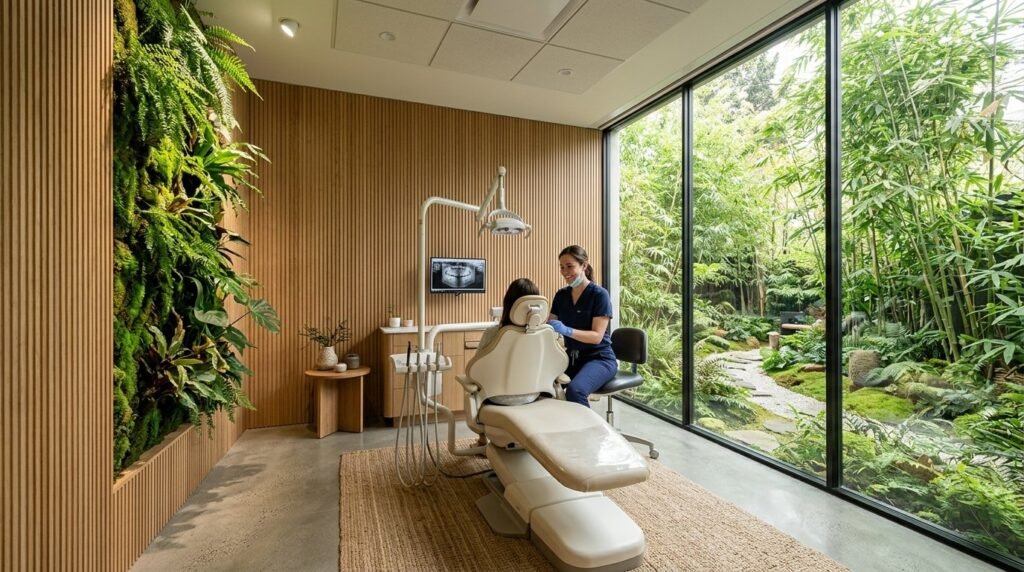
Operatory noise triggers involuntary neuroendocrine stress responses before a single dental instrument touches tooth structure. High-speed air turbines scream between 75 and 88 decibels at sharp frequencies near 4,000 Hertz. That specific harmonic range pierces the acoustic notch of human mammalian hearing. It stimulates immediate autonomic defensive reflexes. Dentists who dismiss operatory acoustic design as superficial interior decorating ignore basic auditory neuroanatomy.
Sound damages physiological equilibrium. The acoustic wave enters the external auditory canal, vibrates the tympanic membrane, and moves the ossicular chain of the middle ear. Liquid waves within the cochlea displace the basilar membrane, bending stereocilia on inner hair cells. These neural impulses do not travel exclusively to the primary auditory cortex. Collaterals fire directly into the reticular activating system, the locus coeruleus, and the lateral amygdaloid nucleus. The sympathetic nervous system discharges instantly.
The Auditory Pathway and Subcortical Arousal
Evolutionary memory is deaf to reason. For ancestral humans, persistent shrieking frequencies signified imminent predator attack or mechanical bone trauma. The human brain cannot distinguish the metallic whine of an air rotor from an evolutionary survival threat.
Cortisol surges in response to acoustic exposure. Clinical measurements show salivary cortisol and plasma catecholamines elevate within four minutes of continuous high-speed turbine idling. Heart rates accelerate by eight to sixteen beats per minute. Peripheral vasoconstriction chills the patient fingertips by up to two degrees Celsius. This somatic reaction occurs even when the patient remains completely conscious, relaxed, and anesthetized. The subconscious auditory reflex operates independently of cognitive will.
Bone conduction intensifies internal perception. When an ultrasonic scaler or rotating diamond bur contacts enamel, mechanical vibrations transfer through the alveolar bone directly to the petrous portion of the temporal bone. The cochlea perceives sound through solid tissue conduction. Earplugs cannot attenuate this direct craniomaxillofacial vibration. The patient hears an internal grinding drone exceeding 95 decibels inside the skull. That internal roar produces intense vestibular discomfort, cranial pressure spikes, and involuntary muscular clenching of the masticatory complex.
Hard Surfaces and the Echo Chamber Fallacy
Modern clinics are acoustic reverberation chambers. Polished porcelain tiles, glass partitions, enameled cabinetry, and bare quartz countertops create harsh acoustic reflection planes.
Hard materials do not absorb sound waves. Glazed ceramic tile reflects 98% of incident acoustic energy. Glass panels reflect 96%. When a high-speed handpiece, an ultrasonic scaler, a high-volume surgical evacuator, and a compressor motor operate simultaneously, sound waves ricochet between non-absorptive boundaries. Reverberation time, measured as RT60, frequently exceeds 1.4 seconds in standard clinical operatories. An acceptable clinical reverberation time should remain below 0.5 seconds.
Chronic reverberation generates cognitive fatigue. Clinical staff suffer alongside patients. Prolonged exposure to reflective noise fields induces mental exhaustion, reduces fine motor dexterity, and raises operator systemic blood pressure across seven-hour shifts. The clinician becomes irritable; the patient becomes defensive. This toxic acoustic loop compromises the safety of delicate microsurgical interventions and degrades diagnostic communication between provider and patient.
Principles of Dental Neuroarchitecture
Neuroarchitecture applies neuroscience to structural operatory design. Its objective is the systematic neutralization of sensory stressors through environmental engineering.
Micro-perforated acoustic panels break reverberation loops. Installing ceiling baffles and wall assemblies constructed from acoustic-rated porous mineral fibers with a Noise Reduction Coefficient of 0.85 or higher drops ambient reverberation under 0.4 seconds. High-frequency turbine harmonics are absorbed on first contact rather than reflected across the room.
Geometric baffling diffuses sound paths. Angling partitions by eight to twelve degrees prevents standing sound waves from forming between parallel walls. Recessing dental suction pumps and noisy oil-free compressor units behind double-stud soundproof utility closets with decoupling rubber isolation pads removes low-frequency mechanical rumble from the clinical zone entirely. Walls should meet Sound Transmission Class ratings of 50 or higher to block plant room vibrations. HVAC ductwork requires silencer baffles and oversized low-velocity air diffusers to prevent continuous air turbulence hum from elevating the operatory noise floor.
Active sound-masking restores acoustic privacy. Ambient white or pink noise generators calibrated between 40 and 45 decibels blur sudden high-frequency transient noises. The sharp click of an instrument tray or the hiss of an air-water syringe ceases to shock the patient central nervous system. Replacing metal surgical suction tips with vented silicone aspirator cannulas silences turbulent fluid intake whistles by up to 14 decibels. Masking creates an acoustic buffer zone, enabling calm vocal communication without elevated vocal strain.
Biophysical Sensory Decoupling Protocols
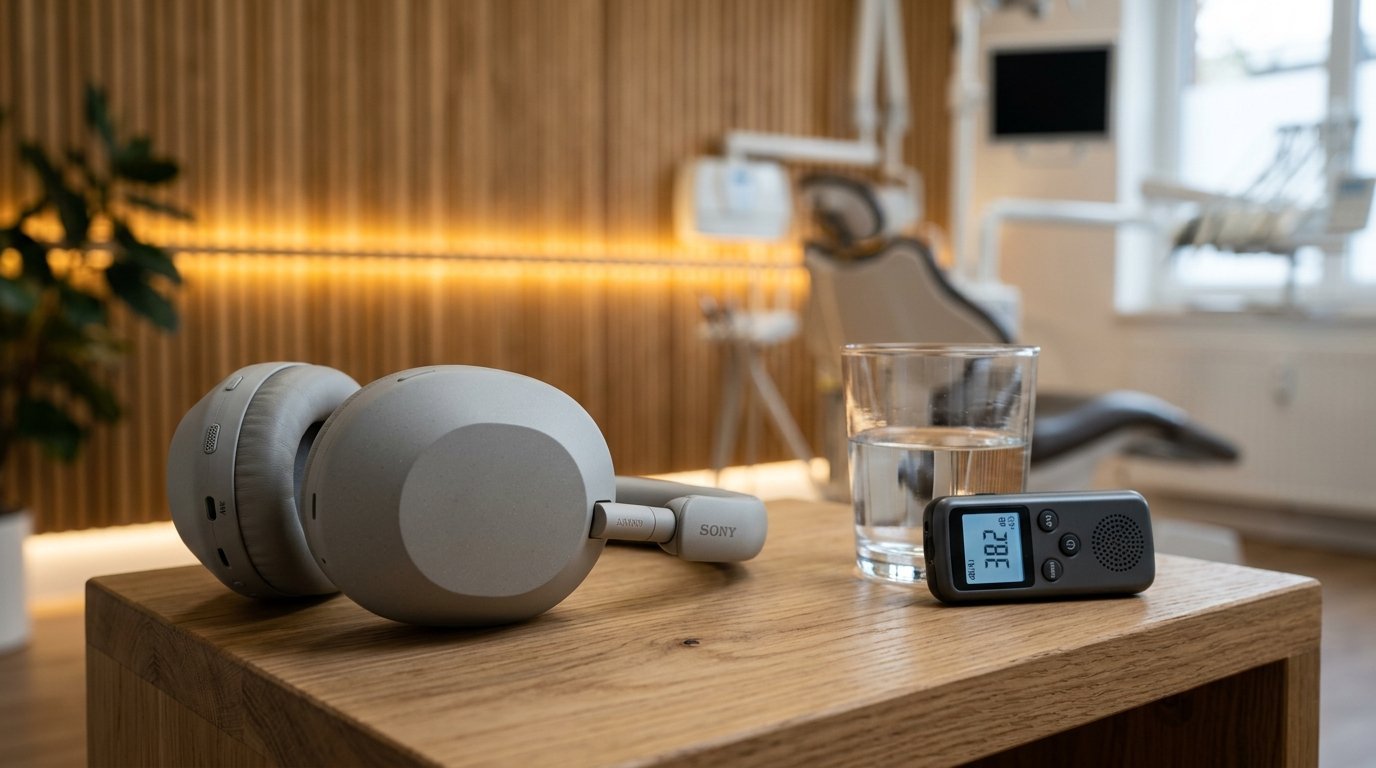
Passive acoustic isolation completes the environmental defense. High-attenuation over-ear circumaural headphones equipped with phase-inversion active noise cancellation attenuate airborne turbine whines by up to 28 decibels across the critical 2,000 to 5,000 Hertz spectrum. Supplying curated acoustic frequencies, such as binaural delta or theta beats oscillating around 432 Hertz, promotes alpha-wave synchrony in the cerebral cortex.
Sensory decoupling shifts mental focus away from operatory mechanics. When acoustic inputs match natural organic soundscapes, prefrontal cognitive vigilance relaxes. The autonomic nervous system transitions from sympathetic fight-or-flight dominance toward vagal parasympathetic homeostasis. Respiratory rates normalize. Peripheral vascular tone softens, resulting in measurably warmer extremity temperatures during clinical treatment.
Biophotonic Instrumentation as the Ultimate Acoustic Solution
The most effective noise control is noise elimination. You cannot quiet a pneumatic turbine that spins at 400,000 revolutions per minute on compressed air bearings. The physical laws of compressed gas expansion ensure acoustic emission.
Er:YAG lasers replace mechanical rotary cutting. Erbium lasers operating at a wavelength of 2,940nm ablate enamel and dentin through water-mediated micro-explosions. The interaction is photonic rather than mechanical. Instead of a deafening high-pitch turbine scream, the Er:YAG laser emits a rhythmic, low-frequency pulse resembling soft water drops at less than 50 decibels. The 4,000 Hertz acoustic threat is erased from the operatory atmosphere.
Diode systems quiet soft-tissue surgery. Electrosurge units buzz loudly and generate burning tissue odors. High-frequency 980nm diode lasers perform gingivectomy, frenectomy, and pocket debridement in total acoustic silence. Optical energy delivers contact vaporization through flexible quartz fibers without auditory collateral damage.
Quiet procedures foster physiological calm. When high-decibel auditory cues disappear, the patient central defense circuits remain dormant. Pulse oximetry confirms stable cardiac rhythms throughout the restorative appointment. The dental clinic transforms from an adversarial sensory chamber into a controlled surgical suite.
Clinical architectural acoustics is a medical necessity. Ignoring acoustic physics while treating anxious patients with high-speed pneumatic handpieces is an obsolete standard of care.
Architectural acoustic measurements published by the National Institute for Occupational Safety and Health confirm that dental healthcare personnel face continuous ambient noise exposure exceeding 82 decibels during 68% of standard operative procedures. Incorporating micro-perforated sound absorption panels and water-mediated erbium lasers reduces peak operatory acoustic spikes by an average of 24 decibels across full restorative appointments.
Leave a Reply