

Severe dental phobia in adult patients frequently stems from complex childhood developmental trauma rather than isolated painful dental experiences. A distinct, under-recognized etiology involves survivors of medical child abuse (historically termed Munchausen syndrome by proxy or Factitious Disorder Imposed on Another). In these cases, a caregiver systematically subjected a child to unnecessary, invasive, or fabricated medical and dental interventions. Survivors enter adult dental clinics with profound, deep-seated terror characterized by extreme hypervigilance, anticipation of physical exploitation, and complete disintegration of trust in clinical authority figures. Conventional desensitization methods fail when clinicians do not recognize that the clinical setting itself acts as a potent trigger of childhood exploitation and bodily violation. Re-establishing clinical trust requires meticulous boundary establishment, unconditional procedural transparency, and absolute verification of patient-directed autonomy.
The psychological footprint of medical child abuse fundamentally alters the patient’s perception of professional care. In typical dental anxiety, patients fear physical pain or loss of control; in survivors of medical child abuse, patients fear that the clinician is intentionally performing unnecessary procedures for ulterior motives, financial gain, or sadistic satisfaction. Having experienced a primary caregiver colluding with authority figures to orchestrate unnecessary bodily harm, the survivor views diagnostic proposals with profound skepticism. When a dentist states that a tooth requires a crown or an extraction, the survivor’s immediate autonomic response is self-preservation through resistance, avoidance, or dissociation. Clinicians must avoid interpreting this profound distrust as hostility, non-compliance, or personality disorder pathology, recognizing it instead as an adaptive survival mechanism developed in an abusive medical environment.
Establishing unconditional transparency in diagnostic presentation forms the initial therapeutic pillar. The dental team must adopt an open-source diagnostic philosophy where every clinical finding is visually substantiated before any intervention is scheduled. Intraoral digital photography, high-resolution radiographic imaging, and illuminated transillumination should be viewed collaboratively on a large screen with the patient seated upright and fully clothed. The clinician must explain diagnostic criteria in clear, objective anatomical terms, pointing out specific enamel cavitations, periapical radiolucencies, or structural fractures. The patient must be provided with printed copies or digital files of all radiographs and images to review at home. The dental team should actively encourage the patient to obtain independent second opinions, explicitly stating that seeking verification is entirely valid and welcomed. This non-defensive posture disarms deep-seated fears of covert clinical deception.
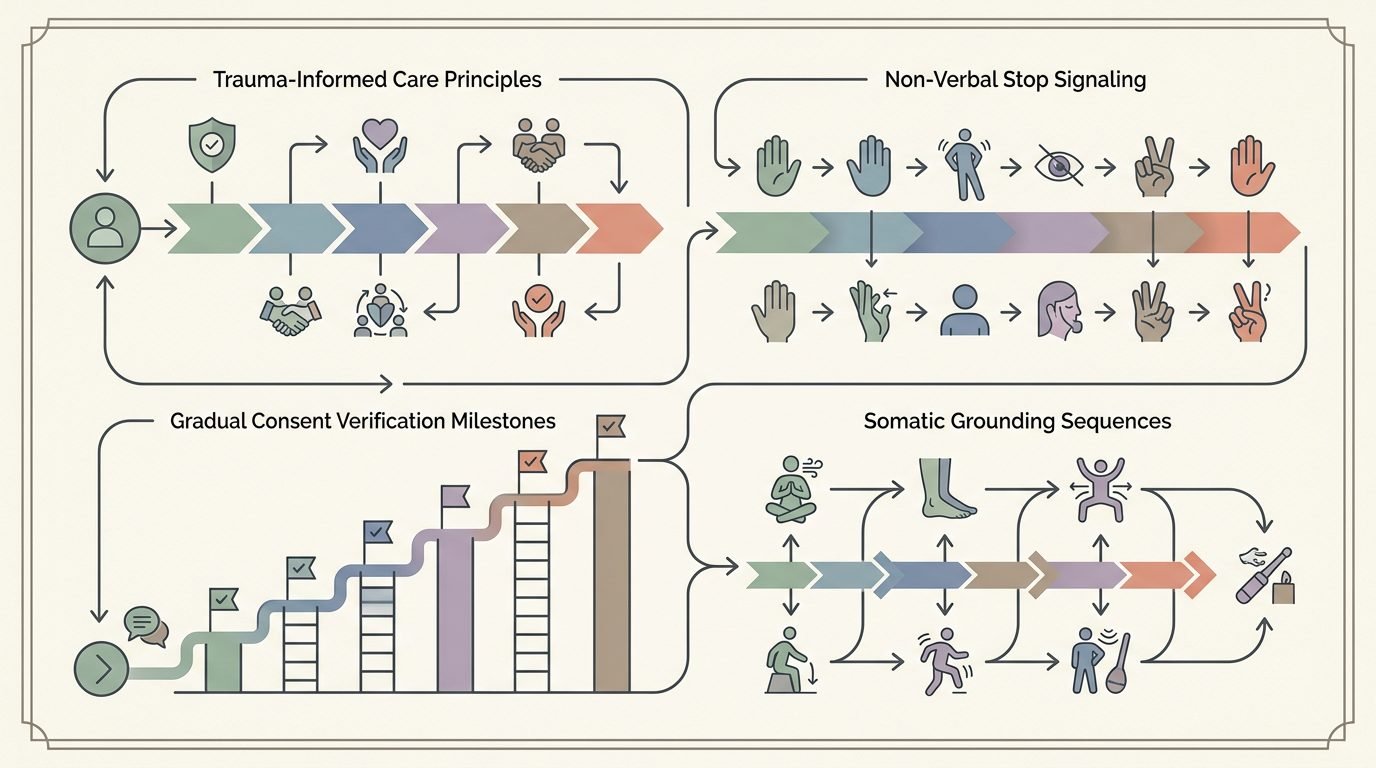
Informed consent must transition from a legal paperwork formality into an active, continuous, and revocable dialogue. Standard written consent forms can provoke severe anxiety in trauma survivors, mirroring childhood experiences where documentation was used to legitimize unnecessary procedures. Clinicians should implement fragmented, modular consent where each procedural phase is negotiated, evaluated, and authorized separately. Before touching any instrument to an intraoral surface, the clinician explicitly explains what will be done, how long it will take, and what sensations will be felt. The clinician then asks for specific, verbal permission to proceed with that discrete step. The patient must possess absolute, unquestioned authority to withhold or withdraw consent at any moment during treatment without fear of clinician irritation, abandonment, or moral judgment.
Operationalizing the physical pause mechanism requires rigid clinician adherence. Every dental appointment must begin with establishing a universal, unambiguous stop signal: raising the left hand immediately halts all active clinical operations. When the patient raises their hand, the clinician must withdraw all instruments, hands, and suction tips instantly from the oral cavity within one second, without finishing a stroke or delivering a dismissive reassurance. The patient is allowed to sit upright, breathe, and regain autonomic equilibrium before clinical dialogue resumes. Demonstrating that the patient exercises total mechanical control over the operatory environment directly contradicts their childhood experiences of helpless physical restraint, rebuilding somatic safety in the dental chair.
Operatory ergonomics and sensory management require deliberate customization to eliminate institutional triggers. Survivors of medical child abuse are intensely sensitive to feelings of confinement and vulnerability. The dental chair should never be placed in a fully supine position unless biologically required for maxillary visibility; maintaining a semi-supine angle preserves the patient’s peripheral vision and physical orientation. The operatory door must remain unlocked and partially ajar so the patient does not perceive themselves as trapped in an isolated chamber. Clinicians and dental assistants must narrate their physical movements in advance, avoiding unexpected tactile contact or moving instruments behind the patient’s head. Direct eye contact should be maintained at eye level during all conversations, avoiding standing over the reclined patient.
Treatment sequencing must prioritize ultra-conservative, non-invasive therapies during initial appointments to build psychological momentum. Undertaking complex, irreversible procedures such as root canal therapy, multi-unit crown preparations, or extractions during early visits overwhelms the survivor’s fragile coping resources. The clinician should begin with familiar, non-threatening procedures such as superficial supragingival scaling without ultrasonic scalers, gentle fluoride varnish applications, or direct preventive sealants. Achieving successful completion of small, non-painful interventions allows the patient’s central nervous system to recalibrate its threat-detection networks, establishing positive experiential evidence that dental care does not equate to physical violation.
Pharmacological support and conscious sedation must be approached with extreme caution and patient consensus. While pharmacological sedation (such as oral benzodiazepines or intravenous midazolam) is frequently prescribed for severe phobia, in survivors of medical child abuse, drug-induced cognitive clouding and loss of bodily awareness can induce severe panic reactions or trauma flashbacks. Chemically impairing a patient who survived predatory medical manipulation risks repeating the experience of bodily helplessness. If pharmacological support is requested by the patient, titrated inhalation conscious sedation utilizing nitrous oxide and oxygen is preferable due to its rapid reversibility and preservation of clear cognitive orientation. The patient must always retain the right to decline sedation entirely if they prioritize maintaining sharp situational awareness.
Communication protocols among all operatory staff must maintain strict clinical consistency. Administrative receptionists, dental hygienists, and chairside assistants must be briefed on the patient’s need for strict autonomy, clear boundaries, and predictable scheduling without disclosing confidential biographical trauma details. Unannounced clinical interruptions, staff substitutions, or hurried appointment pacing compromise emotional stability. Maintaining continuity of the same treating dentist and dental assistant across every appointment fosters a stable, safe interpersonal container where trust can gradually take root.
Regarding clinical practice, treating adult dental phobia stemming from medical child abuse fundamentally challenges traditional paradigms of clinical paternalism and unquestioned practitioner authority. By firmly grounding care in meticulous objective transparency, continuous modular consent, predictable procedural pacing, and non-negotiable patient autonomy, the dental team successfully transforms the operatory from a space of historical terror into a setting of restorative somatic safety and psychological healing. This enlightened, trauma-informed commitment protects the patient’s long-term physical oral health while honoring their hard-won personal boundaries, self-determination, and fundamental human dignity.
Leave a Reply