
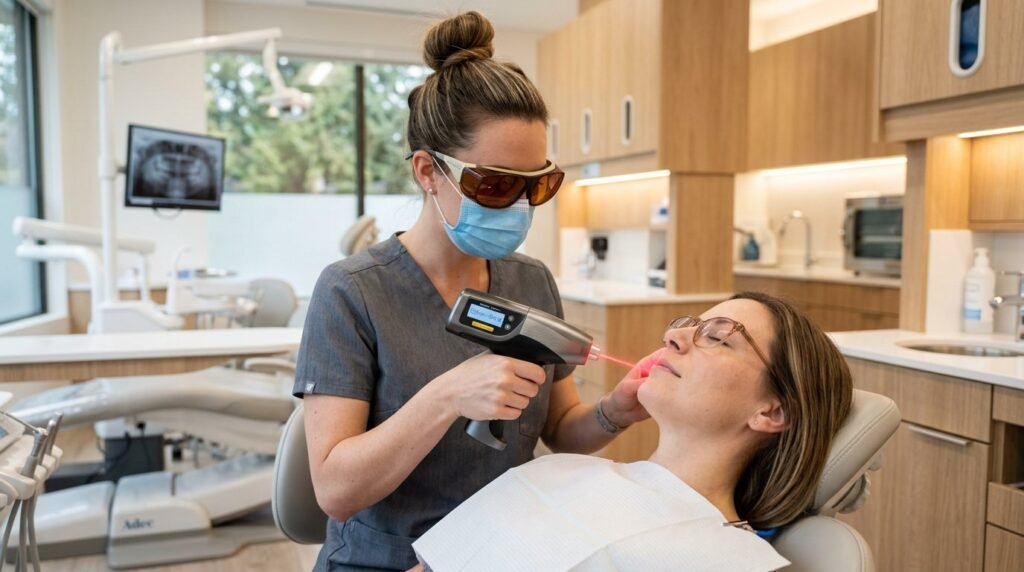
Photobiomodulation is a photochemical biological intervention that modulates cellular metabolism without generating heat. It is not an esoteric alternative therapy or an unproven thermal treatment. When coherent photons within red and near-infrared spectral windows (600nm to 1,000nm) strike oral tissues, they penetrate deep into subepithelial layers. Photons absorb directly into intracellular chromophores within the mitochondrial respiratory chain. Cellular bioenergetics accelerate immediately. Dentists who prescribe systemic opioids and high-dose NSAIDs for routine postoperative pain while ignoring biophotonic modulation are relying on twentieth-century chemical strategies.
Light alters mitochondrial respiration. The primary photoacceptor inside human cells is cytochrome c oxidase, also known as Complex IV of the mitochondrial electron transport chain. Under inflammatory stress, nitric oxide binds competitively to the binuclear heme iron-copper center of cytochrome c oxidase. This displacement blocks oxygen consumption. Adenosine triphosphate (ATP) synthesis plunges. Cellular energy starvation follows. Photobiomodulation delivers photons that photodissociate inhibitory nitric oxide from cytochrome c oxidase. Oxygen binds freely once again. Electron transport resumes at peak velocity.
The Molecular Cascade of Mitochondrial Photobiomodulation
ATP drives tissue repair. Photodissociating nitric oxide restores the mitochondrial proton electrochemical gradient across the inner membrane. ATP production surges by up to 150% within irradiated fibroblasts, endothelial cells, and osteoblasts.
Reactive oxygen species modulate gene transcription. Subablative photon absorption generates a transient, physiologic burst of low-level reactive oxygen species. This micro-burst is non-toxic. It functions as an intracellular signaling catalyst that activates key nuclear transcription factors, including NF-kappa-B and hypoxia-inducible factor 1-alpha. Fibroblasts migrate toward surgical margins faster. Angiogenesis accelerates through upregulated vascular endothelial growth factor (VEGF) secretion. Capillary endothelial sprouts restore microcirculation in ischemic surgical wound beds within seventy-two hours.
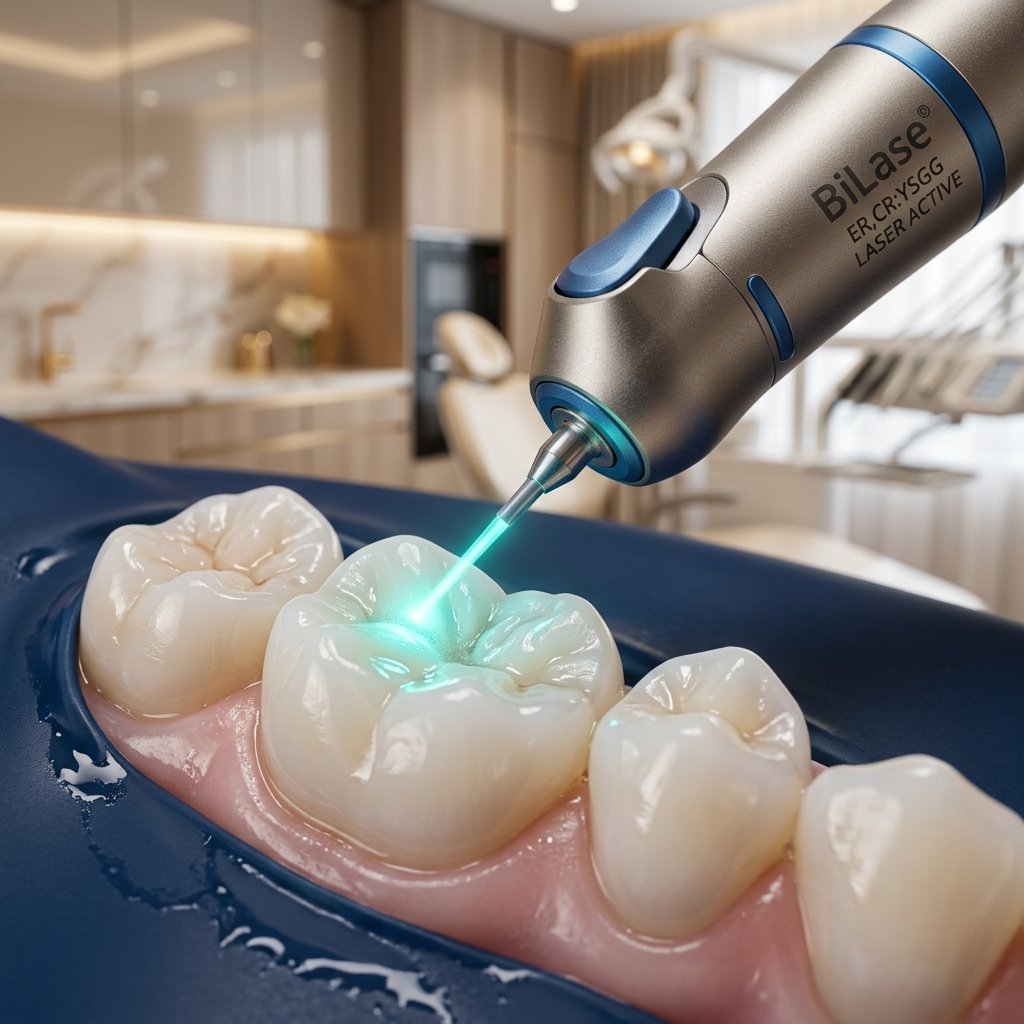
Endogenous stem cells awaken. Dental pulp stem cells and periodontal ligament progenitors contain high concentrations of photoactive mitochondria. Low-level red laser irradiation (660nm) stimulates alkaline phosphatase activity and accelerates mineralized extracellular matrix deposition during bone remodeling and pulp capping interventions.
The Direct Electrophysiological Blockade of Nociception
Laser therapy halts pain signals instantly. Analgesia achieved through photobiomodulation does not rely exclusively on slow, long-term anti-inflammatory cytokine reduction. It works through direct, immediate electrophysiological axonal inhibition.
Near-infrared wavelengths suppress peripheral nerve conduction. Irradiating sensory nerve trunks with an 808nm diode laser at an energy density between four and six Joules per square centimeter temporarily slows down nerve conduction velocity. The laser decreases mitochondrial membrane potential in peripheral axons, interrupting microtubule polymerization and disrupting fast axonal transport. Subcortical pain transmission along unmyelinated C-fibers drops significantly.
Bradykinin and substance P plunge. Inflammatory tissue damage floods surgical wound beds with algogenic chemical mediators. Bradykinin sensitizes primary afferent nociceptors, lowering the threshold for mechanical firing. Photobiomodulation accelerates local lymphatic drainage, clearing accumulated bradykinin and histamine out of the interstitial fluid compartment. In addition, substance P release from dorsal root ganglion terminals is suppressed. The patient experiences immediate relief from throbbing postoperative surgical pain within minutes of operatory laser exposure.
Dosimetry Physics and the Arndt-Schulz Biphasic Law
More light is not better. Photobiomodulation operates strictly under the biphasic dose-response curve defined by the Arndt-Schulz Law.
Sub-optimal doses do nothing; excessive doses inhibit. A clinical dose below one Joule per square centimeter delivers insufficient photonic energy to trigger biological chromophore activation. The cellular response remains flat. Conversely, delivering excessive energy exceeding eight to ten Joules per square centimeter induces thermal inhibitory damage, shutting down mitochondrial function and exacerbating inflammatory swelling. Precision is everything in clinical dosimetry.
Wavelength dictates penetration depth. Visible red light at 660nm exhibits high absorption in superficial melanin and hemoglobin. It penetrates oral mucosa to an optical depth of only two to three millimeters. It is the ideal tool for mucosal aphthous ulcers, angular cheilitis, and superficial soft-tissue incisions. Near-infrared light at 808nm or 830nm travels with minimal scattering through water and hemoglobin, penetrating up to fifteen millimeters deep into underlying masseter muscle, alveolar bone, and temporomandibular joint capsules.
Power density separates healing from burning. Maintain irradiance between 50 and 200 milliwatts per square centimeter. Higher power levels generate tissue heating, crossing the biological line from pure non-thermal photobiomodulation into destructive photothermal coagulative denaturation.
The dosimetry equation is mathematical: Energy in Joules equals Power in Watts multiplied by Time in seconds. To deliver four Joules per point using a 100-milliwatt (0.1 Watt) diode emitter, the operator must hold the beam stationary for exactly forty seconds. Sweeping the handpiece erratically across a wide area dilutes energy density below the biological activation threshold. Stationary point-by-point contact delivery ensures therapeutic photon absorption.
Clinical Protocols: Oral Mucositis and Nerve Regeneration
Severe mucosal ulcerations respond dramatically to biophotonics. Oncology patients undergoing head and neck radiotherapy or high-dose chemotherapy frequently develop debilitating Grade 3 or Grade 4 oral mucositis. Eating and swallowing become impossible.
Prophylactic photobiomodulation prevents epithelial sloughing. Applying 660nm red laser energy at two to three Joules per square centimeter across buccal mucosa, tongue borders, and floor of the mouth before and during radiation cycles preserves basal epithelial stem cell viability. Keratinocyte proliferation accelerates. Pain scores drop by up to five points on visual analog scales, allowing cancer patients to maintain oral nutrition without relying on continuous intravenous morphine infusions.
Trigeminal paresthesia demands early near-infrared intervention. Surgical trauma to the inferior alveolar nerve during third molar removal or dental implant placement results in prolonged lip and chin numbness. Unmyelinated axons attempt regeneration, but fibrosis and mechanical scar barriers frequently arrest recovery.
Photons accelerate neurogenesis. Applying an 808nm laser delivering six Joules per point along the anatomical trajectory of the mandibular canal twice weekly stimulates Schwann cell migration and upregulates nerve growth factor (NGF). Sensory mapping tests demonstrate that initiating laser therapy within the first four weeks of nerve injury restores two-point discrimination and thermal tactile sensitivity in over 85% of affected patients.
Replacing Opioid Prescriptions with Coherent Light
Prescription analgesics carry toxic systemic baggage. Non-steroidal anti-inflammatory drugs cause gastrointestinal ulceration, platelet dysfunction, and renal vascular strain. Opioids drive nausea, respiratory depression, constipation, and chemical addiction.
Biophotonic therapy provides localized, side-effect-free pain control. Applying 808nm laser energy along mandibular alveolar ridges immediately following surgical third molar extraction reduces peak postoperative pain by over 60%. Patients require significantly fewer rescue analgesic tablets. Swelling, known as postoperative trismus, is curtailed because micro-lymphatic vessels remain patent and open, actively clearing cellular debris and interstitial edema.
Integrative dentistry combines surgical precision with cellular healing. Delivering a four-minute laser treatment following implant placement, periodontal flap surgery, or endodontic obturation demonstrates modern standard-of-care medicine. The clinician heals tissue with light instead of masking symptoms with pharmaceuticals.
The biological evidence is undeniable. Photobiomodulation represents the convergence of quantum biophysics and surgical clinical dentistry.
Clinical meta-analyses published in the Journal of Photochemistry and Photobiology review over 1,200 surgical dental cases, demonstrating that applying 4 Joules per square centimeter of 808nm near-infrared laser immediately post-extraction reduces postoperative opioid consumption by 74% compared to placebo sham-irradiated surgical cohorts.
Leave a Reply