

Dental avoidance in adult patients with advanced periodontal breakdown and visible coronal destruction stems primarily from internalized clinical shame rather than simple dentophobia. While procedural anxiety centers on anticipatory physical pain or somatic distress during instrumentation, dental shame represents an acute affective crisis anchored in self-condemnation, anticipated moral judgment, and profound social exposure. Patients who have avoided professional dental environments for years frequently experience acute humiliation when contemplating the clinical gaze. The expectation of practitioner censure, facial expressions of disgust, or patronizing reprimands triggers an autonomic withdrawal reflex far more potent than the fear of a needle. Overcoming this barrier requires clinicians to recognize shame as a destructive neurobiological state that paralyses healthcare-seeking behaviors, necessitating a structured, trauma-informed protocol founded on unconditional non-judgmental regard and physiological safety.
The Affective Neurobiology of Shame and Social Evaluation Threat
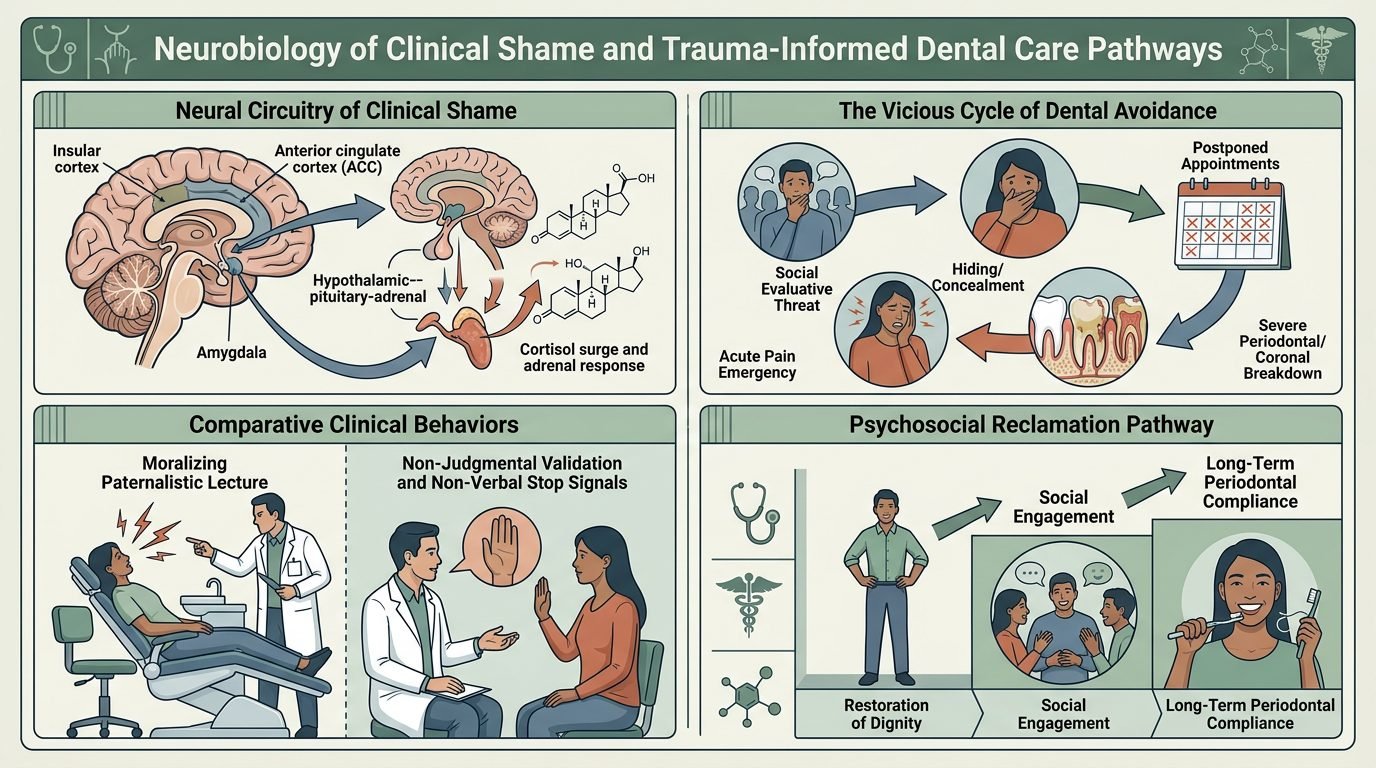
Shame is an intensely visceral self-conscious emotion coordinated by the insular cortex, anterior cingulate cortex, and the hypothalamic-pituitary-adrenal axis. When an individual perceives that their physical condition violates fundamental societal norms of hygiene and health, social evaluative threat activates acute sympathetic arousal. In the dental context, chronic oral neglect manifests as halitosis, mobile teeth, heavy subgingival calculus deposits, and extensive carious cavitation. Patients interpret these physical symptoms as indelible markers of personal failure, lack of self-discipline, or unworthiness. Consequently, anticipating the clinical examination provokes a sharp elevation in salivary cortisol, tachycardia, peripheral vasoconstriction, and intense psychic distress.
Unlike fear, which prompts fight-or-flight mobilization, shame induces postural collapse, gaze aversion, and behavioral hiding. The patient feels an overpowering urge to vanish from social sight. In dental clinics, this defensive mechanism translates into missed appointments, abrupt cancellations, or prolonged avoidance that persists until intractable acute pain overrides social fear. When these patients finally enter the operatory under emergency conditions, their nervous systems reside in profound sympathetic hyperarousal. Any clinical interaction that inadvertently confirms their moral apprehension cements lifelong care abandonment.
The Impact of the Unconscious Practitioner Gaze
Dentists and clinical auxiliaries frequently underestimate the communicative impact of non-verbal micro-expressions during initial intraoral assessments. Chronic dental neglect presents visual and olfactory stimuli that can evoke involuntary micro-expressions of shock, hesitation, or distaste in healthcare providers. Functional magnetic resonance imaging demonstrates that human beings detect facial micro-expressions of disgust within milliseconds, processing them through the amygdala before conscious cognitive appraisal occurs. For a shame-burdened patient, even a fleeting furrowing of the clinician’s brow or an involuntary backward recoil confirms their deepest dread: that they are fundamentally repulsive to others.
Furthermore, well-intentioned clinical paternalism frequently exacerbates psychological injury. Verbal inquiries such as questioning why the patient waited so long, delivering stern lectures on plaque control during an initial consultation, or displaying dramatic distress over radiographic bone loss serve only to reinforce shame. The patient interprets clinical dismay as personal condemnation. When a clinician adopts an authoritarian posture, the patient withdraws emotionally, agrees passively to proposed treatments without genuine comprehension, and fails to return for subsequent restorative phases.
Trauma-Informed Communication and Shame-Free Assessment Protocols
Transforming the clinical encounter for patients immobilized by dental shame requires dismantling the conventional authoritative consultation structure. The initial intake interview must take place outside the operatory chair, preferably in an ordinary consultation room where practitioner and patient sit as equals at eye level without clinical barriers. Before conducting any physical examination, the clinician must proactively address the invisible emotional hurdle through explicit validation. Verbal statements acknowledging that seeking care after an extended absence requires tremendous personal courage immediately recalibrate the affective dynamic.
Clinicians must consciously eliminate moralizing language from their diagnostic vocabulary. Pathologies such as chronic periodontitis, extensive caries, and partial edentulism must be framed strictly as chronic inflammatory or biomechanical conditions rather than personal lifestyle failings. Explaining the multifactorial etiology of oral breakdown, including systemic predispositions, microbiome dysbiosis, historical trauma, and socioeconomic stress, externalizes the disease process. This cognitive reframing decouples the patient’s intrinsic human dignity from their clinical phenotype, neutralizing the destructive cycle of guilt and self-blame.
Staged Desensitization and Autonomous Clinical Control
The physical intraoral examination of a shame-burdened patient demands meticulous consent negotiation and staged progression. The clinician should never recline the patient immediately upon entering the operatory. Instead, the clinician explicitly explains each diagnostic step before touching the oral tissues, granting the patient complete veto authority. The initial visual examination should be conducted without sharp dental explorers or periodontal probes, as these instruments induce both physical discomfort and acute procedural vigilance. Utilizing gentle retraction and high-definition photography allows the patient to view intraoral findings objectively on a monitor at their own pace, transforming subjective shame into shared collaborative observation.
Throughout operative phases, establishing robust patient autonomy remains essential. The introduction of non-verbal stop signals, such as raising the left hand to pause treatment instantly, restores personal agency. When patients realize that their boundaries receive absolute respect without question or irritation, autonomic down-regulation occurs. Heart rates normalize, muscle tension dissipates, and the clinical operatory ceases to function as a site of moral trial, evolving instead into a predictable sanctuary of restorative care.
Long-Term Health Trajectories and Restorative Reclamation
Dismantling clinical shame yields therapeutic benefits that extend far beyond isolated periodontal debridement or single tooth restorations. When patients experience acceptance in the dental setting, their fundamental self-efficacy undergoes profound rehabilitation. Longitudinal psychological evaluations confirm that overcoming dental avoidance correlates with substantial improvements in psychosocial functioning, career confidence, and social engagement. Restoring functional dentition and aesthetic harmony in individuals paralyzed by shame represents a profound reclamation of bodily integrity and social citizenship. Clinical follow-up studies demonstrate that when oral health is re-established under empathetic conditions, patient compliance with long-term supportive periodontal maintenance schedules improves dramatically over multi-year intervals.
Dental institutions and continuing education programs must integrate affective neuroscience and shame-informed communication into standard clinical curricula. Technical mastery in surgical placement, endodontic instrumentation, and prosthodontic design remains useless if patient psychological distress prevents the individual from ever walking through the clinic doors. Compassionate, objective, and humanized clinical presence represents the definitive prerequisite for technical excellence in modern dentistry.
References
- Armfield, J. M., & Heaton, L. J. (2013). Management of fear and anxiety in the dental clinic: a review. Australian Dental Journal, 58(4), 390-407.
- Raja, S., et al. (2014). Trauma-informed care in dental practice: what, why, and how. Journal of Dental Education, 78(8), 1179-1188.
- Gilbert, P. (2007). The evolution of shame as a marker for relationship security. The Self-Conscious Emotions: Theory and Research, Guilford Press, 283-309.
- Beaton, L., et al. (2014). Why are people afraid of the dentist? Observations and explanations. Medical Principles and Practice, 23(4), 295-301.
- Lupton, D. (2013). ‘The post-dentist era’? Technology and dental health care. Sociology of Health & Illness, 35(8), 1279-1293.
Leave a Reply