
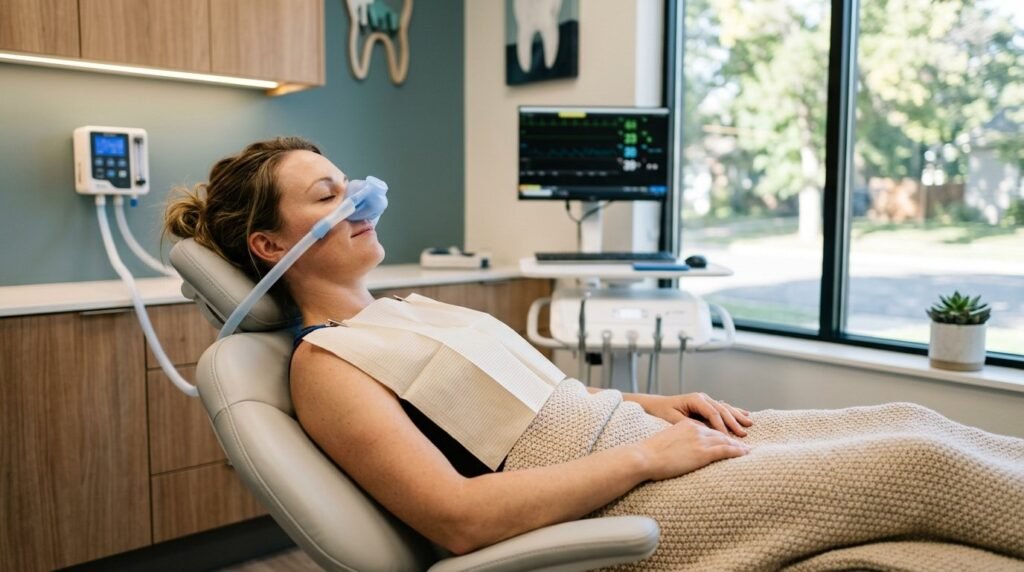
Nitrous oxide is an inorganic gas that modulates central neurotransmission through non-competitive NMDA receptor antagonism. It is not an emotional tranquilizer or a psychological placebo. When blended with pure medical oxygen and delivered via a calibrated nasal hood, nitrous oxide crosses the alveolar-capillary barrier within seconds. Brain tissue absorbs the molecule rapidly. Clinicians who treat nitrous oxide sedation as casual conversation therapy fail to grasp its intricate neurochemical mechanics.
Speed defines this gas. Nitrous oxide possesses an exceptionally low blood-gas partition coefficient of 0.47. In practical clinical terms, this means very little gas dissolves in the liquid portion of human blood. The bloodstream serves as a rapid transit highway directly from the pulmonary alveoli to cerebral capillary beds. Equilibrium between alveolar concentration and brain partial pressure occurs in less than five minutes. When the flow stops, elimination occurs almost entirely through pulmonary exhalation.
Molecular Mechanisms in the Central Nervous System
Pain signals require NMDA receptors. Nitrous oxide inhibits N-methyl-D-aspartate glutamate receptors across the dorsal horn of the spinal cord and subcortical relays. Glutamate is the primary excitatory neurotransmitter of pain pathways. By blocking these ionotropic channels, the gas suppresses polysynaptic transmission of nociceptive impulses. The brain still receives peripheral signals, but their emotional valence and sensory sharpness are blunted.
Endogenous opioids mediate the analgesia. Inhalation activates noradrenergic neurons in the locus coeruleus and descending brainstem pathways, stimulating the release of endogenous dynorphins and enkephalins. These peptide molecules bind directly to mu, kappa, and delta opioid receptors. Pretreatment with naloxone reverses nitrous oxide-induced analgesia completely in animal models. This biological fact confirms that nitrous oxide functions as a true pharmacological analgesic rather than a hypnotic sedative.
GABA receptors produce anxiolysis. The gamma-aminobutyric acid type A receptor complex contains benzodiazepine-binding sites that govern clinical sedation and muscle relaxation. Nitrous oxide enhances GABA-mediated chloride ion influx, hyperpolarizing neuronal membranes across the cerebral cortex and amygdaloid defense nuclei. Limbic overactivity diminishes. The patient remains awake, responsive to verbal command, and capable of airway maintenance.
Titration Physics and the Fallacy of Fixed Ratios
Fixed percentages invite failure. Administering a rigid fifty-fifty mix of nitrous oxide and oxygen to every patient is clinically careless. Biological variability in alveolar ventilation, tidal volume, and neurochemical receptor sensitivity demands progressive incremental titration.
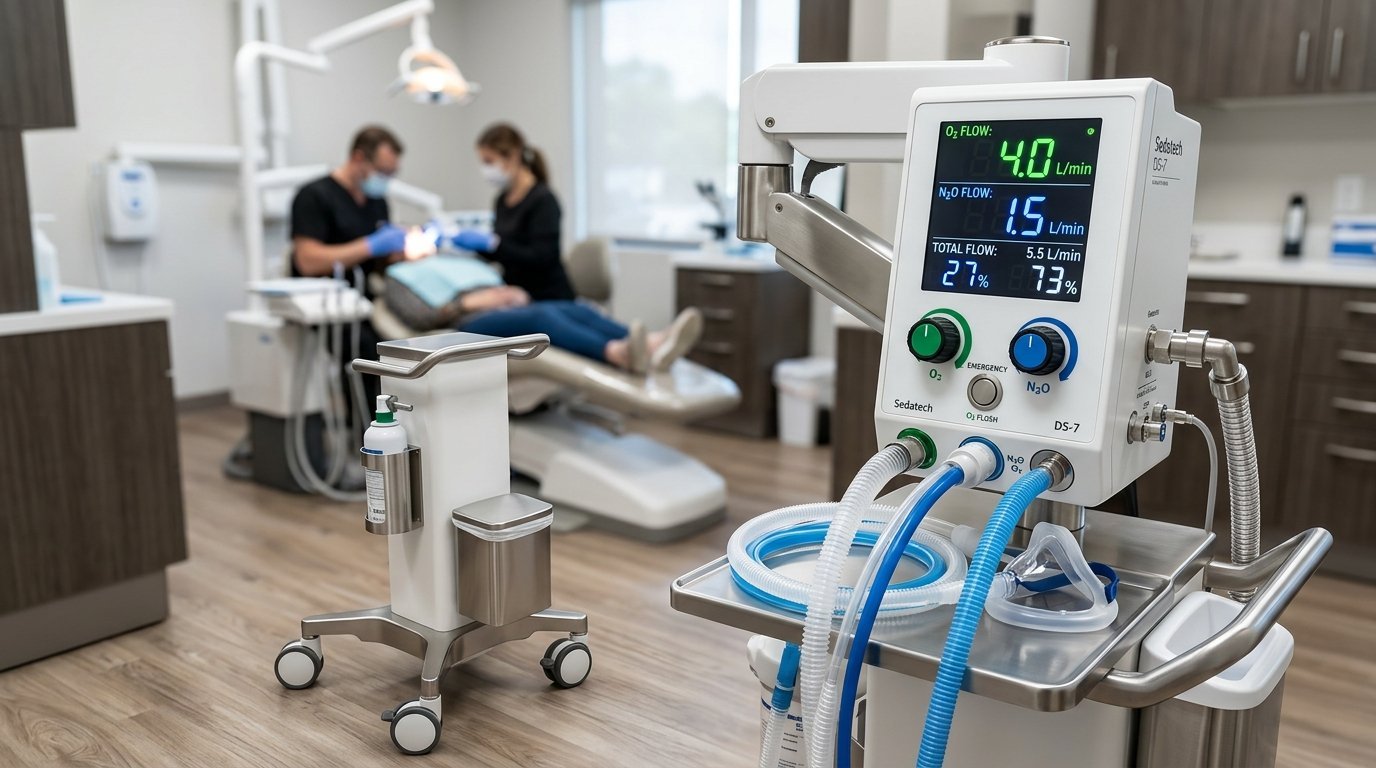
Start with oxygen. Establish minute ventilation using one hundred percent oxygen for two to three minutes. Calculate minute volume precisely. Most adults require between five and seven liters per minute to prevent rebreathing and reservoir bag collapse. Observe chest excursions. Check the tightness of the nasal hood seal. Ambient room contamination drops when vacuum scavenging operates at forty-five liters per minute.
Introduce the gas slowly. Initiate nitrous oxide delivery at twenty percent concentration. Wait sixty to ninety seconds before adjusting flow rates. Increase by ten percent increments until early signs of light sedation appear. The patient experiences tingling in distal extremities, perioral numbness, and physical heaviness. Speech slows perceptibly. At this therapeutic plane, sensory aversion to operatory sights and sounds recedes.
Over-sedation triggers adverse events. Pushing concentrations beyond fifty percent increases the incidence of nausea, dysphoria, and involuntary motor restlessness. If a patient closes their mouth, reports auditory buzzing, or fails to respond promptly to verbal stimuli, you have drifted past conscious sedation into light general anesthesia. Reduce nitrous oxide concentrations immediately by ten to fifteen percent. Restoring precise consciousness takes precedence over procedural speed.
Physiological Limits and Clinical Contraindications
Gas expands in closed cavities. Nitrous oxide diffuses into gas-filled spaces thirty-four times faster than nitrogen can leave them. This physical law produces dangerous volumetric expansion in rigid or compliant anatomical cavities.
Tympanic membranes can rupture. Patients with recent middle ear surgery, tympanoplasty, or acute eustachian tube dysfunction face pressure spikes within the middle ear cavity during prolonged inhalation. Intestinal obstruction, active pneumothorax, and recent vitreoretinal gas bubble eye surgeries represent absolute, non-negotiable contraindications. Ignoring these anatomical parameters risks irreversible tissue barotrauma.
Chronic respiratory disease alters uptake. Severe chronic obstructive pulmonary disease patients rely on hypoxic drive to sustain spontaneous ventilation. Flood their alveoli with high concentrations of supplemental oxygen, and their central respiratory drive diminishes. Conversely, acute upper respiratory infections occlude nasal passages, preventing transnasal gas absorption and rendering the procedure entirely ineffective.
Metabolic interference is real. Prolonged exposure oxidizes the cobalt atom of cobalamin (vitamin B12), completely inactivating the enzyme methionine synthase. This enzyme governs myelin sheath maintenance and folate metabolism. While a thirty-minute clinical session in a healthy adult poses negligible risk, patients with untreated methylenetetrahydrofolate reductase mutations or pernicious anemia require documented hematological clearance prior to sedation.
Occupational Safety and Atmospheric Scavenging Standards
Trace gas leakage poses health hazards to clinical personnel. Operating an unevacuated or leaking nasal hood exposes dental auxiliaries and operators to chronic ambient concentrations. Chronic reproductive toxicity and hepatic stress have been linked to uncontrolled operatory exposure exceeding fifty parts per million over extended clinical shifts.
Compliance demands dual-mask scavenging systems. The inner mask delivers the gas mixture directly to the patient nares, while the concentric outer mask draws escaping vapors into a calibrated central vacuum line. Calibrate the scavenging vacuum flow between forty and forty-five liters per minute. Check rubber seals and hoses weekly for microscopic micro-perforations using soapy water leak tests or infrared spectrophotometric sensors. Ambient air exchanges within the dental surgical operatory must cycle at a minimum rate of twelve fresh air changes per hour.
Synergy with Atraumatic Dental Instrumentation
Sedation does not replace local anesthesia. Nitrous oxide elevates pain thresholds, but it does not eliminate pulpal nociceptive firing during deep cavity excavation or surgical extraction. The gas softens the anticipation of the needle; it does not eliminate the physical trauma of poor technique.
Pairing gas with dental lasers yields biological efficiency. When patients inhale thirty to forty percent nitrous oxide while clinicians perform soft-tissue recontouring with 980nm diode lasers, tissue excision proceeds with zero bleeding and minimal sensory discomfort. Water-assisted Er:YAG lasers eliminate hard-tissue friction. The absence of mechanical turbine screech prevents autonomic startle reflexes from breaking through the sedation barrier.
Recovery must be complete. Discontinuing nitrous oxide abruptly without delivering one hundred percent oxygen induces diffusion hypoxia. As nitrous oxide rapidly floods out of capillary blood back into pulmonary alveoli, it dilutes alveolar oxygen concentration, dropping arterial saturation below ninety percent. Administering pure oxygen for a minimum of five minutes post-procedure prevents this phenomenon entirely.
Documentation protects the practice. Record the baseline blood pressure, pulse rate, oxygen saturation, total procedural time, peak percentage of nitrous oxide delivered, and post-oxygenation vital signs on every sedation chart. Objective documentation separates rigorous medical sedation from amateurish clinical management.
Clinical audit records from the American Society of Dentist Anesthesiologists show that nitrous oxide conscious sedation administered within concentrations under 50% maintains an adverse event rate below 0.08 per 1,000 surgical appointments. That safety margin relies entirely on active scavenging systems and calibrated pulse oximetry monitoring.
Leave a Reply