

Dental management in advanced neurocognitive decline fails when clinicians attempt to enforce traditional procedural compliance upon deteriorating neurological substrates. Major neurocognitive disorders, including Alzheimer’s disease, vascular dementia, and Lewy body dementia, systematically dismantle neocortical inhibitory control, sensory decoding pathways, and expressive language capacity. When an individual with severe dementia resists oral care, clinicians often mislabel it as hostility. Neurologically, these responses represent protective catastrophe reactions triggered by disorientation and perceived assault. The patient cannot recognize the dental operatory, comprehend dental instruments, or understand why a stranger is invading their oral space. Delivering effective oral healthcare to individuals with advanced dementia requires abandoning coercive restorative expectations, instituting caregiver triangulation, and shifting toward sensory de-escalation and palliative comfort care.
Neuropathology of Dementia and Sensory Misinterpretation
Progressive neurodegeneration selectively damages association cortices and prefrontal networks, impairing orientation while visual agnosia diminishes recognition of familiar environments.
In the dental setting, sensory gating deficits cause ordinary clinical stimuli to be processed as life-threatening emergencies. The glare of an operating light, the high-frequency whine of suction tips, and the sight of masked clinicians trigger primitive survival circuits in the amygdala. Because prefrontal inhibitory oversight is destroyed by amyloid plaques and neurofibrillary tangles, the fight-or-flight response fires without modulation. Tactile sensations within the mouth are perceived as choking or mutilation. The resulting motor agitation, characterized by bite blocks, biting reflexes, head turning, and verbal resistance, is an involuntary defensive reflex rather than deliberate non-compliance.
The Diagnostic Dilemma: Recognizing Occult Dental Pain in Non-Verbal Patients
As dementia advances from moderate to severe stages, patients lose the linguistic ability to express physical pain. They cannot localize toothache, articulate mucosal ulceration, or complain of cracked roots. Untreated oral pain does not disappear; it surfaces as secondary neuropsychiatric symptoms.
Clinicians and nursing teams must recognize behavioral pain proxies: refusal of food, sudden weight loss, pulling at the face, grinding teeth, sleep disruption, or unexplained aggression during bathing. The Pain Assessment in Advanced Dementia (PAINAD) scale provides an objective framework, scoring breathing patterns, negative vocalizations, facial expressions, body language, and consolability. Infiltrating local anesthetic into a suspected quadrant or administering empirical analgesia often resolves severe agitation, proving that behavioral outbursts were driven by dental pain rather than psychiatric decompensation.
Caregiver Triangulation: Building the Collaborative Alliance
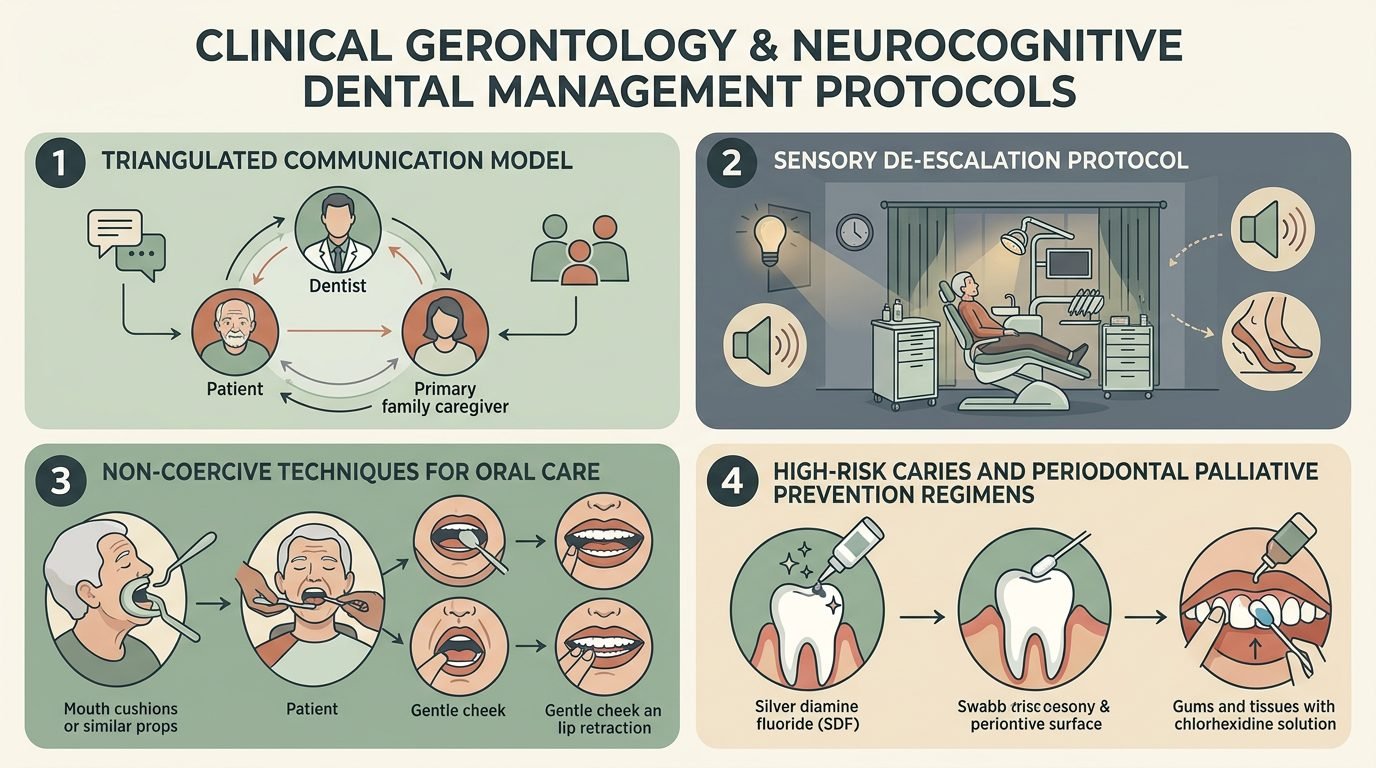
Effective clinical management of patients with cognitive decline requires tripartite clinical engagement involving the patient, clinician, and primary caregiver. The primary caregiver serves as the patient’s emotional anchor and external cognitive proxy. Excluding the caregiver from the operatory out of procedural tradition increases patient anxiety and precipitates behavioral distress.
The caregiver should be positioned directly within the patient’s visual field, maintaining soothing eye contact and holding the patient’s hand throughout the visit. Clinicians must gather detailed biographical intelligence before approaching the patient: identifying music preferences, soothing sensory triggers, and specific words that elicit calm. Transferring legal consent requires meticulous documentation of durable power of attorney for healthcare. The clinician must guide caregivers through realistic discussions regarding treatment goals, balancing systemic medical risks against the burdens of invasive oral rehabilitation.
Sensory Simplification and Communication: The Bridging and Chaining Techniques
Clinical communication must adapt to degraded neurological processing speeds. Clinicians should eliminate competing background noises, dim harsh ambient lighting, and approach the patient from the front at eye level. Towering over a seated patient triggers dominance threat perceptions.
Practitioners utilize validated behavioral strategies, including bridging and hand-over-hand chaining. Bridging engages the patient’s senses by placing a familiar oral hygiene object, such as a soft toothbrush, into their dominant hand before the clinician initiates inspection. Tactile contact with the brush activates intact procedural memory pathways in the basal ganglia, signaling that oral cleaning is about to commence. Chaining involves placing the clinician’s hand gently over the patient’s hand while holding the toothbrush, guiding the initial brushing strokes together. Once the rhythmic motor pattern is established, the clinician slowly transitions to direct assistance. Commands must be short, positive, and delivered one step at a time: “Open a little,” rather than “Open your mouth and turn your head.”
Modifying Operative Procedures: Palliative Restorative Realism
Complex, multi-stage dental reconstructions are clinically contraindicated in advanced dementia. Attempting crown preparations, surgical implant placement, or intricate endodontic re-treatments ignores the patient’s limited life expectancy and compromised oral hygiene maintenance capacity. Operative treatment must prioritize pain elimination, infection control, and chewing comfort.
Non-invasive and minimally invasive biological management represents the gold standard. High-viscosity glass ionomer cements placed via atraumatic restorative treatment seal cavitated carious lesions without requiring rotary instrumentation or local anesthesia injections. Silver diamine fluoride at thirty-eight percent concentration arrests active coronal and root caries with a single brush application, eliminating infection without procedural stress. Sharp enamel edges and fractured cusps should be smoothed with hand files or polishing discs to prevent mucosal lacerations. Complex removable prostheses should often be retired if the patient repeatedly loses or chokes on them, simplifying daily management for caregivers.
Palliative Oral Hygiene Protocols in Long-Term Care Facilities
The primary dental hazard in late-stage dementia is aspiration pneumonia resulting from the inhalation of colonized oropharyngeal secretions and food debris. Severely compromised patients accumulate heavy plaques of desquamated epithelial cells, food particles, and pathogenic respiratory bacteria on the tongue and palate.
Palliative oral hygiene protocols must be integrated into daily nursing routines. Mouth care should be performed with the patient seated upright, using suction toothbrushes or specialized foam swabs dipped in 0.12 percent chlorhexidine gluconate. Toothpastes that foam heavily should be avoided, as sodium lauryl sulfate stimulates coughing and increases aspiration risks. Non-foaming enzymatic gels containing lysozyme, lactoferrin, and lactoperoxidase lubricate xerostomic tissues and supplement innate antimicrobial defenses. Daily application of chlorhexidine gel to gingival margins suppresses pathogenic microflora, reducing the incidence of fatal hospital-acquired pneumonia by up to forty percent.
Clinical Synthesis for the Dedicated Dental Professional
Humanized dentistry in advanced dementia honors the moral worth of human beings whose cognitive faculties have faded. Success is defined by the preservation of biological comfort, freedom from pain, and prevention of aspiration emergencies. By understanding neuropathology, partnering with devoted caregivers, and adopting non-invasive palliative techniques, the dental professional protects the vulnerable and ensures that every individual finishes their days with comfort and bodily dignity.
References
- Chalmers, J. M., & Pearson, A. (2005). Oral hygiene care for residents with dementia: a literature review. Journal of Advanced Nursing, 52(4), 410-419.
- Marchini, L., et al. (2019). Worldwide trends in the education of geriatric dentistry: an international survey. Journal of Dental Education, 83(8), 922-935.
- Warden, V., et al. (2003). Development and psychometric evaluation of the Pain Assessment in Advanced Dementia (PAINAD) scale. Journal of the American Medical Directors Association, 4(1), 9-15.
- Kossioni, A. E., et al. (2018). European College of Gerodontology: guidelines for the oral healthcare of frail older people. Gerodontology, 35(4), 283-294.
- Yoneyama, T., et al. (2002). Oral care reduces pneumonia in older patients in nursing homes. Journal of the American Geriatrics Society, 50(3), 430-433.
Leave a Reply