

Delivering oral care to institutionalized individuals suffering from advanced dementia demands systematic non-verbal pain assessment tools, legal surrogate decision-making frameworks, and minimally invasive operative interventions tailored to progressive cognitive decline. Alzheimer’s disease, vascular dementia, and frontotemporal degeneration progressively dismantle language processing, abstract reasoning, and voluntary motor coordination. In advanced stages (Global Deterioration Scale stages 6 and 7), patients lose the cognitive capacity to localize, describe, or complain of dental pain. Odontogenic pathology, including untreated pulpitis, periapical abscesses, and fractured roots, manifests atypically through behavioral disturbances such as refusal of food, physical combativeness during hygiene, agitation, or catastrophic withdrawal. Inappropriate prescription of antipsychotic tranquilizers often masks unaddressed toothaches. Transforming this vulnerable reality requires dentists to assess behavioral nociceptive markers, collaborate with legal guardians, and utilize non-aerosol silver diamine fluoride protocols.
Neurocognitive Decline and Atypical Behavioral Pain Expressions
Cortical atrophy in advanced dementia disrupts sensory processing and verbal communication while sparing primitive limbic pain responses. Patients experiencing severe tooth decay cannot say “my lower left molar aches.” Instead, untreated orofacial pain expresses itself through neuropsychiatric symptoms that institutional caregivers frequently mistake for dementia progression.
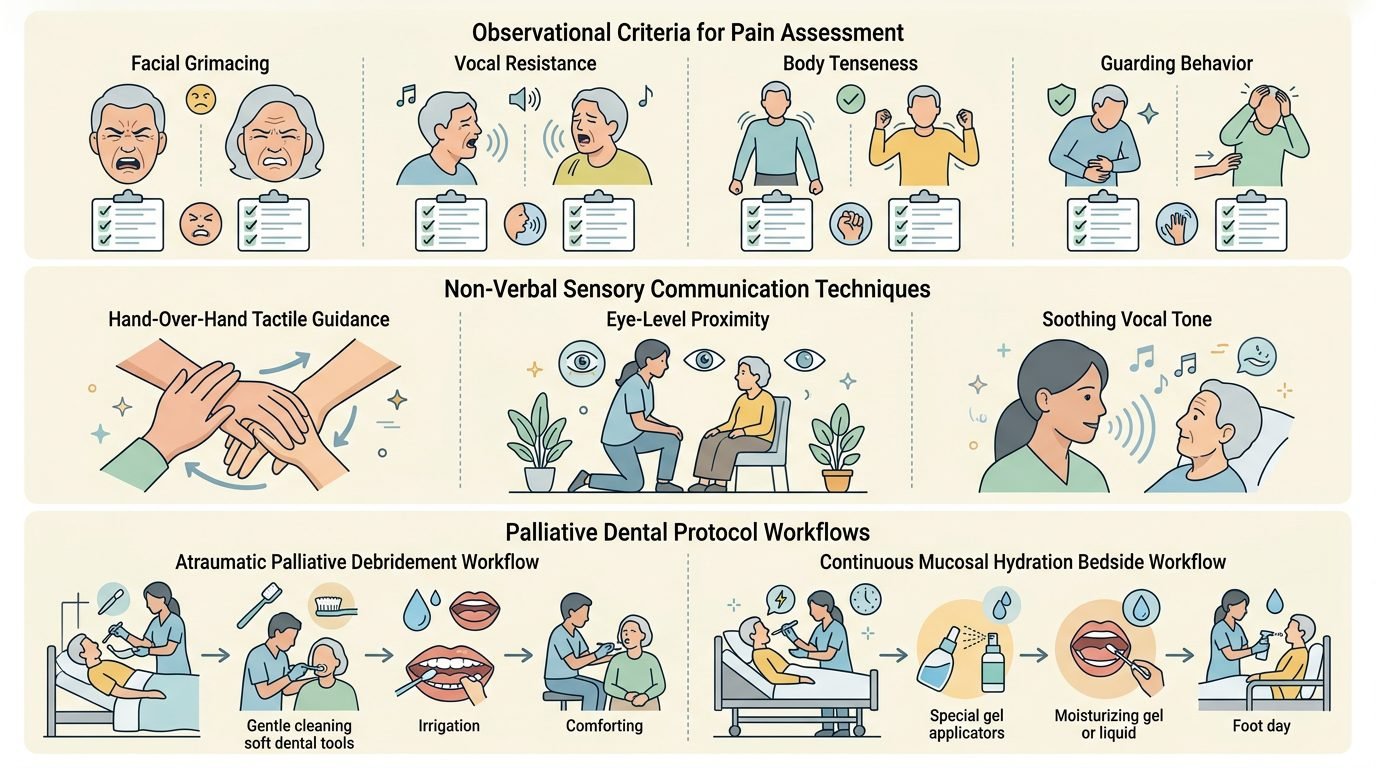
Common clinical indicators include clenching the jaws tightly when utensils approach, pulling at the face or ear, spitting out previously accepted meals, crying during face washing, or shouting during transfers. Sudden aggressive outbursts, such as hitting or biting caregivers during mouth cleaning, reflect protective survival reflexes against agonizing tactile contact on inflamed pulp or ulcerated gingiva. When systemic analgesic trials with acetaminophen produce marked reductions in agitation, occult oral nociception is confirmed. Clinicians must educate long-term care staff that behavioral distress often signals an underlying dental emergency requiring diagnostic intervention rather than chemical sedation.
Validated Behavioral Pain Assessment Instruments
Because self-report scales like the visual analog scale are invalid in severe cognitive impairment, clinicians must employ validated observational instruments. Two primary tools exhibit robust diagnostic validity: the Pain Assessment in Advanced Dementia (PAINAD) scale and the Pain Assessment Checklist for Seniors with Limited Ability to Communicate (PACSLAC).
The PAINAD scale evaluates five observable behavioral categories: breathing independent of vocalization (normal versus labored or hyperventilating), negative vocalization (none versus groaning, moaning, or calling out), facial expression (smiling versus grimacing, frowning, or tight closure), body language (relaxed versus tense, guarding, or fist clenching), and consolability (reassurance effective versus unable to console). Observations are recorded over five minutes during oral hygiene or rest. A score of four or higher indicates significant physical discomfort requiring immediate clinical triage. Incorporating these scales into daily nursing charts enables objective detection of oral pathology before systemic sepsis or dehydration develops.
Legal Framework: Surrogate Consent and Patient Assent
Performing clinical procedures on individuals lacking decision-making capacity necessitates strict adherence to legal surrogate consent while continuously honoring situational patient assent. The clinician must verify the identity of the designated healthcare proxy, durable power of attorney, or court-appointed legal guardian.
All treatment alternatives, risks of sedation, financial estimates, and the option of palliative non-intervention must be documented transparently in written consent forms signed by the proxy. Concurrently, the practitioner must respect patient assent at the bedside. If a patient with severe dementia resists physical examination by clamping their teeth, turning their head violently, or expressing visible terror, treatment must halt immediately. Physical restraint should never be utilized for elective restorative dental procedures. When defensive resistance prevents bedside stabilization and acute facial cellulitis threatens airway patency, the clinical team and guardian must evaluate hospital-based general anesthesia rather than traumatic chairside coercion.
Minimally Invasive Interventions: Silver Diamine Fluoride and ART
Conventional restorative workflows involving rubber dam isolation, high-speed rotary drills, and prolonged suctioning are completely contraindicated in advanced dementia due to disorientation, panic, and acute aspiration risks. The standard of care centers on Atraumatic Restorative Treatment (ART) and Silver Diamine Fluoride (SDF).
Application of 38% silver diamine fluoride provides non-invasive carious arrest. The silver ions function as potent bactericidal agents against Streptococcus mutans and anaerobic biofilms, while fluoride ions remineralize depleted hydroxyapatite, forming hard fluorapatite. The procedure requires only gentle drying of the cavity with cotton rolls, followed by direct microbrush application of SDF for sixty seconds, without mechanical drilling or local anesthetic injections. Clinicians must counsel legal surrogates regarding the permanent black discoloration of arrested carious dentin, which confirms successful biochemical stabilization without posing aesthetic concerns in this clinical population. Cavities with structural food impaction are sealed with high-viscosity auto-curing glass ionomer cement placed with hand instruments. This eliminates pain, arrests dentin destruction, and establishes smooth cleansable contours in less than three minutes per tooth.
Aspiration Pneumonia Prevention and Bedside Ergonomics
Aspiration pneumonia represents the leading cause of mortality among institutionalized dementia patients, with pathogenic oral bacteria serving as primary microbial vectors. Colonization of the tongue dorsum and dental plaques by Porphyromonas gingivalis and enteric gram-negative bacilli, combined with neurogenic dysphagia and suppressed cough reflexes, creates life-threatening pulmonary seeding.
Dental professionals must establish comprehensive bedside oral care protocols. Patients should be positioned in an upright sitting posture (minimum 60 to 90 degrees) or in a lateral decubitus position with the head tilted forward to prevent posterior pooling of fluids. Sonic electric toothbrushes or ultra-soft manual brushes dipped in 0.12% chlorhexidine digluconate gel should be utilized instead of foaming dentifrices, eliminating liquid aspiration risks. Specialized suction toothbrushes attached to portable aspirators remove debris efficiently from the vestibules of bedridden residents, directly reducing hospital readmissions for aspiration pneumonia.
Interprofessional Care Models and Human Dignity
Sustaining oral health in institutionalized dementia requires integrating dental hygiene into daily nursing home operations. Dentists must train nursing assistants on practical desensitization techniques, such as singing familiar melodies, maintaining reassuring eye contact, and employing the “hand-over-hand” brushing method where the caregiver guides the resident’s own hand to preserve procedural familiarity.
Recurrent educational workshops empower care staff to view oral hygiene as essential infection control rather than an optional cosmetic chore. By replacing aggressive mechanical expectations with compassionate biological preservation, the dental profession upholds the comfort, systemic health, and inviolable human dignity of seniors navigating the final stages of neurocognitive illness.
References
- Chalmers, J. M., et al. (2005). The oral health of older adults with dementia: a review. Special Care in Dentistry, 25(1), 22-30.
- Horst, J. A., et al. (2016). UCSF protocol for caries arrest using silver diamine fluoride: rationale, indications and consent. Journal of the California Dental Association, 44(1), 16-28.
- Marchini, L., et al. (2019). Oral health and dementia: a review of the literature. Gerodontology, 36(2), 107-116.
- Warden, V., et al. (2003). Development and psychometric evaluation of the Pain Assessment in Advanced Dementia (PAINAD) scale. Journal of the American Medical Directors Association, 4(1), 9-15.
- Yoneyama, T., et al. (2002). Oral care reduces pneumonia in older patients in nursing homes. Journal of the American Geriatrics Society, 50(3), 430-433.
Leave a Reply