

Tourette syndrome presents unique physical challenges and psychological complexities within the dental operatory that require specialized clinical protocols, mechanical adaptations, and compassionate communication. Tourette syndrome is a neurodevelopmental movement disorder characterized by multiple motor tics and at least one vocal tic persisting for more than twelve months, typically emerging in childhood and exhibiting fluctuating waxing and waning courses. Motor tics frequently involve sudden, repetitive, non-rhythmic muscle contractions of the head, neck, and orofacial complex, including rapid head jerking, violent jaw snapping, tongue protrusion, teeth clenching, and forceful grimacing. When these involuntary movements occur while rotary instruments or sharp hand scalers are active inside the oral cavity, the risk of traumatic soft tissue laceration, tooth structure fracture, or instrument breakage escalates dramatically. Historically, misinformed practitioners attempted to manage these movements through physical restraint, reprimands, or unnecessary general anesthesia. Humane, evidence-based dental care rejects coercive restraint in favor of stress-attenuated operatory ergonomics, padded intraoral protection, and deep clinical understanding of premonitory urges.
The neurobiology of tics involves disinhibition within cortico-striato-thalamo-cortical (CSTC) neurocircuitry, coupled with dopaminergic and noradrenergic hyper-responsiveness within the basal ganglia. Crucially, the majority of adolescent and adult patients experience premonitory urges: uncomfortable, focal somatic sensations such as localized tension, tickling, or pressure in specific muscle groups that precede the physical execution of a tic. Patients describe executing the tic as an intentional, albeit overwhelming, response to relieve this intolerable internal somatic tension. Stress, physical fatigue, interpersonal scrutiny, and emotional anxiety directly amplify both the intensity of premonitory urges and the frequency of motor discharges. Consequently, the traditional dental environment, with its sensory overload, perceived lack of control, and fear of judgment, serves as a potent trigger for severe tic exacerbations.
Voluntary tic suppression represents a major source of hidden psychological and physiological exhaustion for patients during dental visits. Many individuals expend immense mental effort attempting to suppress motor tics in social and clinical settings to avoid embarrassment or administrative chastisement. However, voluntary suppression is temporary and invariably followed by a severe rebound phenomenon, where suppressed tics erupt in rapid, violent clusters once cognitive control falters. A clinician who demands that a patient sit still directly accelerates this rebound surge. The foundational step in humanized care is explicit verbal de-stigmatization: the dental team must inform the patient that tics are entirely understood, welcomed, and normalized within the clinic. Permitting the patient to release tics freely without apologizing relieves psychological pressure, dramatically reducing overall autonomic stress and procedural tic frequency.
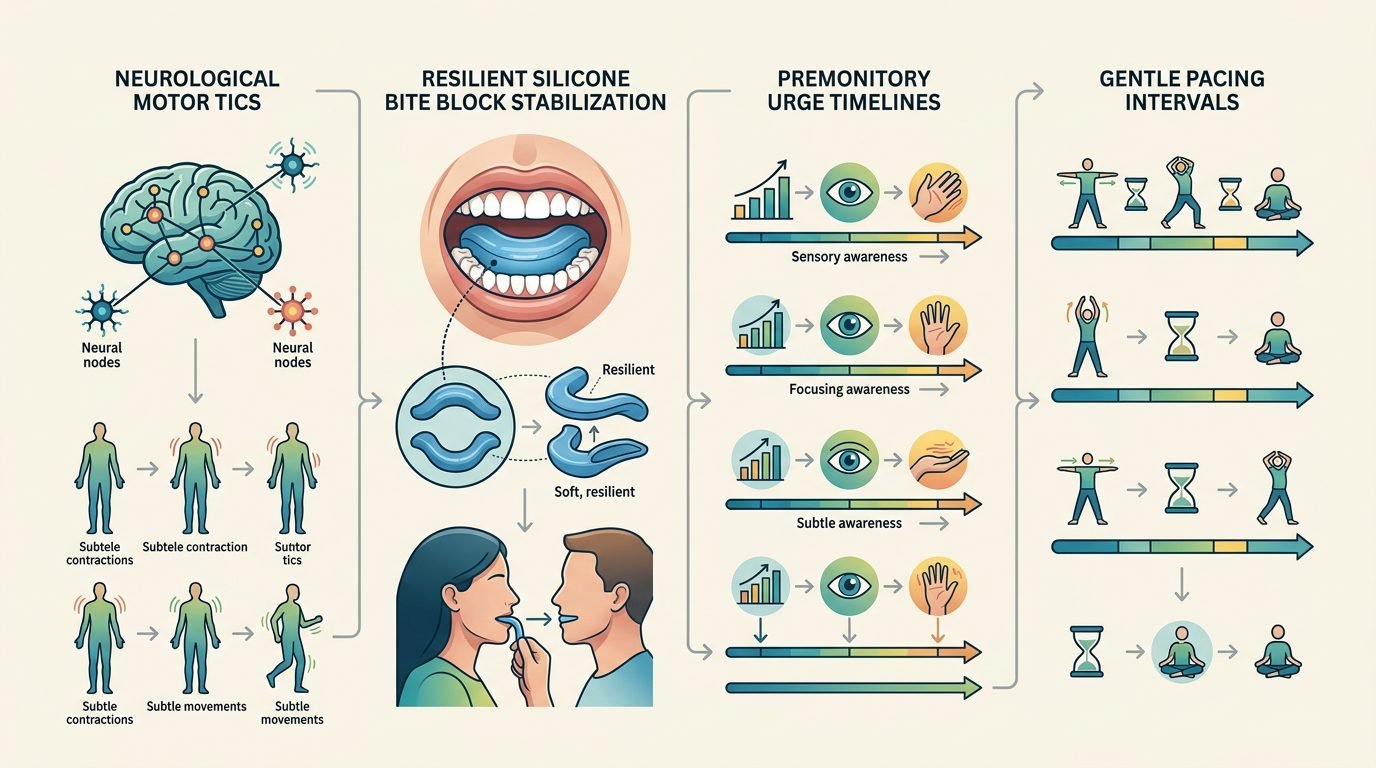
Chairside bite protection constitutes the foremost mechanical safeguard against accidental occlusal trauma and soft tissue lacerations. Sudden jaw-snapping tics can cause catastrophic impact forces, shattering porcelain crowns, shearing diamond burs, or amputating portions of the tongue or buccal mucosa. Clinicians must never operate without stable, resilient intraoral protection. Rigid metal mouth gags should be avoided, as sudden clenching against unyielding steel can cause enamel microfractures or temporomandibular joint condylar bruising. Instead, clinicians should utilize soft, medical-grade silicone bite blocks (such as Logi-Bloc or Molt-style props with resilient rubber sleeves) positioned on the contralateral arch. The bite prop must be securely tied with a thirty-centimeter length of dental floss anchored outside the oral cavity to prevent accidental pharyngeal aspiration if a sudden pharyngeal vocal tic occurs. Stable, broad finger rests on sound alveolar bone structures are mandatory at all times to ensure that hand instruments move synchronously with the patient’s head if an unexpected cervical jerk occurs.
Operatory ergonomics and sensory pacing must be systematically customized. Sessions should be scheduled during late morning or early afternoon hours, avoiding early morning drowsiness or end-of-day physical exhaustion that worsens motor control. Appointment durations should remain short, structured in twenty-to-thirty-minute intervals interspersed with scheduled micro-breaks where the patient sits upright, rinses, and voluntarily discharges accumulated physical tension. Procedural pacing must incorporate mutual stop-signals: the patient is instructed that raising their non-dominant hand pauses all instrumentation instantly. Furthermore, high-speed suction tips and air-water syringes should feature rounded plastic contours rather than sharp metal edges to prevent mucosal gouging during sudden head movements.
Managing vocal tics, such as explosive throat clearing, grunting, coprolalia, or echolalia, requires professional equanimity and specific intraoral suction protocols. When an individual experiences an involuntary pharyngeal or laryngeal vocal tic, forceful coughing or sudden glottic closure can dislodge cooling water spray, causing momentary aspiration or coughing spasms. Clinicians should maintain continuous high-volume evacuation adjacent to the operative site, utilizing wide-bore suction tips to clear water instantly before it reaches the palatoglossal arches. The clinical team must never comment on, flinch at, or react to involuntary vocalizations or socially inappropriate words emitted during appointments. Maintaining calm, unbothered procedural focus reassures the patient that their involuntary vocal symptoms do not distress the provider, defusing the social anxiety that exacerbates subsequent vocal bursts.
Restorative material selection directly influences treatment longevity in patients with high-amplitude occlusal tics. Highly brittle restorative materials, including monolithic all-ceramic feldspathic porcelain and unbonded composite veneers, are prone to catastrophic chipping or catastrophic fracture under the violent, sudden impact loads produced by jaw-snapping motor tics. Clinicians should prioritize ductile, impact-absorbing materials. Direct resin composites placed with reliable dentin bonding systems provide resilient stress absorption and allow simple chairside repair if marginal fractures occur. When indirect full-coverage restorations are necessary, full-cast high-noble gold crowns or metal-ceramic restorations with substantial metal occlusal collars provide superior impact fracture resistance compared to brittle ceramic alternatives.
Pharmacological considerations and drug-drug interactions require vigilant review before prescribing dental therapeutics. Many individuals with Tourette syndrome receive daily psychotropic medications, including alpha-2 adrenergic agonists (clonidine, guanfacine), typical neuroleptics (haloperidol, pimozide), or atypical antipsychotics (aripiprazole, risperidone). Alpha-2 agonists frequently induce orthostatic hypotension, sedation, and significant salivary hypofunction. Antipsychotics induce competitive dopamine D2 receptor blockade, predisposing patients to drug-induced extrapyramidal symptoms, xerostomia, and secondary cardiac QT interval prolongation. When administering local anesthesia, the clinician must avoid high-concentration intravascular epinephrine, which can interact with psychotropic regimens or trigger acute tachycardia that exacerbates anxiety-induced tics. Using plain 3 percent mepivacaine or 4 percent prilocaine with felypressin provides safe, predictable anesthesia. If procedural anxiety remains unmanageable despite behavioral adaptations, conscious inhalation sedation utilizing titrated nitrous oxide and oxygen provides effective muscle relaxation and anxiety reduction without depressing vital protective airway reflexes.
Co-occurring neuropsychiatric conditions demand holistic clinical awareness. Approximately fifty to seventy percent of individuals with Tourette syndrome present with comorbid attention-deficit/hyperactivity disorder (ADHD), obsessive-compulsive disorder (OCD), or generalized anxiety. An obsessive-compulsive need for symmetry or sensory tactile perfection can manifest as compulsive, aggressive tooth-brushing that produces deep cervical wedge-shaped non-carious cervical lesions (abfractions and abrasions) and gingival recession. Conversely, severe ADHD comorbidity can impair the executive planning required for daily flossing. The dental team must address these co-occurring behaviors with practical, non-judgmental preventive tools: custom soft nighttime bruxism splints protect teeth from violent nocturnal clenching tics, while prescription high-fluoride dentifrices (5000 ppm) protect compromised root surfaces.
Regarding clinical practice, managing patients with Tourette syndrome exemplifies the principles of trauma-informed, humanized dentistry. By replacing paternalistic demands for immobility with resilient bite blocks, scheduled release.
Leave a Reply