

Huntington’s disease is an autosomal dominant neurodegenerative disorder characterized by progressive motor chorea, cognitive decline, psychiatric disturbances, and severe bulbar dysfunction. As the disease advances through early, middle, and late stages, maintaining oral hygiene and accessing dental care become progressively fraught with physical hazards and psychological distress. Involuntary hyperkinetic movements of the limbs, head, and tongue disrupt intraoral instrumentation and threaten mechanical trauma to both patient and operator. Concurrently, progressive pharyngeal dysphagia elevates the risk of life-threatening aspiration pneumonia during routine dental cleanings. Clinicians must abandon rigid restorative paradigms in favor of humanized, trauma-informed, and risk-stratified oral healthcare that prioritizes aspiration prevention, airway safety, ergonomic adaptations, and compassionate palliative support.
The neurobiology of chorea fundamentally alters intraoral dynamics and patient safety during dental visits. Chorea manifests as irregular, unpredictable, and involuntary motor contractions that can affect any muscle group without warning. In the oral cavity, sudden involuntary tongue thrusting, abrupt jaw snapping, and violent cervical flexion can dislodge sharp hand instruments or high-speed rotary diamonds, causing mucosal perforations or dental fractures. Clinicians must never attempt to forcibly restrain the patient’s head or limbs with rigid mechanical straps; physical restraint invariably triggers intense emotional panic, autonomic distress, and a compensatory surge in violent choreic motor discharges. The operatory environment must accommodate involuntary movement through flexible, shock-absorbing stabilization rather than rigid physical immobility.
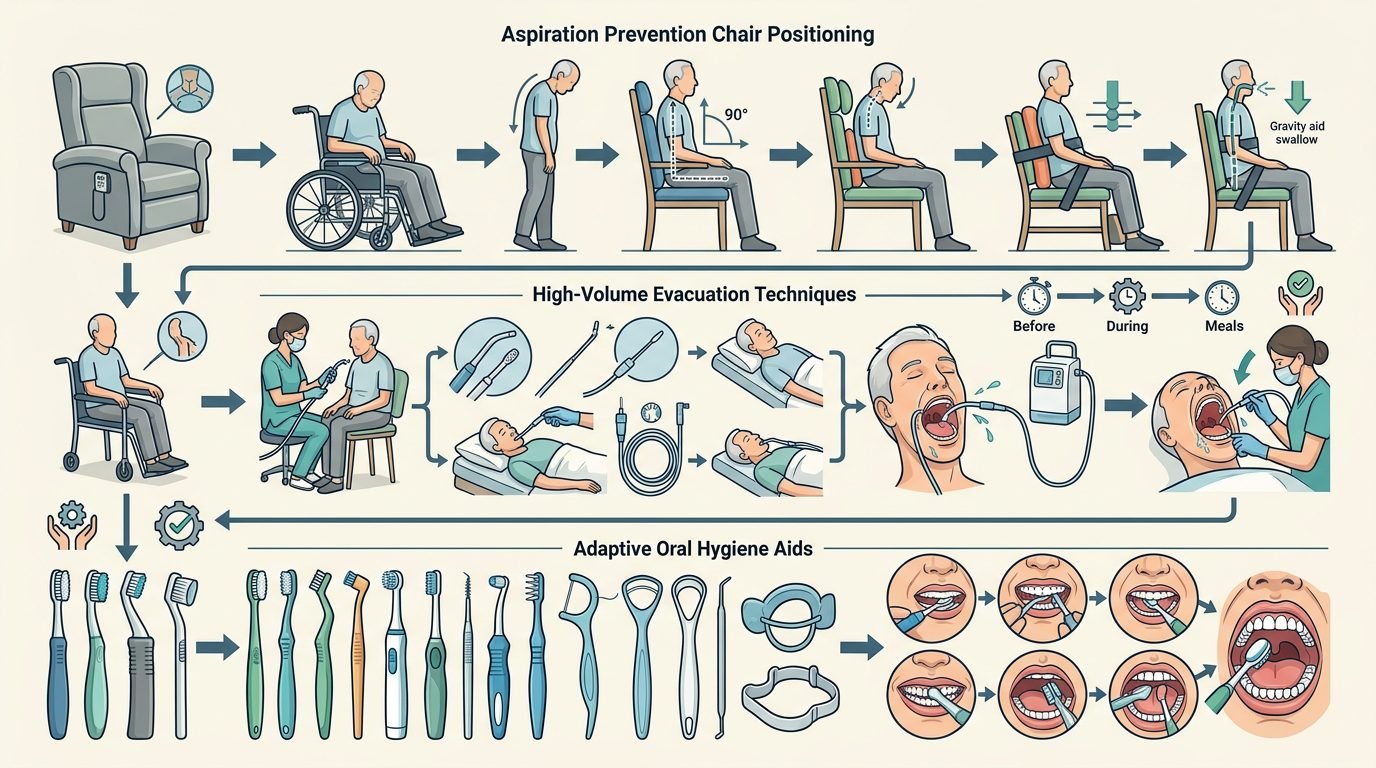
Operatory ergonomics and physical stabilization must be customized to the patient’s individual stage of neurodegeneration. In early-to-middle stages, patients can transfer to the dental chair but require specialized positioning. Semi-supine chair angulation (approximately thirty to forty-five degrees) is required to reduce the mechanical risk of liquid pooling in the posterior pharynx. Beanbag positioners (such as vacuum-molded contour cushions) should be placed on the dental chair to cradle the patient’s torso, shoulders, and pelvis. These conforming supports absorb kinetic energy from involuntary motor bursts and provide comforting proprioceptive containment. Soft padded wrist bands held gently by an empathetic assistant or caregiver can provide reassuring stability without applying coercive restraint. In late-stage disease, when patients are wheelchair-dependent or bedridden, dental interventions should be delivered directly within their custom tilt-in-space wheelchair utilizing portable headrests to avoid dangerous physical transfers.
Chairside bite protection is an indispensable safety measure against accidental occlusal trauma. Sudden involuntary masseter spasms can shatter brittle instruments and amputate operator fingers. Clinicians should consistently utilize medical-grade silicone bite blocks (such as Logi-Bloc or Molt-style props with resilient rubber sheaths) placed on the side contralateral to instrumentation. The bite block must be securely threaded with a long piece of dental floss (at least thirty centimeters) anchored outside the mouth to ensure immediate retrieval if displaced during a pharyngeal choreic spasm. Clinicians must maintain firm, broad finger rests on stable bony structures, ensuring that the working hand moves synchronously with any sudden head movement.
Managing progressive dysphagia and preventing pulmonary aspiration constitute the highest clinical priorities. Pharyngeal phase dysphagia, delayed laryngeal elevation, and uncoordinated glottic closure make water spray highly hazardous. Routine ultrasonic scaling and copious water cooling with high-speed handpieces should be strictly avoided. Instead, clinicians must rely on atraumatic hand scaling with sharp curettes, wiping debris frequently onto gauze sponges. When moisture control is necessary, clinicians should utilize high-volume evacuation with wide-bore, soft silicone tips manipulated by an experienced chairside assistant. The dental chair must never be placed fully supine. Clinicians should use non-foaming dentifrices (such as sodium lauryl sulfate-free pastes or chlorhexidine gels) and remove all liquids with dry gauze packs to prevent liquid trickling down the posterior pharynx.
Cognitive deterioration and psychiatric symptoms demand specialized, respectful communication strategies. Huntington’s disease causes progressive executive dysfunction, emotional lability, impulsivity, and depression. Patients often feel profound humiliation regarding their involuntary movements and diminishing physical independence. The dental team must address the patient directly with clear, single-concept sentences, maintaining calm vocal tones and unhurried body language. Ample response time must be provided, recognizing that cognitive processing and verbal articulation are severely delayed even when intellectual comprehension remains intact. Caregivers should be included as vital communication partners, but the patient must remain the primary focus of clinical conversation.
Treatment planning must evolve through a phased, anticipatory trajectory that mirrors disease progression. During the early stage, when motor control and cognitive function are largely preserved, clinicians must prioritize definitive, highly durable oral stabilization. This includes comprehensive caries eradication, periodontal therapy, and fabrication of simple, easily cleanable direct restorations. Complex, delicate prosthodontics such as removable partial dentures or high-maintenance multi-unit fixed bridges are contraindicated due to the high risk of prosthesis aspiration, fracture, or mechanical failure as chorea worsens. In middle-to-late stages, the treatment focus shifts definitively toward palliative maintenance, pain relief, and infection prevention through atraumatic restorative treatments (ART) using glass ionomer cements, silver diamine fluoride (SDF) arrest of root caries, and topical antiseptics.
Daily oral hygiene protocols must be systematically customized and simplified for family members and institutional caregivers. As fine manual dexterity deteriorates and executive apraxia progresses, independent tooth brushing becomes impossible for the patient. The dental team must train primary caregivers in safe, effective oral care techniques designed to prevent aspiration. Utilizing soft-bristled suction toothbrushes connected to portable home suction machines allows simultaneous plaque debridement and continuous fluid evacuation without allowing liquid accumulation in the pharynx. High-concentration fluoride varnishes (22,600 ppm sodium fluoride) applied professionally every three to four months provide vital chemical protection against aggressive root surface caries in xerostomic patients receiving daily neuroleptic regimens. Water-soluble chlorhexidine gluconate gels (0.12%) applied with dense foam swabs assist in microbial biofilm suppression without introducing free-flowing liquids. Furthermore, caregivers must be thoroughly educated in emergency chairside protocols, including the immediate use of manual suction and lateral head rotation if sudden choking or coughing paroxysms occur during cleaning.
Pharmacological considerations require rigorous evaluation of potential neuroleptic interactions. Patients with Huntington’s disease frequently receive dopamine-depleting agents (such as tetrabenazine or deutetrabenazine) and atypical antipsychotics (such as olanzapine or risperidone) to control choreic movements. These medications produce profound salivary hypofunction, severe xerostomia, orthostatic hypotension, and elevated risk of cardiac arrhythmias. When administering local anesthesia, the clinician must minimize intravascular epinephrine exposure, utilizing plain mepivacaine (3%) or prilocaine when feasible. Sedation should be approached conservatively; general anesthesia or deep sedation poses substantial pulmonary aspiration risks due to impaired pharyngeal reflexes and prolonged recovery times.
Regarding clinical practice, managing patients with Huntington’s disease exemplifies the highest ideals of compassionate, humanized dentistry. By replacing rigid clinical demands with adaptive ergonomics, vigilant aspiration precautions, and respectful communication, the dental team protects vulnerable patients from physical harm and institutional neglect. This patient-centered approach preserves oral comfort, prevents systemic pulmonary complications, and honors the innate dignity of individuals throughout their neurodegenerative illness.
Leave a Reply