

Dental management of patients with post-traumatic stress disorder requires comprehensive structural operatory modifications to prevent sympathetic hyperarousal, dissociative flashbacks, and violent startle reactions during routine oral healthcare. Post-traumatic stress disorder (PTSD) affects a substantial cohort of military combat veterans, police officers, firefighters, paramedics, and civilian trauma survivors. Characterized by persistent re-experiencing of traumatic events, avoidance of trauma-related stimuli, negative alterations in cognition, and chronic physiological hyperarousal, PTSD transforms the conventional dental operatory into an environment saturated with acute threat cues. High-pitched turbine whines, sensory confinement in reclined dental chairs, physical restriction of the airway, and unexpected tactile contact from behind the headrest trigger immediate survival neuro-circuitry. Clinicians unaware of these neurobiological reflexes risk triggering severe distress, autonomic decompensation, or total treatment abandonment. Delivering safe oral healthcare to patients with PTSD demands redesigning physical seating ergonomics, de-escalating acoustic triggers, establishing transparent consent boundaries, and deploying grounding protocols.
Neurobiological Mechanisms of PTSD: Hyperarousal and Amygdala Hyper-Reactivity
The pathophysiology of post-traumatic stress disorder centers on dysregulated neural circuitry connecting the amygdala, insula, hippocampus, and medial prefrontal cortex. In neurotypical individuals, the medial prefrontal cortex exerts top-down inhibitory control over the amygdala, dampening fear responses when environmental cues are recognized as benign. In individuals suffering from PTSD, this prefrontal inhibitory gating is profoundly compromised.
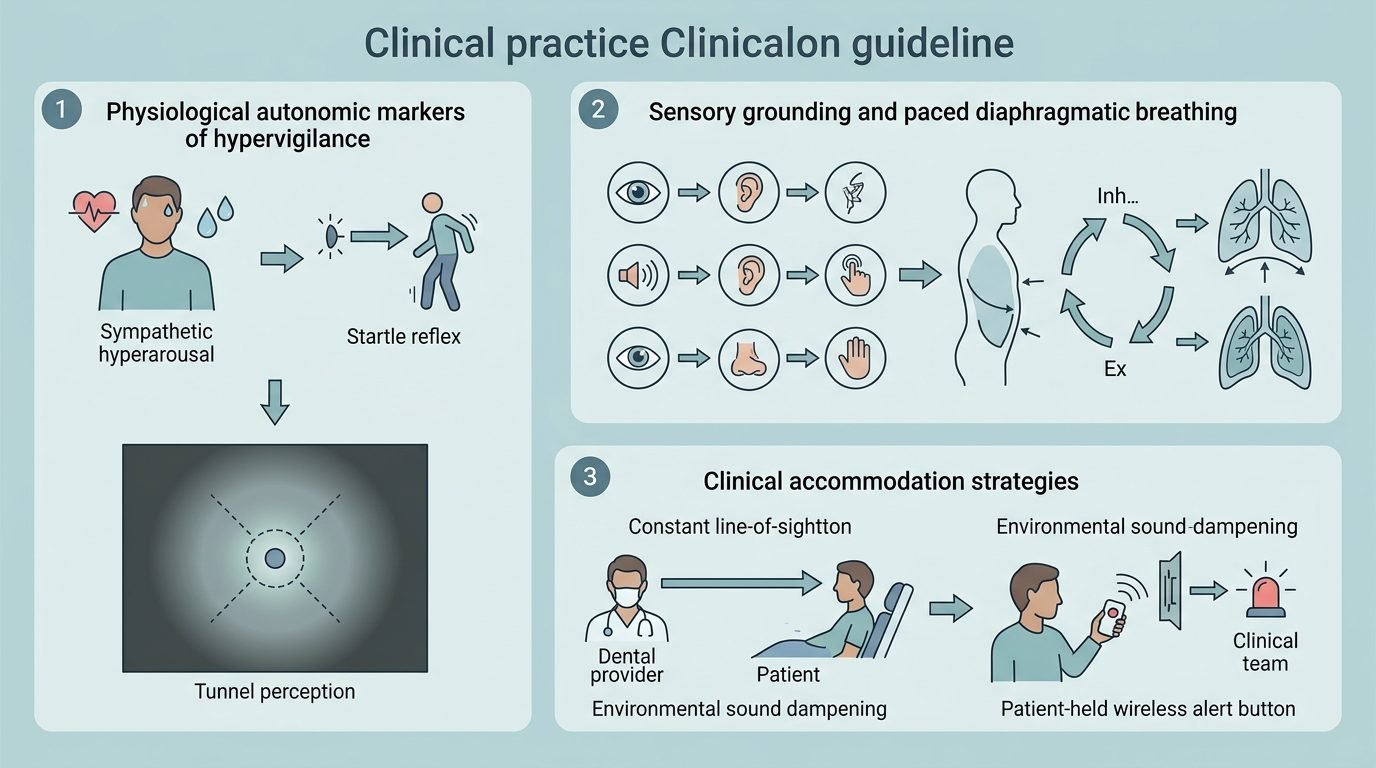
Consequently, the hyper-reactive amygdala fires uncontrollably in response to minor sensory triggers, mobilizing systemic catecholamines and activating the sympathetic-adrenomedullary and hypothalamic-pituitary-adrenal axes. The patient enters a chronic state of hypervigilance, constantly scanning the physical environment for ambush vectors or lethal threats. When seated in a dental chair, this baseline hyperarousal escalates. Sensory inputs that standard patients dismiss as minor inconveniences (vibrating burs, water spray, rubber dams, or clinical shadows passing overhead) are processed by the trauma-conditioned brain as physical assault, prompting sudden autonomic fight, flight, or freeze reflexes.
Deconstructing Operatory Triggers: Acoustics, Positioning, and Neck Constriction
Understanding the specific sensory triggers present within the dental operatory allows clinical teams to eliminate threat vectors before active treatment begins. Acoustic stimuli represent the most prevalent triggers for combat veterans and first responders. The high-frequency acoustic whine of air-turbine handpieces (operating at 300 to 400 kHz) mimics incoming shrapnel, artillery rounds, or emergency sirens, while ultrasonic scalers produce piercing high-frequency vibrations that reverberate through cranial bones.
Spatial positioning represents another profound vulnerability. Positioning a dental chair so the patient faces away from the entrance door, leaving their back exposed to an open hallway, violates survival conditioning. Veterans trained in combat perimeter security experience intense hypervigilance if they cannot visually monitor the primary entry point of the room. Furthermore, physical constriction around the neck or throat (such as a tightly clamped dental bib chain, a tight thyroid lead collar, or heavy clinician hands resting near the carotid triangle) directly simulates battlefield strangulation or entrapment, provoking acute combat panic reactions.
Spatial and Ergonomic Accommodations: Line of Sight and Door Alignment
Modifying the physical configuration of the treatment room provides foundational security for patients with PTSD. The clinical team must position the dental chair so the patient maintains an unobstructed line of sight toward the operatory doorway. If structural cabinetry prevents re-orienting the chair, an optical mirror should be mounted on the operatory wall, allowing the patient to monitor doorway traffic comfortably without craning their neck.
The clinician must avoid operating from the direct twelve o’clock position behind the patient headrest. Working out of the patient’s visual field generates sustained muscular tension and autonomic dread. Operating from the nine o’clock or ten o’clock position (for right-handed clinicians) ensures the provider remains within the patient’s peripheral vision. Furthermore, the dental chair should remain elevated at an angle between thirty and forty-five degrees; full supine positioning should be avoided unless technically mandatory, and the patient must be returned to an upright posture immediately upon pausing clinical instrumentation.
Eliminating Sensory Triggers: Acoustics, Bibs, and Protective Eyewear
Neutralizing environmental stimuli prevents sensory overload and autonomic spikes. To eliminate acoustic triggers, the clinical team should transition from loud air-driven turbines to high-torque electric handpieces, which operate at lower, less piercing decibel levels without pneumatic whining. Patients should be encouraged to wear active noise-canceling headphones streaming chosen audio tracks to mask operatory machinery entirely.
Neck constriction must be eliminated. Traditional metallic bib chains should be discarded in favor of disposable bib clips fastened to clothing below the clavicles, or the bib should be omitted entirely by placing a disposable protective drape across the lap. Dental lights must never be swung suddenly into the patient eyes, as sudden visual blinding triggers combat reflexes; the light should be directed onto the patient chest before being focused into the oral cavity, while dark polarized sunglasses shield the eyes. The patient should always be allowed to retain their street shoes and personal outerwear, reinforcing physical readiness and psychological comfort.
Communication Strategies: Unconditional Stop Signals and Grounding
Clear, transparent communication mitigates feelings of helplessness and physical vulnerability. Clinicians must establish a non-verbal stop signal before any instrument enters the oral cavity. Raising the left hand must produce an immediate cessation of all clinical activity.
The clinician must confirm this contract verbally: “If you raise your hand, I will stop immediately and remove my hands from your mouth. We only proceed at your pace.” Honoring this signal instantly builds deep clinical trust. In addition, providing textured sensory grounding objects, such as tactile silicone therapy balls in the patient hands, helps ground cognitive processing during operative vibration. If the patient begins exhibiting signs of an acute flashback (dilated pupils, hyperventilation, blank stare, or muscular rigidity), the clinician must pause immediately, remove instruments, address the patient by name, and guide them through a five-four-three-two-one sensory grounding exercise, focusing on immediate physical realities: “You are safe in our dental clinic, your feet are on the floor, and you are in control.”
Clinical Synthesis for Trauma-Informed Dental Healthcare
Dental care for patients living with post-traumatic stress disorder demonstrates that empathy and clinical ergonomics are inseparable from biological success. By understanding the neurobiology of hyperarousal, realigning room ergonomics to preserve sightlines, dampening acoustic machinery, and honoring personal agency with inviolable stop signals, dental teams transform high-stress environments into safe clinical spaces. Trauma-informed care preserves teeth, prevents iatrogenic psychological injury, and honors the service and resilience of individuals carrying deep psychological wounds.
References
- Armfield, J. M., et al. (2007). Dental fear and its relationship with general anxiety and specific phobias. Australian Dental Journal, 52(2), 88-94.
- Dworkin, R. H., et al. (2007). Pharmacologic management of neuropathic pain: evidence-based recommendations. Pain, 132(3), 237-251.
- Kaysen, D., et al. (2014). Trauma and PTSD: implications for dental care in veteran populations. Journal of Dental Education, 78(8), 1123-1131.
- Raja, S., et al. (2015). Trauma-informed care in healthcare: an overview for oral health providers. Compendium of Continuing Education in Dentistry, 36(9), 674-681.
- Smyth, C. A., & Braid, J. (2021). Managing dental anxiety in patients with complex post-traumatic stress: practical clinical protocols. Special Care in Dentistry, 41(3), 322-330.
Leave a Reply