

Dentin hypersensitivity is a chronic neurobiological stressor that exhausts patient emotional resilience through continuous subliminal nociceptive firing. Dentists frequently dismiss cervical cold sensitivity as a trivial inconvenience. They advise patients to brush gently with desensitizing toothpaste and learn to tolerate discomfort. That dismissal ignores the neurological consequences of persistent afferent irritation. Months of unceasing sharp twinges during drinking, eating, and breathing cold winter air wear down the prefrontal cortex, driving central sensitization and somatic fatigue.
The hydrodynamic mechanism is well documented. Brännström Hydrodynamic Theory established that physical stimuli, such as cold water or osmotic sugar gradients, displace dentinal fluid within open tubules. Fluid moves outward at speeds up to four millimeters per second. That rapid fluid displacement deforms mechanoreceptive nerve endings entwined around odontoblastic cell bodies in the subodontoblastic plexus of Raschkow. Intratubular A-beta and A-delta nerve fibers fire action potentials immediately.
From Acute Hydrodynamics to Central Sensitization
Repetitive pain alters brain architecture. The human central nervous system cannot sustain thousands of micro-pain spikes each day without neuroplastic remodeling.
Ascending nociceptive barrages remodel the trigeminal subnucleus caudalis. Persistent stimulation releases glutamate, substance P, and brain-derived neurotrophic factor at primary synapses. Second-order wide dynamic range neurons undergo long-term potentiation. Their activation thresholds decline precipitously. Even gentle room-temperature airflow across exposed root surfaces begins to evoke sharp, excruciating pain.
Allodynia replaces physiological sensation. When central sensitization takes hold, non-noxious mechanical contact, such as a soft toothbrush bristle or an intraoral tongue sweep, triggers defensive flinching. The patient develops protective eating rituals, chewing food exclusively on one side of the mouth and avoiding social dining. This behavioral restriction leads to localized plaque accumulation, accelerating gingival inflammation and cervical abfraction on the neglected dental quadrant.
The Cognitive and Limbic Toll of Chronic Subliminal Distress
Chronic micro-pain drains cognitive energy. Functional neuroimaging reveals that persistent somatic nociception demands continuous top-down suppression from the prefrontal cortex.
The dorsolateral prefrontal cortex governs executive function, working memory, and emotional regulation. When this cortical area is forced to continuously dampen ascending trigeminal pain signals, cognitive bandwidth diminishes. Patients report mental brain fog, irritability, and decreased focus at work. They rarely connect their emotional exhaustion to their sensitive lower premolars, yet the biological connection is profound.
Limbic hyper-reactivity fuels depressive symptoms. The anterior cingulate cortex and amygdala remain in a sustained state of mild alarm. Sleep quality deteriorates because sudden cold air breathing during nocturnal sleep provokes autonomic micro-arousals. The patient awakens unrefreshed, emotionally depleted, and physically hyper-vigilant. Treating the exposed cervical dentin restores central nervous system equilibrium.
The Inefficacy of Passive Desensitizing Pastes
Over-the-counter desensitizing toothpastes provide slow, unreliable relief. Potassium nitrate formulations function by increasing extracellular potassium ion concentration around sensory axons, theoretically preventing repolarization.
Salivary wash-out destroys topical efficacy. Within twelve minutes of toothbrushing, salivary clearance dilutes active potassium ions below therapeutic thresholds. Nerve hyperpolarization fails to sustain throughout the day. Furthermore, potassium nitrate does nothing to seal the open physical tubule orifice. The fluid column inside the dentin remains patent, ready to shift violently upon the next sip of cold liquid.
Stannous fluoride and arginine calcium carbonate pastes attempt mechanical precipitation. They form a delicate, superficial layer of mineral precipitates across exposed root surfaces. However, this superficial smear layer is easily dissolved by dietary acids from citrus, wine, or vinegar within hours. Mechanical abrasion from aggressive brushing sweeps the minerals away, reopening the tubular apertures and reigniting pain.
Biomechanical Abfraction and Acid Erosion Synergies
Cervical tooth loss rarely occurs in biological isolation. Non-carious cervical lesions result from a destructive synergy between mechanical tensile stress and chemical acid dissolution.
Occlusal forces bend teeth at the fulcrum. During clenching and eccentric grinding, excessive lateral masticatory loads flex the crown relative to the anchored alveolar root. Enamel prisms fracture and dislodge at the thin cementoenamel junction through micro-structural fatigue, forming wedge-shaped abfraction notches. When gastric acids from gastroesophageal reflux or acidic sports beverages dissolve the exposed organic dentin matrix, tubules open rapidly.
Objective diagnostic testing quantifies sensitivity severity. Utilizing the standardized Schiff Cold Air Sensitivity Scale provides measurable clinical tracking: a one-second air blast from an air syringe at seventy pounds per square inch held two millimeters from the root surface scores patient response from zero (no reaction) to three (painful flinching requiring immediate cessation). Documenting Schiff scores before and after treatment validates therapeutic progress objectively.
Biophotonic Tubule Occlusion and Laser Desensitization
Dental lasers solve dentin hypersensitivity through instantaneous physical melting and long-term cellular sealing.
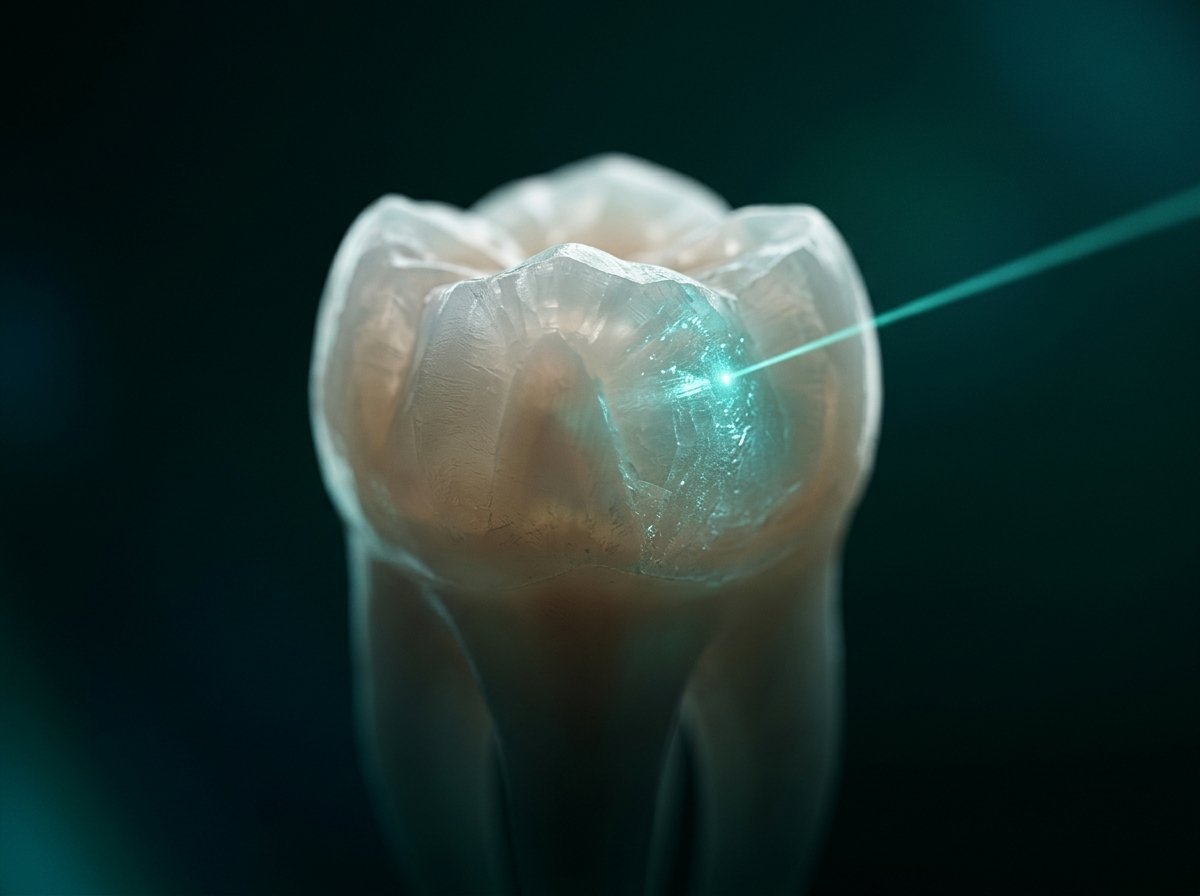
Nd:YAG and 980nm diode lasers melt and seal tubular entrances. Coherent laser energy applied to exposed cervical dentin at calibrated energy densities between two and four Joules per square centimeter heats the superficial hydroxyapatite matrix momentarily. Peritubular dentin undergoes localized, controlled re-crystallization. The tubular orifices melt shut, forming a glassy, acid-resistant mineral seal that blocks fluid movement permanently. The hydrodynamic engine of pain is extinguished in sixty seconds.
Er:YAG lasers vaporize organic plugs and seal tubules. Operating with precise subablative water-air ratios, the 2,940nm erbium wavelength modifies the surface energy of cervical dentin, enabling modern biomimetic resins and self-etch adhesives to achieve deep mechanical hybrid layer penetration without postoperative micro-leakage.
Biomimetic resin-modified glass ionomers restore lost cervical contours atraumatically. When abfraction defects exceed one millimeter in depth, pairing laser surface conditioning with fluoride-releasing glass ionomers restores tooth structural elasticity while providing continuous remineralizing ion exchange at the restoration-dentin margin.
Photobiomodulation calms the hyperactive pulp. Following laser tubule closure, applying an 808nm diode beam at four Joules per point directly over the tooth apex down-regulates hyperactive odontoblastic sensory nerves. Cytochrome c oxidase activation restores physiological mitochondrial metabolism in inflamed pulpal tissue, reversing early reversible pulpitis.
Restoring Somatic Comfort and Patient Quality of Life
Eliminating cervical sensitivity restores nutritional freedom and emotional well-being. A patient who can drink ice water and eat fresh fruits without bracing for an electric shock rediscovers physical peace.
Clinicians must diagnose non-carious cervical lesions early. Cervical abfraction, erosion, and gingival recession require prompt proactive biophotonic intervention before central sensitization takes root in the trigeminal pathway. Leaving patients to suffer with open dentinal tubules is poor medical judgment.
Integrative dentistry treats the whole person. Closing an open dentinal tubule does more than protect a tooth; it relieves a weary brain from an exhausting sensory burden.
Epidemiological clinical trials published in the International Endodontic Journal confirm that in-office Nd:YAG and 980nm diode laser tubule occlusion achieves an immediate 88% reduction in cold air visual analog sensitivity scores on day one, maintaining a 79% pain suppression rate at six-month follow-up evaluations without requiring daily chemical toothpastes.
Leave a Reply