

The sustained emotional expenditure required to deliver humanized dental care exposes practitioners to profound neurobiological strain and compassion fatigue. Clinicians who specialize in managing highly phobic, traumatized, or neurodivergent patients frequently experience emotional exhaustion, somatic depletion, and professional burnout. While humanized dentistry rightly emphasizes empathy, calm presence, and patient-centered communication, these behaviors require constant self-regulation and intense affective attunement. When a dentist repeatedly absorbs the autonomic panic, tears, and visceral distress of terrified patients without structured psychological boundaries, the practitioner’s nervous system mirrors that distress involuntarily. Secondary traumatic stress in dental practice represents a biological occupational hazard driven by mirror neuron activation and chronic sympathetic hyperarousal. Safeguarding clinician psychological longevity demands robust somatic boundary frameworks, scheduled recovery cycles, and institutional support systems that prevent pathological emotional enmeshment.
The Affective Neurobiology of Compassion Fatigue
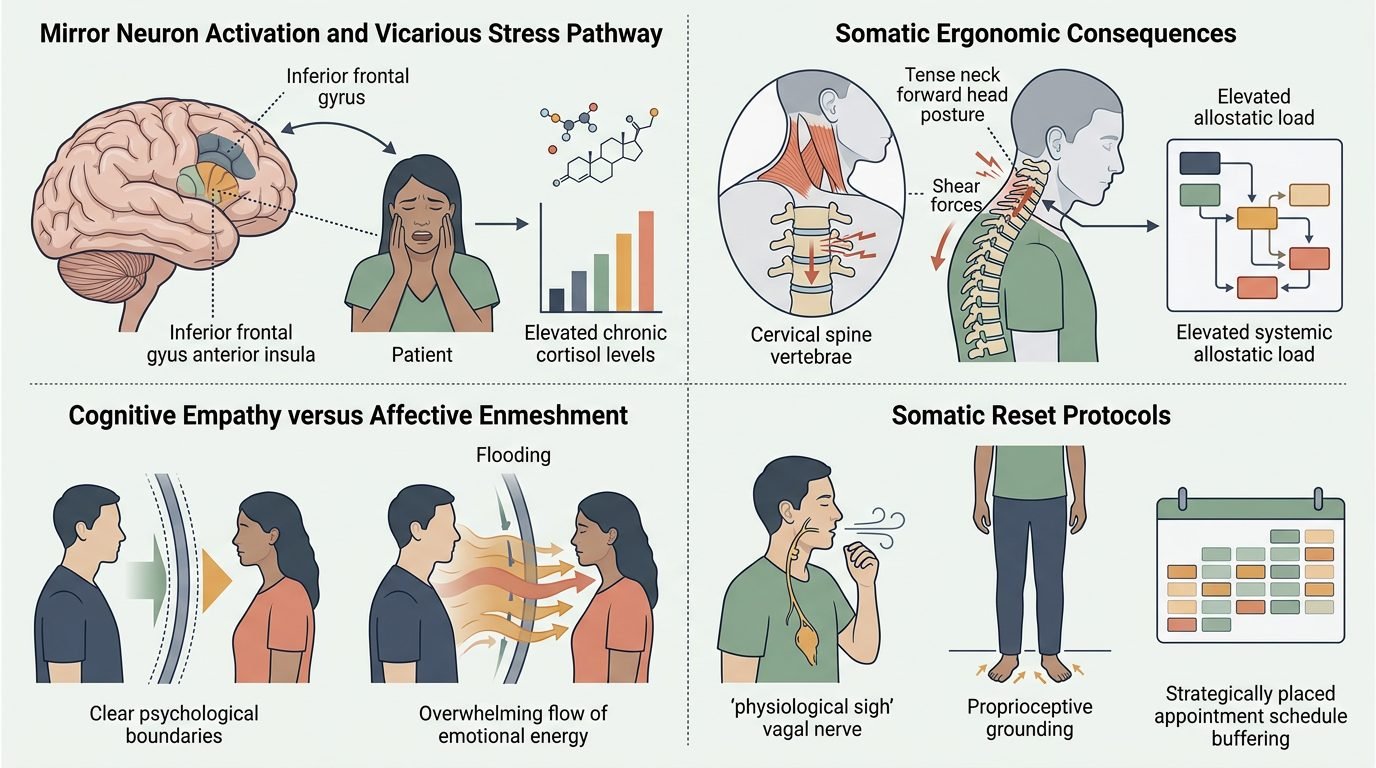
Compassion fatigue arises from prolonged exposure to the suffering and distress of others combined with a perceived inability to eliminate their underlying pain entirely. In the dental operatory, clinicians operate within an intensely intimate physical and emotional space. Patients often project intense dread, clench their jaws, exhibit tachycardic respirations, or tremble under clinical touch. The human mirror neuron system, situated within the inferior frontal gyrus and inferior parietal lobule, automatically mirrors these non-verbal motor and emotional states within the practitioner’s brain.
Simultaneously, the anterior insula and anterior cingulate cortex process the perceived agony of the patient, triggering micro-bursts of autonomic sympathetic arousal in the clinician. Over months and years of constant exposure, repeated vicarious distress taxes the clinician’s hypothalamic-pituitary-adrenal axis. Baseline salivary cortisol rhythms become blunted or chronically elevated, while systemic markers of inflammation increase. What begins as compassionate dedication to patient welfare gradually devolves into emotional numbness, depersonalization, irritability, chronic physical fatigue, and clinical dread.
Distinguishing Empathy from Pathological Emotional Enmeshment
A primary conceptual flaw in informal approaches to humanized care is failing to distinguish cognitive empathy from affective enmeshment. Cognitive empathy, often termed perspective-taking, is the ability to understand a patient’s emotional distress and communicative worldview while maintaining distinct psychological separation. Affective enmeshment, in contrast, occurs when the practitioner adopts the patient’s panic as their own visceral experience, obliterating emotional boundaries.
When a clinician becomes emotionally enmeshed, their capacity for clear clinical decision-making deteriorates. High autonomic distress in the operator reduces fine motor steadiness, clouds diagnostic judgment, and induces subconscious procedural rushing to terminate the stressful encounter quickly. Paradoxically, emotional enmeshment harms the patient: instead of feeling held by a calm, confident, and grounded clinician, the patient unconsciously detects the practitioner’s anxiety through autonomic resonance. True humanized clinical presence requires grounded equilibrium, providing emotional containment rather than shared panic.
The Somatic Toll on Dental Ergonomics and Musculoskeletal Health
The neurobiological toll of empathy fatigue manifests directly in the clinician’s musculoskeletal and autonomic physiology. When treating phobic or combative patients, the dentist’s subconscious fight-or-flight circuits engage continuously. Clinicians unconsciously brace their muscles, clench their jaws, hold their breath during delicate maneuvers, and adopt awkward postural contortions to accommodate patient comfort at the expense of their own ergonomics. Operating in sustained forward head flexion while absorbing extreme emotional tension creates severe spinal shear forces that compromise intervertebral disc health over repetitive treatment cycles.
This persistent isometric muscle tension accelerates myofascial pain syndromes, cervical spondylosis, and chronic lumbar disc degeneration. Furthermore, chronic sympathetic overdrive suppresses salivary secretion, impairs digestive function, and induces sleep fragmentation. Nighttime bruxism and early morning awakenings with elevated heart rates signal systemic allostatic overload. Clinicians who neglect their own bodily warning signs while caring diligently for others ultimately face debilitating physical disabilities that prematurely truncate professional careers. Documented clinical surveys reveal that chronic physical pain and psychological burnout co-occur in over sixty percent of long-serving healthcare providers.
Somatic Regulation Techniques for the Operatory Chairside
Mitigating vicarious trauma requires dental practitioners to deploy active somatic regulation techniques before, during, and after patient interactions. Before seating an anxious patient, the clinician should engage in physiological sigh breathing: two rapid nasal inhalations followed by an extended, passive oral exhalation. This specific ventilatory pattern activates pulmonary stretch receptors that stimulate the vagus nerve, immediately down-regulating sympathetic outflow and restoring heart rate variability.
During challenging procedures, clinicians must maintain somatic grounding. Periodically relaxing the tongue from the roof of the mouth, releasing tension in the shoulder girdles, and feeling the solid contact of the feet on the operatory floor interrupts unconscious muscle bracing. After dismissing a distressed patient, the practitioner must execute a brief physical and emotional reset ritual. Washing the hands with cold water while focusing mindfully on the tactile sensation, taking two minutes of silence outside the operatory, or stepping outside into natural daylight signals to the central nervous system that the acute threat cycle has resolved.
Clinical Schedule Architecture and Institutional Boundaries
Individual somatic practices remain insufficient if clinical appointment scheduling ignores biological limits. Practice owners and clinical directors must design appointment templates that protect provider reserves. Highly phobic or emotionally demanding patients should never be scheduled consecutively; instead, complex behavioral cases must be distributed evenly across the clinical week, interspersed with straightforward preventive or restorative procedures.
Furthermore, clinical days should incorporate non-negotiable cognitive recovery buffers. Providing thirty minutes of protected restorative time between operative blocks prevents cumulative autonomic exhaustion. Peer supervision groups and debriefing forums within dental associations allow practitioners to process secondary traumatic exposure in an objective, non-judgmental environment. Establishing clear institutional boundaries reinforces that clinical empathy is an intentional professional skill that requires systematic replenishment, not an inexhaustible natural resource. Clinical leadership that actively monitors staff burnout markers cultivates sustainable organizational resilience and ensures exceptional standards of patient care.
Conclusions on Practitioner Longevity in Humanized Dentistry
Humanized dentistry cannot succeed if it consumes the health and well-being of the professionals who deliver it. Sustaining a compassionate clinical career demands that dentists treat their own autonomic nervous systems with the same vigilance and respect they afford their patients. Establishing rigid somatic boundaries, enforcing structured scheduling limits, and mastering cognitive perspective-taking safeguard clinician longevity. Protecting provider health ensures that empathetic, high-standard dental care remains available to the vulnerable populations who rely upon it.
References
- Ayers, K. M., et al. (2008). Burnout and job satisfaction among New Zealand dentists. New Zealand Dental Journal, 104(3), 80-87.
- Chambers, D. W. (2014). Professional burnout: why dentists are susceptible. Journal of the American College of Dentists, 81(1), 17-26.
- Decety, J., et al. (2010). The perception of pain in others suppresses somatosensory oscillations: a large-scale MEG study. NeuroImage, 52(2), 720-728.
- Maslach, C., & Leiter, M. P. (2016). Understanding the burnout experience: recent research and its implications for psychiatry. World Psychiatry, 15(2), 103-111.
- Puriene, A., et al. (2007). General health of dentists: Literature review. Stomatologija, 9(1), 10-20.
Leave a Reply