
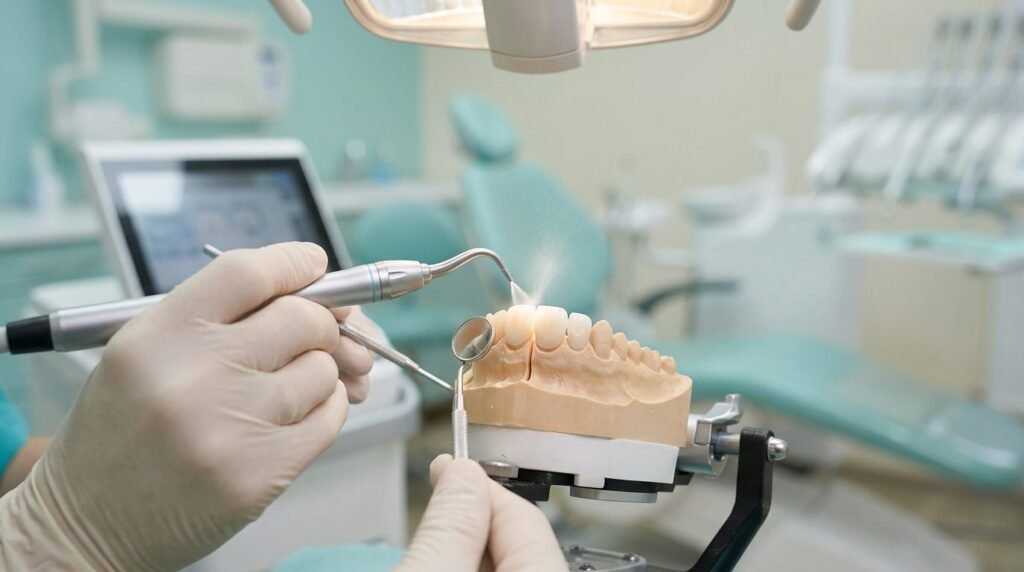
Removing bonded all-ceramic restorations and orthodontic brackets with conventional rotary diamond burs causes irreversible damage to underlying natural enamel prisms. When clinicians attempt mechanical grinding to remove debonded, fractured, or esthetically compromised lithium disilicate veneers, distinguishing translucent porcelain from native enamel under high-speed water spray is virtually impossible. Consequently, rotary bur removal consistently results in significant loss of healthy coronal enamel, micro-cracking, and iatrogenic tooth mutilation. Furthermore, mechanical pliers used to debond ceramic orthodontic brackets exert destructive tensile forces that frequently tear enamel tearouts or fracture bracket bases. Erbium laser technology, specifically Er:YAG (2940 nm) and Er,Cr:YSGG (2780 nm), offers a non-contact optical debonding modality based on wavelength transmission through ceramic materials. Mid-infrared laser energy passes through translucent ceramics to selectively degrade the underlying resin cement interface through photo-thermal and photo-acoustic ablation, allowing complete restoration retrieval within seconds without damaging enamel morphology.
Optical Transmittance and Selective Absorption in Resin Cements
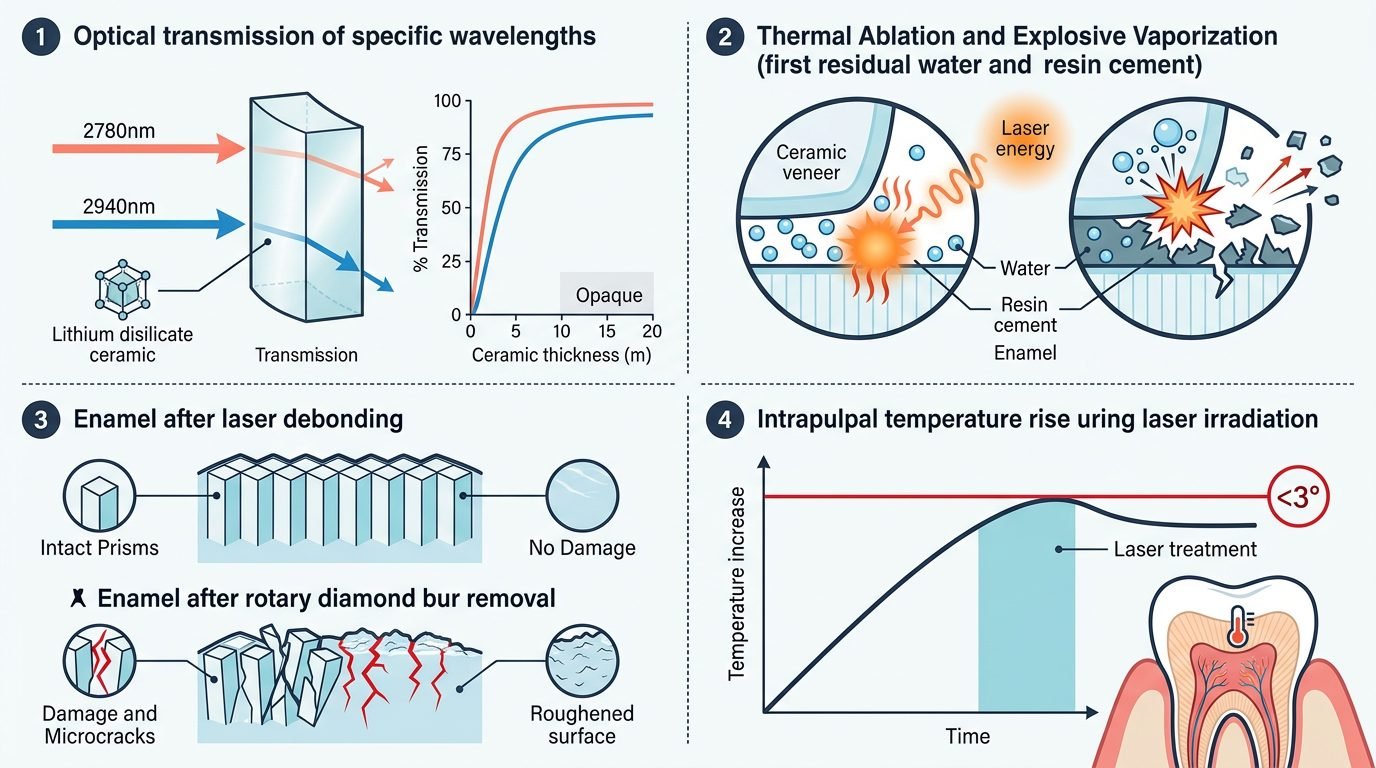
The biophysical feasibility of laser debonding depends upon the differential optical transmission properties of dental ceramics versus adhesive resin cements. Dental ceramics, including feldspathic porcelain, leucite-reinforced glass-ceramics, and lithium disilicate, exhibit high optical transmittance in the mid-infrared spectral window between 2.7 and 3.0 micrometers. Depending on restoration thickness (typically 0.3 to 1.0 millimeters) and material opacity, between thirty and seventy percent of incident erbium photonic energy penetrates directly through the ceramic bulk without being absorbed or converted into heat.
Conversely, the underlying resin luting cement layer possesses high concentrations of water molecules, residual monomer hydroxyl groups, and inorganic glass fillers that strongly absorb 2780 nm and 2940 nm radiation. When transmitted erbium photons strike this interface, instantaneous localized photo-thermal energy absorption occurs within the resin matrix. This rapid energy concentration induces thermal softening of the dimethacrylate polymer network and initiates explosive interstitial micro-cavitation of residual moisture. Within milliseconds, adhesive micro-mechanical interlocking bonds between the ceramic and the enamel substrate dissolve completely.
Ablation Dynamics: Thermal Softening versus Photoacoustic Shockwaves
Laser-assisted ceramic debonding operates through two distinct, synergistic physical mechanisms: photo-thermal plasticization and photo-acoustic shockwave generation. In the photo-thermal pathway, localized heating of the resin cement layer beyond its glass transition temperature (typically 120 to 160 degrees Celsius) causes thermal expansion and structural softening of polymer chains. This thermal softening drastically reduces the shear bond strength of the luting agent, dropping retention values from over twenty-five megapascals to near zero.
Concurrently, in the photo-acoustic pathway, high-energy pulsed laser emission induces rapid vaporization of micro-droplets within the porous cement layer. Because the ceramic restoration physically confines the expanding vapor, localized explosive vapor pressure creates acoustic stress waves that propagate along the adhesive interface. These microscopic shockwaves peel the softened resin cement away from both the ceramic intaglio and the etched enamel prisms. Consequently, the ceramic veneer or bracket detaches cleanly with minimal manual traction, often popping off the tooth surface spontaneously without requiring mechanical prying forces.
Pulpal Thermal Safety and Water Spray Dynamics
Maintaining pulpal vitality is the foremost clinical requirement during laser irradiation of coronal tooth structures. Classic thermodynamic experiments by Zach and Cohen established that an intrapulpal temperature rise exceeding 5.5 degrees Celsius produces irreversible pulpitis and pulpal necrosis in fifteen percent of teeth, while an increase of 11 degrees Celsius induces total pulp tissue necrosis. Because erbium lasers generate substantial localized thermal energy, clinicians must deploy precise cooling protocols to safeguard the delicate dental pulp.
Thermal safety during ceramic debonding is guaranteed by utilizing continuous coaxial water-air sprays (typically forty to fifty percent water flow). Transmitted photonic energy is concentrated almost entirely within the thin cement interface, while the ceramic surface is continuously cooled by the evaporative spray. Thermographic camera monitoring and embedded thermocouple evaluations demonstrate that during clinical Er:YAG veneer debonding (operating at 3 to 5 watts, 10 to 15 Hertz, for sixty to ninety seconds), the internal pulp chamber temperature fluctuates by less than 2.0 degrees Celsius, remaining well below the 5.5-degree pathological threshold. Conversely, attempting laser debonding without adequate water cooling rapidly induces thermal enamel cracking and irreversible pulpal damage.
Enamel Preservation and Integrity of Retrieved Ceramics
Scanning electron microscopy evaluations provide striking visual confirmation of enamel preservation following erbium laser debonding. In sharp contrast to rotary diamond bur grinding, which leaves extensive gouges, striations, and prism fractures across the facial enamel, laser-debonded enamel surfaces remain completely pristine. The original etched enamel prism morphology and aprismatic surface layers remain intact, requiring only gentle ultrasonic resin residue cleanup or low-abrasive pumice polishing to restore native tooth shine.
Furthermore, because the laser beam passes harmlessly through the ceramic restoration, the veneer or bracket suffers zero structural or optical degradation. Spectrophotometric color analysis confirms that ceramic translucency, chromatic stability, and surface gloss are fully preserved. In many clinical scenarios, such as retrieving an intact veneer for minor marginal re-cementation or salvaging valuable ceramic orthodontic brackets, the intact restoration can be cleansed, re-etched with hydrofluoric acid, silanated, and re-bonded immediately, saving significant laboratory expenses and chairside procedure time.
Clinical Operatory Protocols and Laser Parameters
Successful execution of laser ceramic debonding demands systematic operatory technique. The clinician selects an Er:YAG (2940 nm) or Er,Cr:YSGG (2780 nm) system equipped with a wide-diameter non-contact handpiece or a flat sapphire tip. Energy settings typically range between 150 and 250 millijoules per pulse, with pulse frequencies set at 10 to 20 Hertz, delivering an average power output of 2.0 to 4.0 watts under continuous water-air spray.
The laser tip is held perpendicular to the labial ceramic surface at a distance of five to eight millimeters, sweeping continuously in horizontal and vertical scanning passes across the entire facial surface for thirty to sixty seconds. The clinician applies extremely gentle outward traction on the incisal edge using a plastic instrument or gloved fingertip. As soon as the underlying cement reaches its plasticization threshold, the restoration releases effortlessly. Recording physical energy parameters guarantees predictable, safe debonding outcomes across diverse ceramic thicknesses.
Significance in Modern Conservative Dentistry
Erbium laser debonding represents a major technological leap forward in biomimetic and conservative dentistry. By exploiting optical physics to eliminate destructive mechanical bur reduction, clinicians protect the finite biological capital of native enamel prisms. Non-contact optical retrieval converts a historically stressful, destructive procedure into an elegant, painless, and completely tooth-preserving clinical intervention.
References
- Morford, C. K., et al. (2011). Er:YAG laser debonding of porcelain veneers. Journal of the American Dental Association, 142(4), 413-419.
- Oztoprak, M. O., et al. (2010). Debonding of ceramic brackets by a new scanning laser technique. American Journal of Orthodontics and Dentofacial Orthopedics, 138(2), 195-200.
- Gkogkos, C., et al. (2015). Temperature changes in the pulp chamber during ceramic bracket debonding with an Er:YAG laser. Lasers in Medical Science, 30(2), 707-712.
- Al-Balkhi, M., et al. (2018). Laser-assisted debonding of ceramic veneers: A systematic review. Photomedicine and Laser Surgery, 36(8), 397-404.
- Zach, L., & Cohen, G. (1965). Pulp response to externally applied heat. Oral Surgery, Oral Medicine, Oral Pathology, 19(4), 515-530.
Leave a Reply