
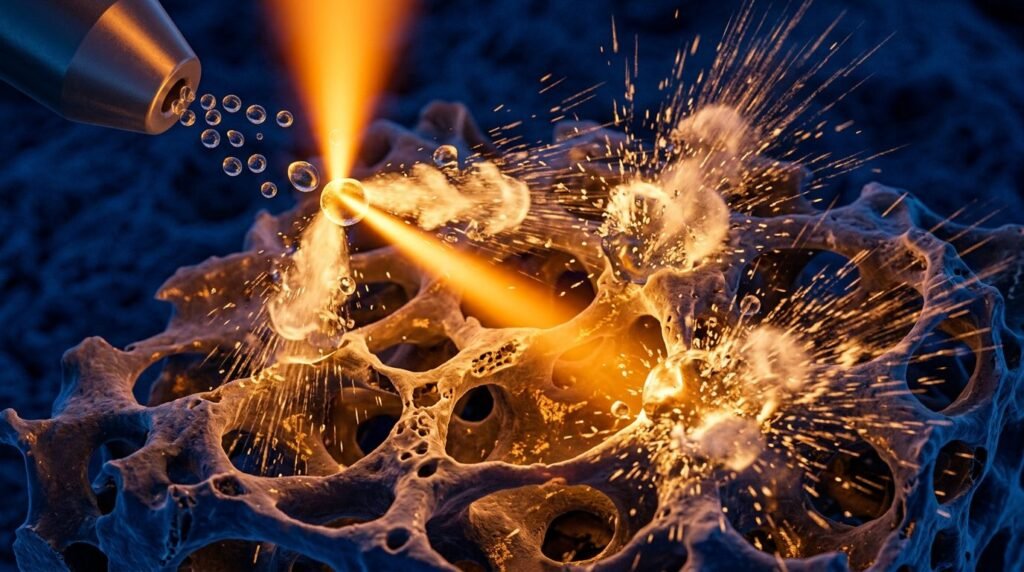
Surgical management of radicular and dentigerous cysts requires total elimination of the pathological epithelial lining while preserving surrounding cortical boundaries and neurovascular bundles. Conventional enucleation relying exclusively on hand curettes and rotary carbide burs frequently leaves microscopic epithelial remnants within crypts and trabecular micro-undercuts of the bony cavity. These persistent cellular clusters account for documented recurrence rates ranging from five to twenty-two percent across longitudinal clinical cohorts. Furthermore, aggressive mechanical burring produces thermal osteonecrosis and mechanical micro-fractures, delaying subsequent osteogenesis. Application of the erbium, chromium:yttrium-scandium-gallium-garnet (Er,Cr:YSGG) laser emitting at 2780 nm introduces a hydrodynamic photoacoustic ablation mechanism capable of selectively vaporizing residual epithelial nests without traumatizing the underlying vital bony architecture.
The physical interaction of the 2780 nm wavelength with mineralized and soft tissues is governed by extreme optical absorption in water and secondary absorption in hydroxyapatite. When the Er,Cr:YSGG laser beam interacts with the cyst wall under calibrated coaxial water-air atomization, water molecules within the cellular cytoplasm and interstitial matrix instantly absorb photonic energy. This explosive micro-expansion causes micro-explosive tissue disruption, ejecting cellular fragments at velocities that avoid thermal accumulation. Histological cross-sections demonstrate that Er,Cr:YSGG ablation produces a residual thermal damage zone measuring less than thirty to fifty micrometers along bone walls, compared to zones exceeding one hundred micrometers created by conventional rotary burring without adequate irrigation. This narrow zone of superficial denaturation leaves open dentinal and osteocyte canaliculi, establishing an optimal biological surface for subsequent cellular migration.
Decontamination of the cystic bony crypt represents a major biological advantage of 2780 nm laser irradiation. Radicular cysts develop in response to chronic intraradicular microbial colonization, typically characterized by persistent endodontic pathogens including Enterococcus faecalis, Prevotella intermedia, and Porphyromonas endodontalis that invade adjacent bony margins. Mechanical curettage removes macroscopically visible granulation and soft tissue lining but fails to eradicate bacteria entrenched within porous trabecular spaces. The photoacoustic shockwaves generated by water-mediated Er,Cr:YSGG pulses penetrate deeply into microscopic bone crevices, disrupting bacterial biofilm architectures and denaturing bacterial lipopolysaccharides (LPS). Clinical bacteriological swabbing confirms a significant reduction in intraluminal bacterial load immediately following laser conditioning compared to mechanical curettage alone.
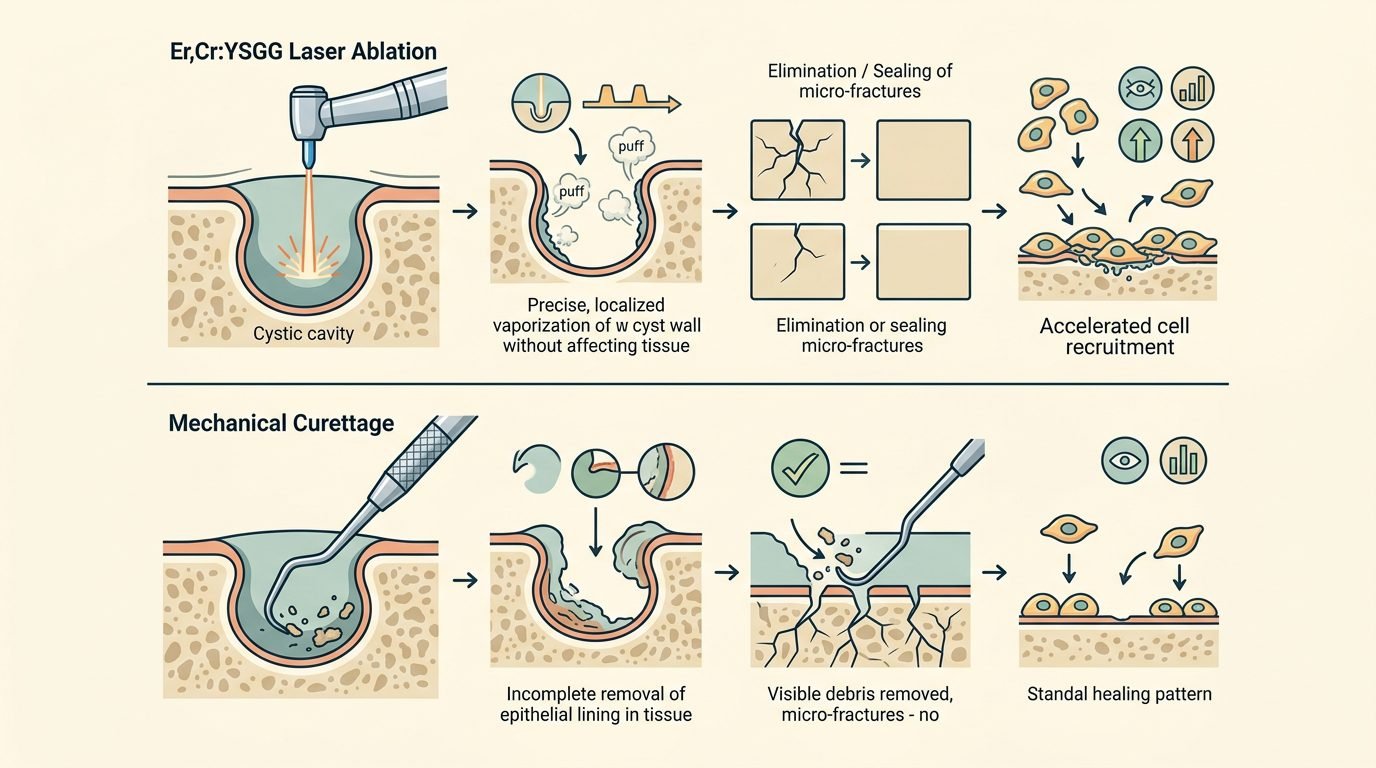
Dosimetric calibration determines the clinical threshold between therapeutic decontamination and undesired osseous destruction. Following macroscopic mechanical delivery of the main cystic specimen via gentle blunt dissection, the clinician switches to laser photoablation for bed conditioning. An end-firing or radial-firing sapphire tip with an outer diameter of six hundred to eight hundred micrometers is selected for surgical delivery. Operating parameters should utilize an average power between 1.5 and 2.5 watts, individual pulse energies calibrated from seventy-five to one hundred and twenty-five millijoules, a pulse repetition rate of twenty to thirty hertz, a short pulse duration of sixty microseconds, and a coaxial water-to-air spray ratio maintained at sixty percent water and forty percent air. Fluence values must be strictly confined between fifteen and twenty-five joules per square centimeter across target bony walls. The delivery tip must remain in continuous, fluid circumferential motion, held one to two millimeters perpendicular to the bony walls. Direct stationary application must be strictly avoided to prevent focal pitting, deep carbonization, or excessive demineralization of trabecular architecture.
Preservation of critical neurovascular structures represents another distinct advantage of hydrodynamic photoacoustic intervention. Large dentigerous cysts frequently displace the inferior alveolar nerve bundle toward the inferior mandibular border, causing cortical thinning and direct contact between cyst lining and the perineural sheath. Mechanical scraping with steel curettes in this anatomical danger zone carries substantial risk of axonotmesis, neurapraxia, and permanent neurosensory deficits. Under magnification and calibrated laser energy, the Er,Cr:YSGG laser allows delicate vaporization of epithelial remnants draped across nerve surfaces without applying mechanical traction. The continuous water spray absorbs thermal dissipation, keeping baseline temperatures below the fourty-three-degree-Celsius neurotoxicity threshold.
Osteogenic kinetics within the healing bony cavity exhibit notable biological differences between laser-assisted and conventionally managed defects. Postoperative cone-beam computed tomography (CBCT) volumetric assessments reveal enhanced bone fill rates in cavities treated with Er,Cr:YSGG irradiation at six and twelve months post-surgery, with defect remineralization occurring up to eight weeks faster than curetted controls. Histological investigations clarify this acceleration: bone prepared with erbium lasers preserves open vascular micro-channels and exhibits unoccluded Haversian systems free of compacted, devitalized smear layers. Moreover, low levels of scattered photonic energy at peripheral surgical margins induce local photobiomodulative responses, stimulating osteoblast proliferation, alkaline phosphatase enzymatic activity, and direct transcriptional upregulation of bone morphogenetic protein-2 (BMP-2), osteocalcin, and vascular endothelial growth factor (VEGF). This osteoinductive stimulus accelerates primary woven bone formation and facilitates robust structural consolidation of cortical boundaries.
Root management of adjacent involved teeth requires combined endodontic and surgical laser intervention. Radicular cysts originate from periapical inflammatory stimulation of the epithelial cell rests of Malassez, necessitating definitive apicoectomy or retrograde root conditioning. When utilizing the Er,Cr:YSGG laser, root-end resection is executed with a sharp, beveled cut that prevents cemental micro-cracking and elimination of root-face micro-porosities. Retrograde cavity preparation performed with a narrow sapphire tip produces clean, debris-free cavities devoid of the smear layer, enhancing adhesion of bioceramic retro-filling materials such as mineral trioxide aggregate (MTA) or calcium-silicate putties. The non-contact nature of photonic ablation minimizes vibrational shock to the periodontal ligament of adjacent teeth.
Complication profiles and patient-reported outcomes further delineate the merits of this protocol. In comparative clinical trials, patients undergoing laser-assisted cyst enucleation reported reduced postoperative edema, lower pain scores on visual analogue scales (VAS), and significantly reduced consumption of oral rescue analgesics throughout the first week. The reduction in acute inflammation correlates with minimal mechanical traction applied to periosteal envelopes and lower soft-tissue trauma during mucosal elevation. Intraoperative bleeding is simultaneously curtailed due to focal capillary coagulation, providing the operator with exceptional visual clarity throughout deep crypt exploration.
Histopathological submission protocols must be maintained without modification. Clinicians must recognize that laser photoablation is strictly an adjunctive cavity-refining procedure and not a substitute for histological diagnosis. The primary cystic capsule must always be retrieved intact using gentle blunt dissection and immediately immersed in ten percent neutral buffered formalin for definitive histopathological analysis to rule out odontogenic keratocysts, ameloblastomas, or cystic squamous cell carcinomas. Only after the bulk specimen is secured should laser energy be applied to ablate microscopic residual epithelial nests on cavity margins.
Regarding clinical practice, integrating the Er,Cr:YSGG 2780 nm laser into odontogenic cyst surgery bridges the historic divide between aggressive surgical radicality and conservative tissue preservation. By leveraging photoacoustic hydrodynamic ablation under continuous water-air atomization, clinicians can eliminate microscopic epithelial remnants, eradicate stubborn biofilm reservoirs entrenched within porous bone, and preserve adjacent vital nerves without causing thermal osteonecrosis. This biologically conservative protocol significantly lowers long-term recurrence rates, accelerates postoperative recovery, and fosters predictable, high-density osseous regeneration across previously compromised anatomical sites.
Leave a Reply