
Erbium-doped yttrium aluminum garnet (Er:YAG) lasers emitting at 2940 nm offer an effective thermo-mechanical ablation modality for selective caries removal and cavity preparation in primary and young permanent dentition. The principal behavioral barrier in pediatric operative dentistry is dental fear triggered by the vibrational oscillation, high-pitched acoustic noise, and mechanical pressure generated by rotary air turbines. Children perceive mechanical rotary instruments as intrusive physical threats, frequently escalating behavioral resistance and necessitating pharmacological sedation or protective physical stabilization. The Er:YAG laser alters this operatory dynamic by ablating mineralized dental substrates through micro-explosive water vaporization without tactile pressure or bone-conducted sound vibrations. However, primary teeth possess distinct biological vulnerabilities that demand rigorous clinical oversight. Deciduous dental elements exhibit thinner enamel and dentin layers, larger pulpal horns located closer to anatomical outer surfaces, higher organic matrix water content, and wider dentinal tubules. Uncontrolled laser parameters generate thermal accumulation capable of causing irreversible pulpitis or internal root resorption. Successful pediatric laser intervention requires exact dosimetric control, continuous coaxial water-air atomization, and sound knowledge of adhesive substrate interactions.
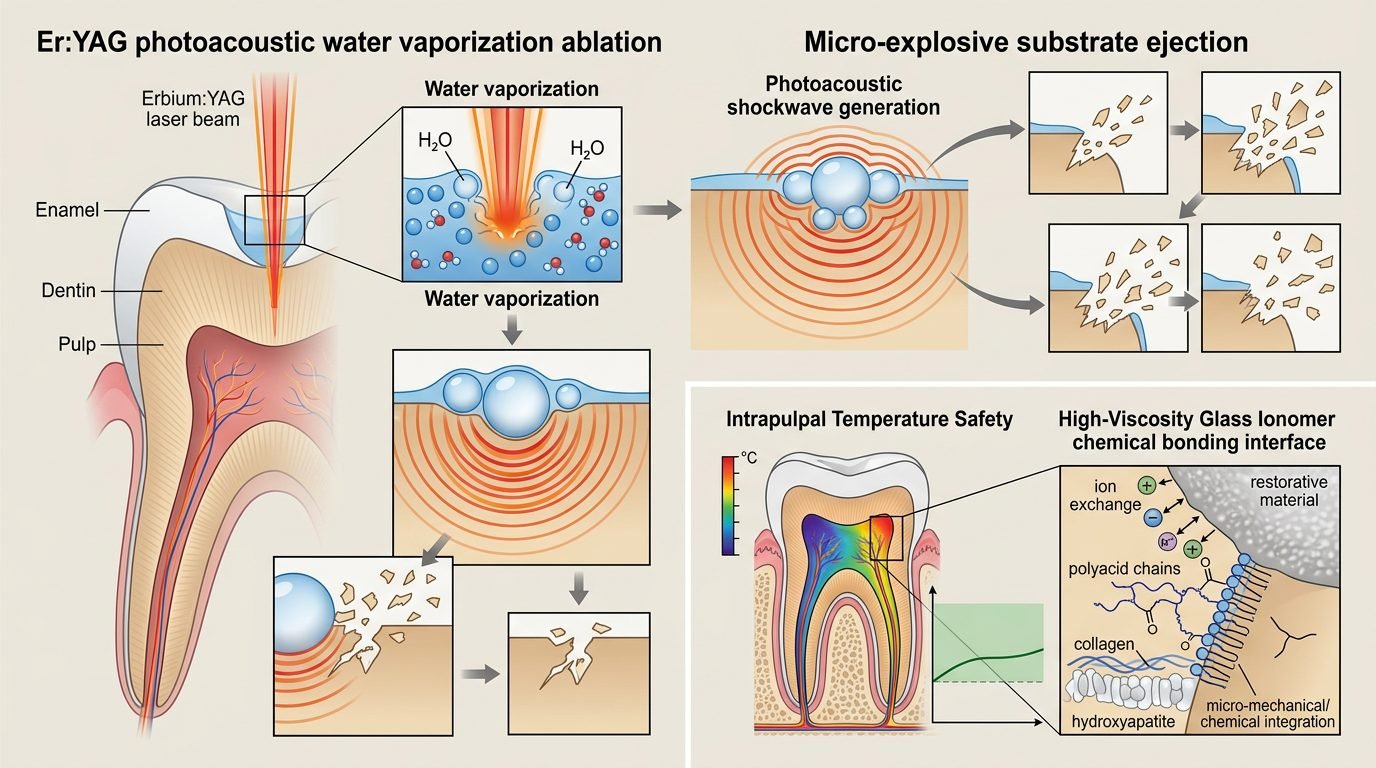
The biophysical mechanism of 2940 nm radiation relies on the coincident peak absorption coefficient of liquid water and hydroxyapatite within the mid-infrared spectrum. At this wavelength, optical energy is absorbed within the initial two to five micrometers of hydrated mineralized tissue. Subsurface interstitial water instantly superheats into steam, expanding in volume by approximately one thousand six hundred times. This massive volumetric expansion produces micro-explosions that fracture and eject calcified crystalline clusters before thermal conduction penetrates adjacent sound tissues. Because active carious dentin contains higher water content and lower mineral density than sclerotic or healthy dentin, Er:YAG radiation selectively ablates infected, decomposed organic substrate while preserving deeper affected dentin that retains remineralization capacity. This selective ablation aligns with contemporary minimally invasive pediatric dentistry principles.
Pulpal safety remains the paramount biological threshold in pediatric laser applications. Zach and Cohen established that an intrapulpal temperature increase of 5.5 degrees Celsius leads to fifteen percent pulpal necrosis in primate models, whereas an increase exceeding 11.1 degrees Celsius causes complete irreversible necrosis in one hundred percent of examined teeth. In primary molars, the residual dentin thickness separating a moderate carious lesion from the coronal pulp horn frequently measures less than one millimeter. Consequently, dry irradiation with an Er:YAG laser causes catastrophic heat accumulation within milliseconds, leading to vascular thrombosis, odontoblastic destruction, and asymptomatic pulpal death. Continuous coaxial water-air spray is non-negotiable. The water irrigant serves a dual role: it replenishes the surface chromophore required for explosive ablation and continuously extracts accumulated thermal energy. Clinicians must maintain a water flow rate between thirty and forty-five milliliters per minute. When operated under calibrated water atomization, intrapulpal temperature elevations during deciduous cavity preparations rarely exceed 2.2 degrees Celsius, well below the established pathological threshold.
Pediatric behavioral outcomes and subjective pain perception reveal consistent clinical advantages. Visual analog scale (VAS) and Wong-Baker Faces Pain Rating Scale evaluations across randomized controlled pediatric trials demonstrate statistically significant reductions in perceived procedural pain during Er:YAG cavity preparations compared to conventional diamond and carbide burs. The reduction in bone-conducted low-frequency vibrations eliminates the somatic discomfort that young patients frequently misinterpret as acute physical pain. Furthermore, the absence of tactile pressure diminishes the sensation of physical intrusion. Clinical studies confirm that between seventy-five and eighty-eight percent of pediatric patients undergoing superficial to moderate Er:YAG caries removal do not require local infiltration or inferior alveolar nerve block anesthesia. Avoiding local anesthetic injections eliminates needle phobia triggers and prevents post-operative soft tissue trauma, such as accidental lip and cheek self-mutilation while numb.
Restorative adhesion to laser-ablated deciduous substrates requires tailored restorative strategies. Er:YAG laser ablation leaves an etched, micro-retentive surface devoid of a conventional rotary smear layer, characterized by patent dentinal tubules and protruding collagen fibril bundles. When restoring primary teeth with high-viscosity glass ionomer cements (GICs) or resin-modified glass ionomers (RMGICs), this laser-conditioned topography influences chemical and micromechanical bonding. Standard conditioning with ten to twenty percent polyacrylic acid remains recommended after laser preparation to remove superficial carbonization micro-debris and expose mineral ions for true ionic chelation. Laboratory microleakage assessments yield nuanced conclusions. Restorations placed in cavities prepared by Er:YAG lasers exhibit cervical margin seal integrity comparable to conventional rotary preparations, provided energy density thresholds do not exceed twenty-five joules per square centimeter. Excessive energy density creates subsurface microcracks and disrupted dentin collagen fibrils, increasing long-term interfacial microleakage and secondary caries risks.
Parameter optimization dictates procedural success. For deciduous enamel margin conditioning and shallow fissural preparations, pulse energies between one hundred and fifty and two hundred millijoules at repetition rates of fifteen to twenty-five hertz (average power 2.2 to 3.5 watts) yield rapid, clean enamel margins. When operating within deep dentinal carious lesions near the pulp horn, pulse energy must be reduced to eighty to one hundred and twenty millijoules at ten to fifteen hertz (average power 0.8 to 1.8 watts), utilizing short pulse durations of one hundred microseconds to minimize thermal transit. Operators must hold the sapphire tip or non-contact handpiece at a working distance of one to two millimeters, maintaining continuous sweeping movements over the carious lesion. Lingering in a static position produces deep micro-craters and localized thermal spikes.
Clinical efficiency in pediatric settings requires realistic operational assessment. Rotary high-speed diamonds clear bulky enamel walls faster than mid-infrared lasers. In an uncooperative, hyperactive toddler, a twenty-second bur preparation might occasionally be preferred by an operator seeking rapid procedural completion. However, the total appointment duration with Er:YAG laser preparation is frequently identical or shorter because the clinician avoids waiting for local anesthetic onset and avoids managing injection-induced distress. The appointment proceeds calmly, building positive behavioral conditioning. Children experience the laser as a high-technology light tool, fostering clinical trust and cooperation for future preventive visits.
Appropriate safety precautions protect both the child and operatory personnel. Protective eyewear calibrated to 2940 nm must be fitted securely to the pediatric patient, using pediatric-sized frames or soft opaque eye shields that prevent accidental displacement. High-volume intraoral evacuation is required to capture the aerosolized plume containing moisture, vaporized dentinal debris, and airborne biological particulates. Water spray reflection on the mouth mirror requires constant gentle air clearing or non-fogging surfaces to maintain direct visual feedback of cavity depth.
Regarding pediatric clinical practice, the Er:YAG laser represents a biologically sound, evidence-supported modality for caries removal and tissue conditioning in primary and young permanent dentition. It does not entirely eliminate the clinical need for rotary burs in extensive crown preparations or rapid bulk reduction. Nevertheless, when applied with rigorous dosimetric discipline, adequate water cooling, and respect for primary pulpal proximity, mid-infrared laser cavity preparation eliminates procedural pain and anxiety. This technology preserves healthy dentin structure, minimizes anesthetic complications, and elevates the quality of humanized pediatric dental care.
Leave a Reply