
Providing oral healthcare to geriatric individuals suffering from progressive neurodegenerative dementias requires fundamentally restructuring conventional clinical workflows. As progressive neurodegenerative conditions such as Alzheimer’s disease, vascular dementia, and Lewy body dementia degrade cortical networks, patients lose the cognitive capacity to interpret complex medical environments. The operatory chair, overhead illumination, acoustic handpiece whine, and intrusive intraoral instrumentation are no longer recognized as benign therapeutic actions. Instead, progressive sensory agnosia and apraxia transform routine dental assessments into perceived physical assaults, provoking intense defensive combativeness, verbal aggression, or catastrophic emotional reactions. Inappropriate clinical responses, such as forceful physical restraint or aggressive chemical sedation, compound psychological agitation and increase cardiovascular morbidity. Humanized geriatric dentistry deploys neurobiologically grounded behavioral techniques, sensory environmental adaptations, and a strong caregiver alliance to deliver dignified, minimally invasive oral maintenance while safeguarding the systemic health of vulnerable older adults.
The Neuropathology of Sensory Agnosia and Apraxia in Dementia
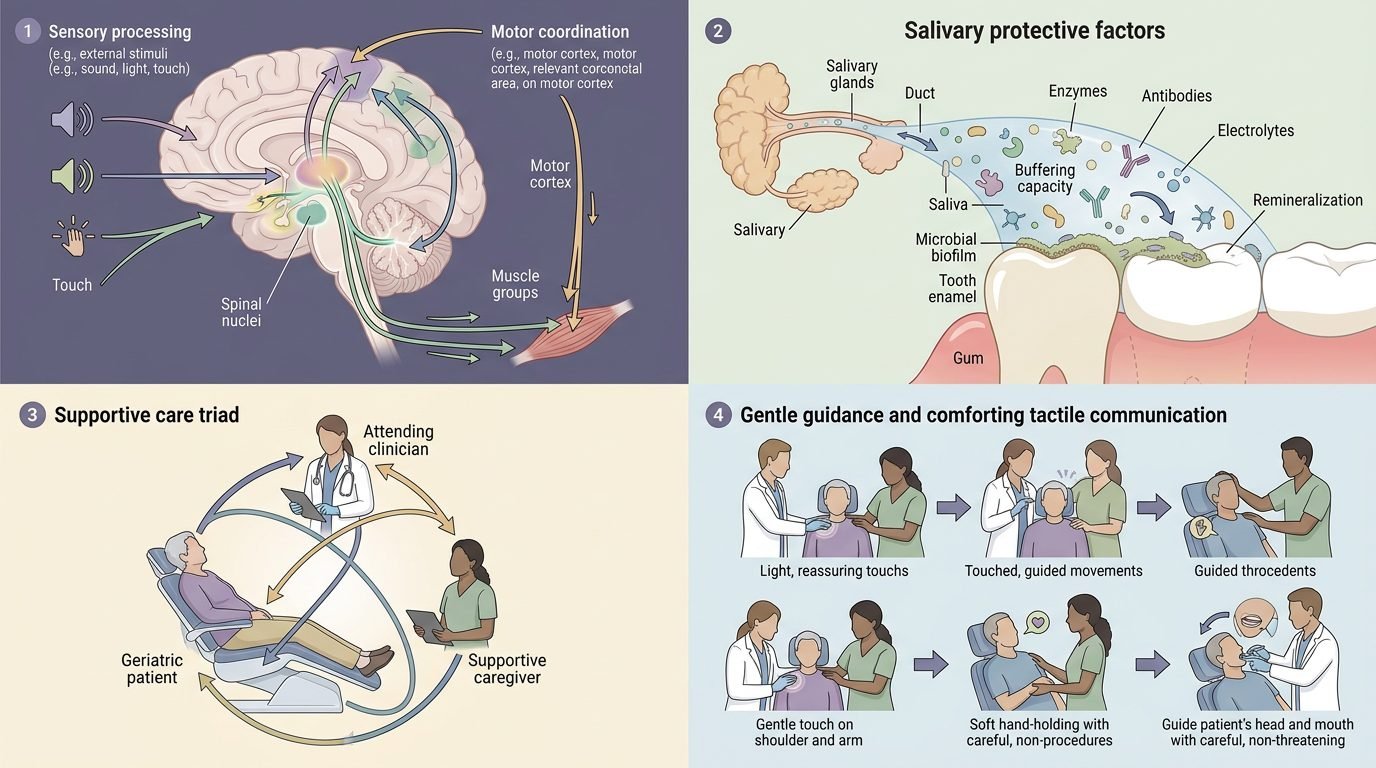
The progression of Alzheimer’s dementia involves progressive neurofibrillary tangle deposition and amyloid-beta plaque accumulation throughout temporoparietal association areas and frontal executive circuits. This structural breakdown produces sensory agnosia: the complete inability of the brain to recognize and interpret incoming sensory stimuli despite intact peripheral sensory organs. When a dentist places a mouth mirror into the oral cavity of an advanced dementia patient, the patient’s damaged parietal cortex cannot identify the metallic object as a diagnostic instrument.
Concurrently, loss of motor planning circuits in the premotor cortex induces ideomotor apraxia. The patient loses the ability to execute learned motor tasks upon verbal command, such as opening the mouth, turning the head, or spitting into a cup. Frustrated commands from clinical staff telling the patient to open wider only heighten confusion and panic. When unfamiliar hands touch the face without warning, primitive subcortical threat circuits in the amygdala fire without prefrontal inhibition, initiating instinctive defensive reflexes including biting down forcefully on instruments, swatting at the clinician’s hands, or screaming in terror.
Oral Pathologies in Cognitive Decline and Systemic Consequences
Cognitive deterioration directly correlates with catastrophic breakdowns in oral homeostasis. As memory loss, apathy, and motor apraxia progress, patients lose the ability to perform basic daily mechanical plaque removal. Concurrently, polypharmacy causes severe xerostomia by suppressing salivary flow, eliminating protective immunoglobulins and bicarbonate buffers.
This xerostomic, plaque-rich oral environment drives rapid development of rampant cervical root caries, advanced periodontal destruction, and aggressive mucosal candidiasis. Broken, sharp coronal remnants cause chronic lingual and buccal ulcerations that the non-verbal patient cannot articulate, manifesting instead as food refusal, acute weight loss, nocturnal agitation, or localized facial clutching. Left unmanaged, subgingival anaerobic biofilms and persistent oral pooling of saliva lead directly to aspiration pneumonia, which represents one of the primary proximate causes of mortality in advanced dementia cohorts.
The Therapeutic Triad: Cultivating the Caregiver Alliance
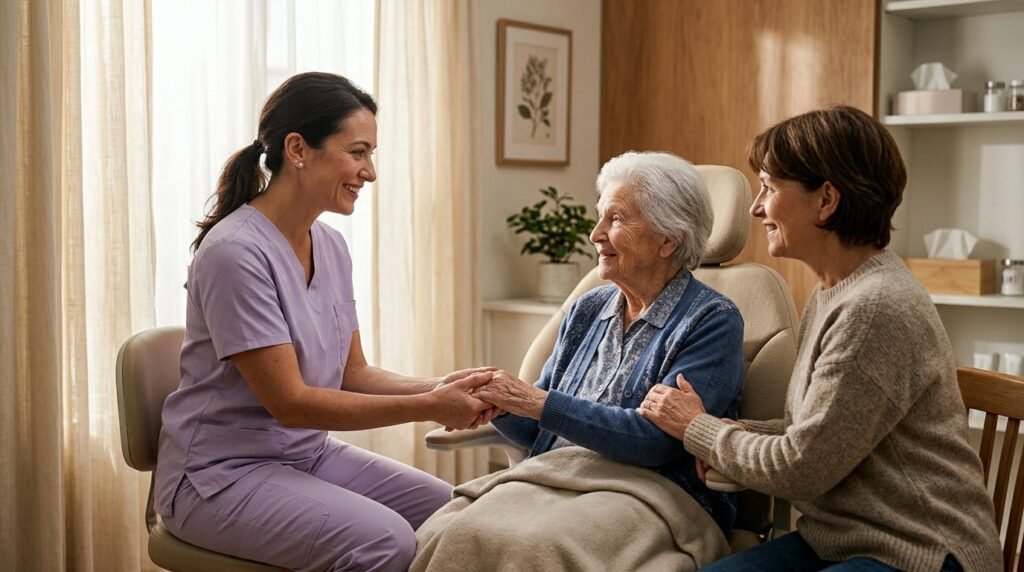
Humanized geriatric care operates through an interdependent therapeutic triad consisting of the patient, the primary caregiver, and the dental clinician. Family members or professional care aides possess irreplaceable knowledge regarding the patient’s individual autobiographical history, specific emotional triggers, non-verbal distress indicators, and established daily routines. Attempting to manage a cognitively impaired older adult in isolation from their trusted caregiver is an invitation to clinical failure.
The primary caregiver should be positioned directly within the patient’s primary field of forward vision throughout the entire clinical encounter. Familiar tactile contact, such as the caregiver holding the patient’s hand or stroking their arm, stimulates cutaneous mechanoreceptors, activating oxytocinergic pathways that down-regulate autonomic sympathetic arousal. Clinicians must actively educate caregivers in specialized home plaque control techniques, demonstrating practical methods for gentle lip retraction and the use of chlorhexidine-impregnated foam swabs or high-fluoride varnishes, thereby bridging clinical care and daily home maintenance.
Behavioral De-Escalation Protocols: Bridging, Chaining, and Hand-over-Hand
Overcoming oral defensiveness demands specialized behavioral bridging and chaining protocols rather than forceful clinical intervention. The bridging technique connects unfamiliar dental actions to familiar, deeply conditioned sensorimotor routines. Because brushing teeth is an ingrained procedural memory stored within robust subcortical basal ganglia circuits, placing a familiar toothbrush into the patient’s hand allows them to initiate natural brushing movements spontaneously. Once this familiar motor loop engages, the clinician gently guides the instrument or diagnostic mirror alongside the brush, bypassing defensive resistance.
Similarly, the hand-over-hand technique honors patient autonomy while facilitating necessary clinical movements. The clinician places their hand gently over the patient’s hand, holding the diagnostic instrument or toothbrush together. This tactile coupling reassures the patient’s sensory system that they retain personal physical agency in the action. Another essential protocol is chaining, where the clinician initiates the first step of an oral action and allows the patient to complete the movement, or vice versa. These non-coercive techniques respect the patient’s remaining neural pathways, preventing the acute panic associated with unexpected bodily intrusion.
Operatory Engineering and Minimally Invasive Biomimetic Care
The clinical environment must be modified to accommodate compromised cognitive processing. Operatory appointments should be scheduled during late morning hours, avoiding both early morning stiffness and the late-afternoon agitation known as sundowning syndrome. The clinical room should remain quiet, eliminating background telephone rings, sudden intercom announcements, or extraneous staff conversation. The operatory chair should remain semi-upright; fully supine positioning induces severe disorientation, vestibular vertigo, and heightened aspiration risks in patients with swallowing dyspraxia.
Treatment goals must shift from aggressive surgical reconstruction to minimally invasive biological stabilization. Silver diamine fluoride (thirty-eight percent) represents an indispensable non-invasive tool, arresting active coronal and root caries lesions instantaneously without requiring local anesthesia, rotary excavation, or prolonged operative chair time. High-viscosity glass ionomer cements can be applied utilizing atraumatic restorative treatment protocols to seal cavitated defects and provide continuous fluoride release. Maintaining a pain-free, functional, and clean dentition preserves chewing efficiency, nutritional status, and human dignity without subjecting the patient to psychological trauma.
Ethical Imperatives in Humane Geriatric Care
Geriatric dentistry in the context of cognitive decline demands the highest standard of ethical maturity and clinical compassion. Practitioners must abandon technical perfectionism in favor of pragmatic, comfort-focused biological management. By viewing combative behaviors as symptoms of neurological distress rather than purposeful defiance, clinicians provide patient, respectful, and dignified care. Ensuring oral health in the final chapters of human life represents an essential expression of medical humanism.
References
- Chalmers, J. M., & Pearson, A. (2005). Oral hygiene care for residents with dementia: a literature review. Journal of Advanced Nursing, 52(4), 410-419.
- Jablonski, R. A., et al. (2011). Intervention to reduce care-resistant behavior during oral hygiene in persons with dementia. Special Care in Dentistry, 31(4), 115-123.
- Marchini, L., et al. (2019). The geriatric dentistry education curriculum: A consensus from the ADEA Geriatric Dentistry Section. Journal of Dental Education, 83(8), 987-995.
- Gao, S. S., et al. (2016). Clinical trials on silver diamine fluoride in arresting caries among children and older adults: a systematic review. JDR Clinical & Translational Research, 1(3), 201-210.
- De Visschere, L., et al. (2015). An oral health care guideline for institutionalised older people. Gerodontology, 33(3), 385-398.
Leave a Reply