
Antimicrobial photodynamic therapy utilizing indocyanine green activated by near-infrared diode lasers overcomes the physical limitations of mechanical root debridement and systemic antibiotic therapy in deep periodontal defects. Mechanical scaling frequently fails to eradicate periopathogens in root concavities and pocket walls. Systemic antibiotics risk allergic events, toxicity, and bacterial resistance. Indocyanine green is an amphiphilic tricarbocyanine dye that binds tenaciously to bacterial cell walls and lipopolysaccharide membranes. When irradiated with an 810 nm diode laser matching its peak absorption band, indocyanine green undergoes dual photodynamic and photothermal reactions. This photonic activation generates singlet oxygen and localized hyperthermia, killing subgingival pathogens without causing root cementum cratering or thermal necrosis in alveolar bone.
Photochemical and Photothermal Physics of Indocyanine Green Activation
Indocyanine green peaks between 790 nm and 810 nm, absorbing near-infrared photons with minimal tissue scattering. At 810 nm, biological tissues display lower scattering and minimal competitive absorption by water, enabling laser energy to penetrate deeper into infected periodontal pocket linings.
Upon absorption of 810 nm photons, the indocyanine green molecule transitions from its ground singlet state to an excited singlet state before undergoing intersystem crossing to a transient triplet state. Energy transfer to ground-state triplet oxygen generates cytotoxic singlet oxygen via Type Two photochemical mechanisms. Concurrently, non-radiative vibrational relaxation dissipates absorbed photonic energy as localized heat via photothermal mechanisms. This combined photodynamic and photothermal interaction produces lethal oxidative stress and localized thermal destabilization of bacterial envelopes at low energy densities between 10 and 20 Joules per square centimeter.
Microbiological Efficacy: Eradicating the Red Complex Biofilm
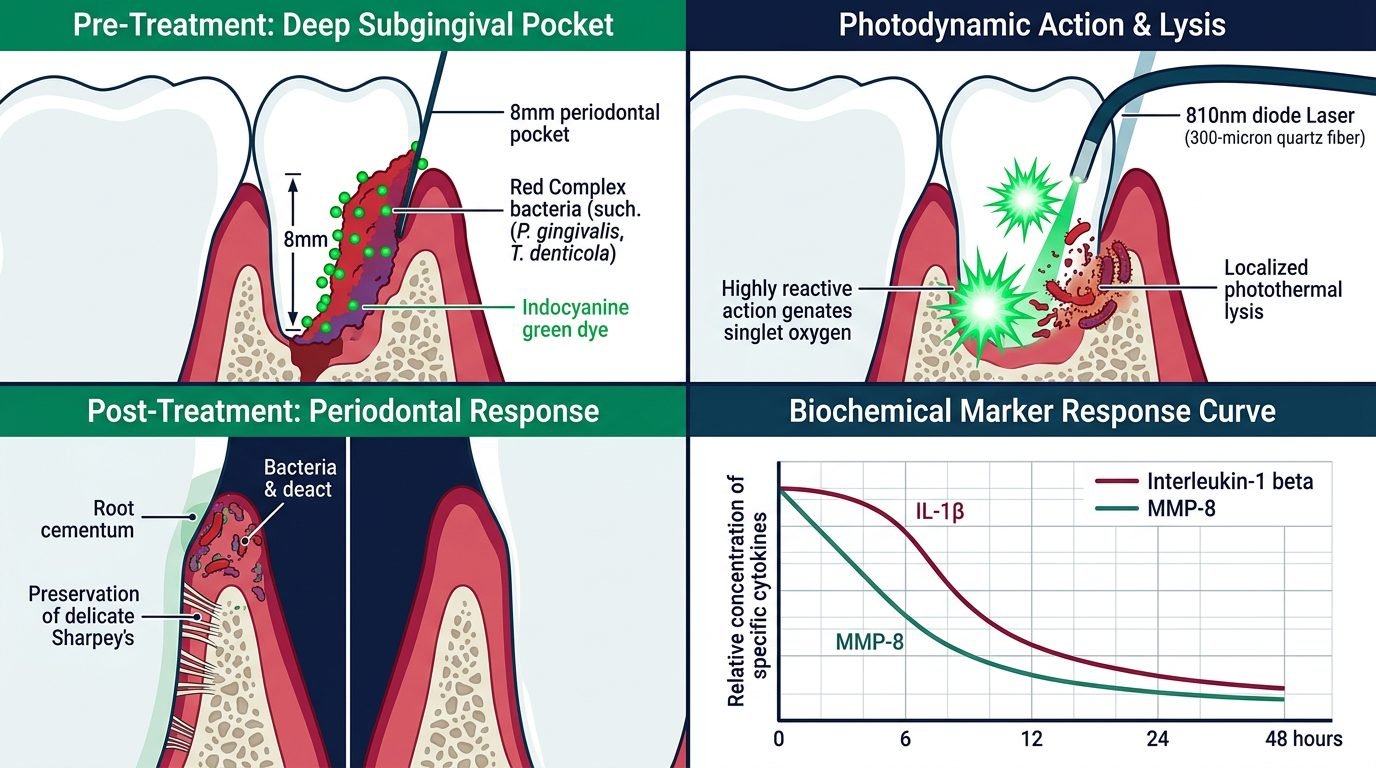
Subgingival microbial communities residing in periodontal pockets exceeding six millimeters organize into dense, resilient biofilm matrices protected by extracellular polymeric substances. The primary etiological drivers of periodontal bone destruction are the Red Complex anaerobes: Porphyromonas gingivalis, Treponema denticola, and Tannerella forsythia. These organisms express virulence factors, including gingipains and collagenases, that degrade host tissues.
Indocyanine green exhibits high binding affinity for outer membrane lipopolysaccharides of Gram-negative bacteria. When 810 nm light is delivered into the pocket, photodynamic action disrupts bacterial cell wall integrity within sixty seconds of exposure. Reactive oxygen species cause peroxidation of membrane lipids, cross-linking of structural proteins, and fragmentation of bacterial genomic DNA. In vitro and clinical microbiological assays reveal a greater than four-log reduction in viable Porphyromonas gingivalis and Aggregatibacter actinomycetemcomitans counts. Furthermore, photodynamic treatment denatures bacterial endotoxins adhering to the root surface, neutralizing lipopolysaccharide-induced inflammatory signaling in adjacent host macrophages.
Cementum Preservation and Comparison with Conventional Scalers
Mechanical debridement with curettes or ultrasonics frequently strips cementum from cervical root surfaces. Over-instrumentation exposes tubules, creating hypersensitivity and hindering fibroblast reattachment.
Indocyanine green photodynamic therapy acts as an atraumatic biological adjunct. Because the 810 nm wavelength is not absorbed by calcium hydroxyapatite or collagen, the photonic energy leaves the mineralized root surface intact. Microscopy demonstrates that root surfaces treated with indocyanine green maintain an intact, smooth cementum layer devoid of grooves or smear debris. Preserving root cementum provides a biocompatible matrix containing native non-collagenous proteins and embedded Sharpey’s fibers, optimizing conditions for connective tissue new attachment rather than long junctional epithelial repair.
Clinical Protocol: Formulation, Incubation, and Fiber Delivery
Achieving predictable clinical outcomes requires standardized dye formulation, adequate pre-irradiation incubation, and disciplined optical delivery. Medical-grade indocyanine green powder must be freshly reconstituted with sterile distilled water or physiological saline immediately before use, as aqueous solutions degrade within hours when exposed to ambient light. The optimal clinical concentration ranges from 0.5 to 1.0 milligrams per milliliter.
Following initial ultrasonic debridement to disrupt supra- and subgingival calculus, the pocket is rinsed and dried gently. Indocyanine green solution is instilled into the base of the pocket using a blunt needle until the dye overflows the gingival margin. An incubation period of sixty to ninety seconds must elapse to permit dye uptake by bacterial membranes throughout the biofilm architecture. Subsequently, a flexible three-hundred-micrometer optical fiber connected to an 810 nm diode laser is inserted to within one millimeter of the pocket base. The laser is operated in continuous wave mode at a power setting of 0.2 to 0.4 watts, yielding an energy density of approximately 15 Joules per square centimeter per site. The operator moves the fiber in slow, continuous circumferential sweeping motions for thirty to forty-five seconds per tooth surface, avoiding static application.
Host-Modulatory Effects and Reduction of Pro-Inflammatory Cytokines
Beyond pathogen elimination, photodynamic therapy delivers anti-inflammatory benefits by suppressing the host osteoclastogenic cascade. Gingival crevicular fluid samples harvested from treated sites demonstrate significant reductions in interleukin-1 beta, tumor necrosis factor-alpha, and matrix metalloproteinase-8 levels within forty-eight hours.
Concurrently, photobiomodulation effects from transmitted 810 nm photons stimulate mitochondrial cytochrome c oxidase in periodontal ligament stem cells, promoting alkaline phosphatase activity and osteoblast differentiation. By shifting the local microenvironment from an osteolytic inflammatory state toward tissue regeneration, photodynamic therapy promotes clinical attachment gain and reduces bleeding on probing more effectively than mechanical debridement alone.
Comparative Long-Term Clinical Evidence and Pocket Depth Reduction
Randomized controlled clinical trials evaluating indocyanine green photodynamic therapy in chronic and aggressive periodontitis show clear therapeutic advantages. In pockets measuring six millimeters or greater, combining scaling and root planing with indocyanine green photo-decontamination achieves an additional 0.8 to 1.2 millimeters of probing depth reduction compared to mechanical instrumentation alone at six months of follow-up.
Furthermore, clinical attachment gains average 1.0 millimeter higher in laser-treated quadrants, alongside marked reductions in sites exhibiting persistent bleeding on probing. In furcation defects and refractory periodontal lesions where mechanical instrumentation is hindered by complex root anatomy, indocyanine green photodynamic therapy serves as an effective non-surgical intervention. The absence of bacterial resistance allows clinicians to repeat the protocol at supportive visits.
Practical Synthesis for the Periodontal Team
Antimicrobial photodynamic therapy with indocyanine green is an evidence-based biological modality that bridges the gap between mechanical root debridement and regenerative healing. By pairing a near-infrared wavelength with an amphiphilic bacterial photosensitizer, the dental clinician eradicates deep biofilms, neutralizes cytotoxic endotoxins, and preserves precious root cementum. Photodynamic dosimetry transforms refractory management into a precise, conservative discipline.
References
- Boehm, T. K., & Ciancio, S. G. (2011). Diode laser activated indocyanine green as an adjunct to scaling and root planing for the treatment of chronic periodontitis: a randomized clinical trial. Journal of Periodontology, 82(4), 513-522.
- Meire, M. A., et al. (2012). Evaluation of the antimicrobial efficacy of indocyanine green photodynamic therapy against Enterococcus faecalis biofilms. Lasers in Medical Science, 27(6), 1139-1145.
- Raut, C. P., & Sethi, K. S. (2016). Comparative evaluation of antimicrobial photodynamic therapy with indocyanine green and scaling and root planing in chronic periodontitis. Journal of Indian Society of Periodontology, 20(5), 519-524.
- Sgolastra, F., et al. (2013). Adjunctive photodynamic therapy to non-surgical treatment of periodontitis: a systematic review and meta-analysis. Journal of Clinical Periodontology, 40(5), 514-526.
- Topaloglu, N., et al. (2013). Antimicrobial photodynamic therapy of oral pathogens using indocyanine green and 809 nm diode laser. Photomedicine and Laser Surgery, 31(7), 323-329.
Leave a Reply