
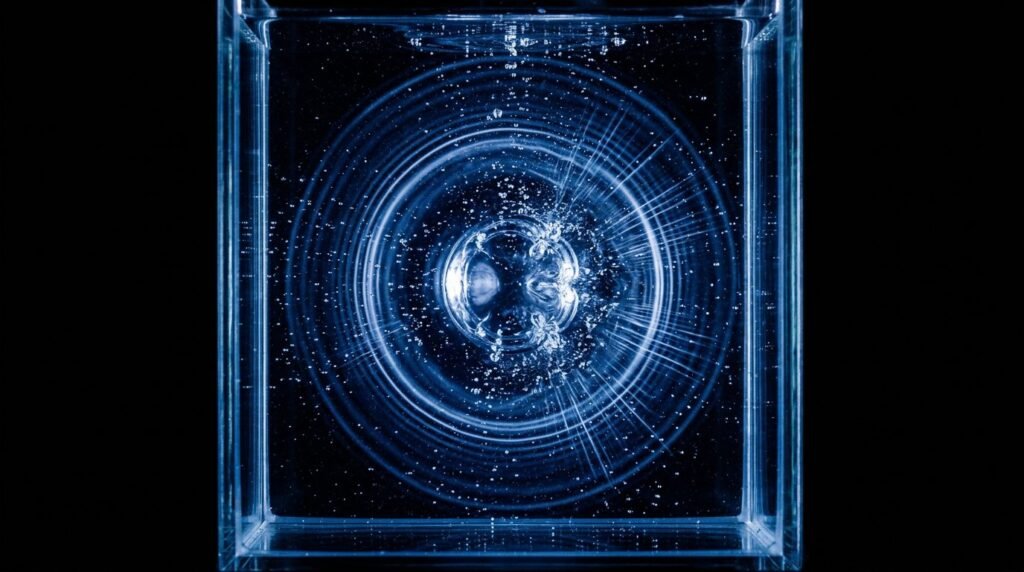
Laser-activated irrigation transforms endodontic debridement by utilizing photoacoustic shockwaves to cleanse anatomical complexities that mechanical instrumentation cannot reach. The root canal system possesses intricate lateral branches, transverse isthmuses, apical deltas, and billions of dentinal tubules. Conventional syringe irrigation delivers antimicrobial irrigants only one to two millimeters beyond the needle tip, relying on stagnant fluid exchange and surface tension that trap gas bubbles at the apical third. Even passive ultrasonic irrigation struggles to circulate solutions into deep anastomoses without dampening against curved canal walls. Photon-induced photoacoustic streaming (PIPS) and shock wave enhanced emission photoacoustic streaming (SWEEPS) deploy sub-ablative erbium laser pulses within the coronal pulp chamber. These pulses generate vapor cavitation bubbles, acoustic streaming, and turbulent shear stresses that sterilize root canal anatomy without apical irrigant extrusion.
Physics of Photoacoustic Streaming: Cavitation and Shockwave Dynamics
Laser-activated irrigation relies on erbium laser wavelengths, specifically Er:YAG at 2,940 nm and Er,Cr:YSGG at 2,780 nm. Both wavelengths coincide with high optical absorption peaks in water and aqueous endodontic solutions. When an ultra-short laser pulse delivers energy into an aqueous irrigant, optical absorption occurs within a microscopic layer measuring mere micrometers. This concentrated energy absorption causes rapid superheating of the fluid above its boiling point, forming a microscopic vapor bubble at the optical fiber tip.
The vapor bubble expands rapidly into the surrounding canal volume, displacing irrigant outward. As the laser pulse terminates, the thermal energy dissipates into the cooler ambient liquid, causing the vapor bubble to implode under hydrostatic pressure. This collapse generates powerful secondary cavitation cycles and emits localized acoustic shockwaves. The resulting fluid turbulence propels irrigants three-dimensionally throughout the canal system. High shear stresses rip bacterial biofilms from dentinal surfaces, shear off extracellular polymeric substance matrices, and force chemical irrigants hundreds of micrometers deep into dentinal tubules.
Evolution from Conventional LAI to PIPS and SWEEPS Protocols
Early laser-activated irrigation techniques required clinicians to insert thin optical quartz fibers deep into the apical third of root canals. This practice carried significant clinical risks. Deep fiber placement frequently resulted in canal wall gouging, thermal ledge formation, or forced irrigant extrusion through open apical foramina into periapical tissues. The development of PIPS revolutionized this approach by altering laser tip geometry and pulse duration.
PIPS utilizes a specialized tapered, stripped quartz tip measuring 600 micrometers in diameter, positioned exclusively in the coronal pulp chamber. The laser delivers sub-ablative pulses with durations of fifty microseconds at low energy levels (10 to 20 mJ) and low repetition rates (10 to 15 Hz). Because the tip remains stationary in the pulp chamber flooded with irrigant, photonic energy propagates through the fluid column as acoustic pressure waves. Intricate intracanal anatomy is debrided entirely by hydraulic kinetic energy, preserving apical dentin integrity and eliminating thermal risks.
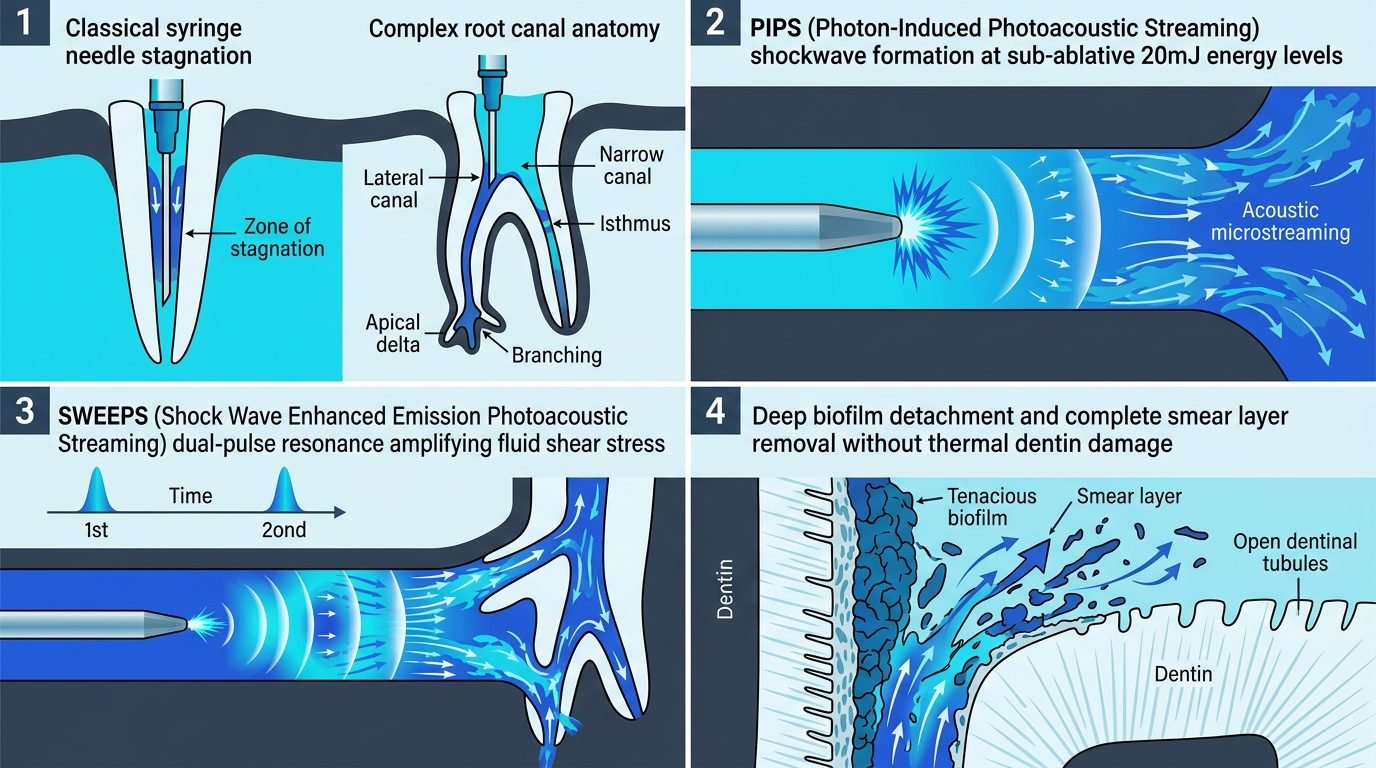
SWEEPS represents the subsequent technological evolution, utilizing dual-pulse technology. The laser delivers a primary pulse that creates an initial vapor bubble, followed immediately by a secondary pulse timed precisely as the first bubble begins its collapse. The expansion of the second bubble accelerates the collapse of the primary bubble, generating amplified acoustic shockwaves and chaotic fluid turbulence. This synchronized resonance delivers unmatched hydraulic cleaning velocities across complex canal networks.
Biofilm Disruption and Microbial Elimination
Root canal reinfection and persistent periapical lesions stem primarily from resilient intracanal biofilms dominated by Enterococcus faecalis and Candida albicans. These microorganisms penetrate deeply into dentinal tubules, where they enter starvation states and resist conventional sodium hypochlorite disinfection. The smear layer produced during mechanical nickel-titanium instrumentation forms a protective barrier, packing collagen debris and bacteria into tubule orifices.
Acoustic streaming generated by PIPS and SWEEPS dismantles this microbial defense system. The acoustic shockwaves shatter the inorganic smear layer within twenty seconds, exposing patent tubule lumens. Simultaneously, the violent micro-implosions rupture bacterial cell membranes through mechanical shear force rather than relying exclusively on chemical oxidation. Confocal laser scanning microscopy demonstrates that laser-activated irrigation delivers sodium hypochlorite into dentinal tubules to depths exceeding one thousand micrometers, achieving complete microbial eradication where passive needle irrigation leaves over eighty percent of bacterial cells viable.
Clinical Protocol: Irrigant Selection, Volume, and Exposure Sequencing
Achieving predictable clinical results requires strict adherence to standardized chemical sequences and fluid volume maintenance. The pulp chamber must remain continuously flooded with irrigant throughout activation to prevent dry firing, fiber damage, or thermal elevation.
The protocol begins following completion of mechanical shaping to a minimal apical size (ISO 20 or 25). The pulp chamber is flooded with 2.5 to 5.0 percent sodium hypochlorite (NaOCl). The PIPS or SWEEPS tip is submerged into the coronal reservoir, and laser activation is executed in three cycles of twenty seconds each, with fresh NaOCl replenished between cycles. This step dissolves pulp tissue remnants and disintegrates organic biofilm components. Next, the canal system is thoroughly flushed with distilled water to avoid chemical precipitation, followed by flooding with 17 percent ethylenediaminetetraacetic acid (EDTA). The laser is activated for thirty seconds with EDTA to strip away inorganic smear layers and open dentinal tubules. Finally, a concluding twenty-second activation with fresh NaOCl delivers deep antimicrobial disinfection into opened tubules, followed by a final sterile water rinse prior to obturation.
Apical Extrusion Safety and Hydrodynamic Dissipation
In conventional syringe irrigation, positive pressure forced through apical needles creates direct hydraulic jetting through the apical foramen.
Laser-activated irrigation operates via negative apical pressure dynamics when executed properly. Because the laser tip is maintained in the coronal access, acoustic pressure waves travel down the canal walls and reflect back toward the coronally vented access opening. Fluid dynamics evaluations utilizing high-speed shadowgraph imaging confirm that laser cavitation does not generate positive fluid displacement beyond the apical constricture. Instead, irrigant solutions circulate dynamically down the canal walls and exit via coronal reflux. This hydrodynamic dissipation renders PIPS and SWEEPS significantly safer than conventional positive-pressure needle irrigation, even in teeth with resorbed apices or open immature apices.
Clinical Synthesis for Advanced Endodontic Practice
Laser-activated irrigation redefines endodontic disinfection by replacing passive chemical soaking with active photoacoustic bio-cleansing. PIPS and SWEEPS unlock the ability to decontaminate microscopic anatomical recesses that instruments cannot touch, removing resilient microbial biofilms while preserving root structure and guaranteeing apical safety. Incorporating photoacoustic protocols empowers clinicians to achieve predictable apical healing, resolve persistent periapical lesions, and elevate long-term tooth preservation rates.
References
- DiVito, E., et al. (2012). Effectiveness of the erbium:YAG laser and new design radial and stripped tips in removing the smear layer after root canal instrumentation. Lasers in Medical Science, 27(2), 273-280.
- Lukac, N., et al. (2020). Acceleration of fluid motion in endodontic canals by dual-pulse Er:YAG laser activation (SWEEPS). Lasers in Medical Science, 35(4), 825-833.
- Peters, O. A., et al. (2011). Disinfection of root canals with photon-initiated photoacoustic streaming. Journal of Endodontics, 37(7), 1008-1012.
- Verhaagen, B., et al. (2014). Radially emitting laser tips for endodontic irrigation: an acoustic, optical, and high-speed imaging analysis. Journal of Endodontics, 40(7), 967-972.
- Zhu, X., et al. (2013). Comparison of antimicrobial efficacy of photon-induced photoacoustic streaming and sonic activation in root canal models. Photomedicine and Laser Surgery, 31(9), 451-456.
Leave a Reply