

Orthodontic treatment fatigue in adolescents triggers clinical compliance breakdown when practitioners rely on punitive scolding and parental coercion rather than addressing biological and psychological exhaustion. Prolonged comprehensive orthodontic treatment lasting longer than twenty-four months places heavy physiological and emotional burdens upon developing adolescent nervous systems. Chronic mucosal friction, continuous mechanical force delivery, plaque accumulation, and dietary restrictions generate persistent sensory annoyance. When adolescents stop wearing intermaxillary elastics, break brackets repeatedly, or neglect oral hygiene, orthodontists frequently deliver moralizing reprimands in front of parents. This authoritarian approach is counterproductive. It provokes passive-aggressive defiance, deepens treatment disengagement, and risks severe iatrogenic complications, including rampant white spot enamel demineralization and apical root resorption. Humanized orthodontics approaches compliance failure through developmental psychology, sensory adaptation, and therapeutic recontracting that treats the adolescent as an autonomous clinical partner.
Neurodevelopmental Realities: Executive Function and the Adolescent Limbic System
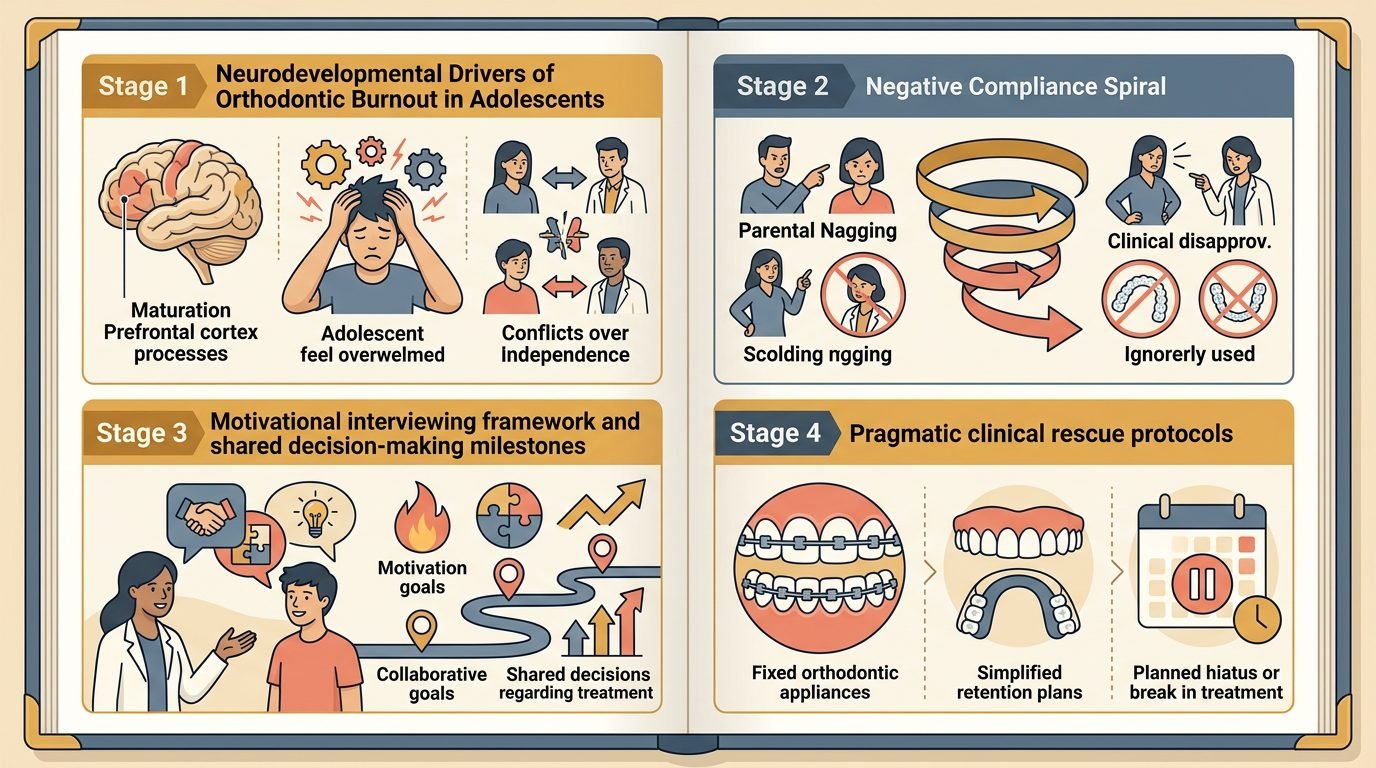
Adolescence is defined by structural neurodevelopmental remodeling characterized by asynchronous maturation between limbic emotion centers and the prefrontal cortex. The ventral striatum and basolateral amygdala, which drive reward sensitivity and peer orientation, mature years ahead of prefrontal cortical networks responsible for executive function, impulse control, and long-term future planning.
Expecting an adolescent to maintain meticulous daily elastomeric wear and complex interdental cleaning for two years requires mature prefrontal executive capacity that biological brains have not fully consolidated. Distant future clinical rewards, such as achieving an ideal Class One occlusion or stable posterior intercuspation, hold minimal neurochemical salience for an adolescent brain wired for immediate peer approval. Conversely, immediate peer scrutiny regarding visible oral appliances, speech alterations, or food impaction carries acute social anxiety. When orthodontists demand compliance without understanding these limbic drivers, treatment becomes an adversarial struggle rather than a therapeutic alliance.
Sensory Overload, Chronic Discomfort, and Mechanical Fatigue
Fixed orthodontic appliances constitute a persistent source of low-grade nociceptive and tactile sensory stimulation. Compressive stresses within the periodontal ligament trigger inflammatory cascades involving prostaglandin E2, substance P, and calcitonin gene-related peptide. This chemical soup sensitizes trigeminal primary afferent neurons, generating persistent masticatory tenderness.
Concurrently, metal brackets, archwires, and crimpable hooks rub continuously against non-keratinized labial and buccal mucosa. The mechanical irritation produces recurrent aphthous-like traumatic ulcerations, fibrous tissue proliferation, and sensory fatigue. Constant appliance contact demands continuous cognitive adaptation. As months turn into years, the patient’s sensory gating mechanisms become exhausted. Behavioral non-compliance, such as spitting out elastics or manipulating archwires with fingers, functions as an unconscious somatic effort to reduce sensory overload.
Adolescent brain circuitry remains exceptionally plastic, responding with heightened reactivity to perceived loss of social status. Peer validation and fear of peer ostracism dictate daily choices far more powerfully than abstract oral hygiene reminders. Clinical success requires honoring this neurodevelopmental phase rather than fighting against it.
The Pitfalls of Tripartite Triangulation and Punitive Communication
The standard clinical dynamic in adolescent orthodontics involves a triangular relationship between the clinician, the adolescent patient, and the paying parent. When progress stalls due to poor elastic wear, clinicians routinely align with the parent, delivering joint lectures on the financial investment and personal ingratitude of the adolescent.
This dynamic ruptures clinical rapport. The adolescent perceives the clinical environment as hostile and shaming. In response, adolescents exhibit psychological reactance, asserting personal autonomy through covert non-compliance. They report wearing elastics twenty-four hours daily while leaving them in school lockers, or deliberately break brackets to delay appointments. Lectures on gingival bleeding and plaque accumulation induce shame rather than motivation. To restore therapeutic efficacy, the clinician must step away from parental enmeshment and re-establish direct, confidential clinical dialogue with the adolescent.
Clinical Recontracting: Therapeutic Reset and Goal Realignment
When chronic treatment stagnation occurs, the clinical team must declare a formal pause and initiate clinical recontracting. Continuing active mechanics while scolding the patient leads to root resorption and enamel scarring without improving tooth position.
The recontracting protocol begins with an honest, non-judgmental private conversation without the parent present. The clinician validates treatment fatigue: “Orthodontic treatment is exhausting, and wearing brackets for over two years is difficult. We need to reset our plan together.” The clinician and patient review photographic and radiographic progress, celebrating what has been achieved while identifying remaining functional goals. The patient is offered genuine choices: modifying mechanics to simplify daily routines, taking a three-month mechanical rest with passive archwires, or transitioning to clear aligners. By returning agency to the patient, the clinician transforms passive compliance into active co-management.
Mechanical Adaptations: Simplifying Force Systems and Minimizing Vulnerability
Recontracting requires practical modifications to clinical mechanics to decrease patient burden. Complex elastomeric configurations requiring multiple daily changes, such as triangular or box elastics, should be replaced with simpler force delivery systems. Employing nickel-titanium closed-coil springs or fixed intermaxillary spring appliances eliminates reliance on patient memory for sagittal correction.
If white spot decalcifications appear around bracket bases, the clinician must prioritize enamel survival over micro-aesthetic alignment. Heavy multibracket systems can be partially debonded in posterior segments, or treatment can be transitioned to thermoplastic aligners that facilitate thorough toothbrushing. Applying high-fluoride varnishes and amorphous calcium phosphate remineralizing agents protects weakened enamel margins. When root resorption reaches critical thresholds, terminating active treatment early and settling for a functional, stable compromise represents sound biological judgment.
Motivational Interviewing and Micro-Goal Structuring
Behavioral modification in adolescents succeeds when grounded in motivational interviewing principles. Rather than asking closed, accusatory questions like “Are you wearing your rubber bands?”, clinicians use open-ended inquiries: “What parts of wearing elastics are hardest during your school day?”
The dental team collaborates with the patient to establish short, achievable micro-goals across four-week intervals. Instead of focusing on vague future completion dates, the agreement focuses on immediate targets: “Let us try wearing elastics only during sleep and home study hours for the next month, and evaluate joint comfort.” Smartphone reminder applications and visual tracking calendars integrate compliance into adolescent digital routines. Positive reinforcement must be specific and immediate, acknowledging effort rather than perfection.
Clinical Synthesis for the Contemporary Orthodontic Team
Orthodontic burnout in adolescents is not a behavioral defect; it is a predictable neurodevelopmental and sensory response to prolonged biomechanical intervention. Forcing compliance through guilt and parental pressure damages psychological trust and endangers oral tissues. By understanding adolescent brain maturation, simplifying mechanical systems, and negotiating respectful therapeutic alliances, the orthodontic team protects enamel, prevents root resorption, and guides young patients toward healthy smiles and positive healthcare relationships.
References
- Nanda, R., & Kierl, M. J. (1992). Prediction of cooperation in orthodontic treatment. Seminars in Orthodontics, 12(2), 125-134.
- Bos, A., et al. (2005). Patient compliance in orthodontics: a review of the literature. European Journal of Orthodontics, 27(6), 569-575.
- Mehra, T., et al. (1998). Predictors of compliance with orthodontic treatment. Seminars in Orthodontics, 4(1), 39-44.
- Albino, J. E., et al. (1991). Psychological and social factors in adolescent orthodontic treatment. Seminars in Orthodontics, 10(4), 252-258.
- Casey, B. J., et al. (2008). The adolescent brain. Annals of the New York Academy of Sciences, 1124(1), 111-126.
Leave a Reply