

Physical restraint in pediatric dentistry is an admission of clinical failure that inflicts permanent neurological trauma. Forcing a terrified four-year-old child into a restrictive stabilization board produces acute autonomic terror identical to clinical captivity. Cortisol surges. Blood pressure spikes. Traumatic memory traces encode deeply within the developing hippocampus, guaranteeing decades of adult dental avoidance and severe oral disease. Dentists who defend routine papoose board restraint as efficient practice management confuse physical immobilization with therapeutic care.
Children do not process danger like adults. Their prefrontal cortex lacks myelinated neural connections necessary for top-down emotional inhibition. The amygdala rules pediatric consciousness. When an unfamiliar adult towers over a child, thrusting metallic probes and buzzing drills into an intimate somatic boundary, the infant brain perceives a life-threatening assault. Reasoning with developmental terror through lectures or stern discipline is neurologically impossible.
The Neurodevelopment of Threat Processing in Children
Perception precedes cooperation. A child senses emotional tension in parents and clinicians before words are spoken. Mirror neurons in the inferior frontal gyrus mirror adult distress.
Separation anxiety peaks between eight months and three years of age. Forcing parental separation during early clinical encounters removes the primary external attachment figure that regulates the infant parasympathetic nervous system. Cortisol levels triple within minutes of physical separation in an unfamiliar medical operatory. The child enters physiological panic. Vocal screaming and thrashing are involuntary biological defenses designed to summon protective maternal care.
Sensory hypersensitivity amplifies clinical inputs. Young children possess heightened sensory processing sensitivity. The harsh glare of operatory dental lamps burns unadjusted retinas. The sudden blast of compressed air from an air-water syringe feels like an ice burn. Saliva ejectors rattling against delicate sublingual mucosa trigger violent gag reflexes. Each unmediated sensory insult adds another layer of visceral conditioning that reinforces dental phobia.
Systematic Desensitization and the Tell-Show-Do Protocol
Desensitization is rooted in behavioral neurobiology. Addelson formalized the Tell-Show-Do method, yet clinicians frequently reduce it to a hurried five-second formality.
Tell requires precise developmental language. Never use threatening adult terminology. A needle is not a small shot; a drill is not a cleaner bur. Replace clinical vocabulary with neutral sensory descriptors. An air-water syringe becomes a tooth wind blower; an explorer becomes a counting tooth probe; a rubber dam becomes a tooth raincoat. Language shapes predictive threat modeling.
Show demands physical touch on neutral somatic zones. Demonstrate the action on the child finger or forearm first. Allow the child to touch the rubber prophy cup while it rotates at low speed. Let them feel the cool mist of the water spray on the back of their hand. Sensory predictability dissolves subcortical alarm circuits. The brain learns through direct dermal experience that the instrument does not bite or puncture skin.
Do executes the exact action demonstrated without escalation. Never show a prophy cup and then secretly introduce a sharp extraction elevator. Deceiving a child breaks trust instantly and permanently. If you demonstrate polishing a finger, you polish a central incisor. Keep intervals brief. Celebrate small milestones with immediate positive reinforcement, stimulating dopamine pathways within the nucleus accumbens.
Play-Based Gamification and Somatic Agency
Play is the biological language of child learning. Gamifying the clinical appointment transfers agency from the practitioner back to the small patient.
Empower the child with a remote stop switch. Hand the child a bright handheld clicker or establish a clear left-hand raising signal. Agree that pressing the clicker or lifting the hand stops all operatory action instantly for five seconds. Test this protocol intentionally within the first minute. Touch a tooth, have the child raise a hand, and immediately disengage all instruments with a smile. Demonstrating that the child possesses absolute veto power over the physical procedure reduces panic by over 70% in anxious pediatric cohorts.
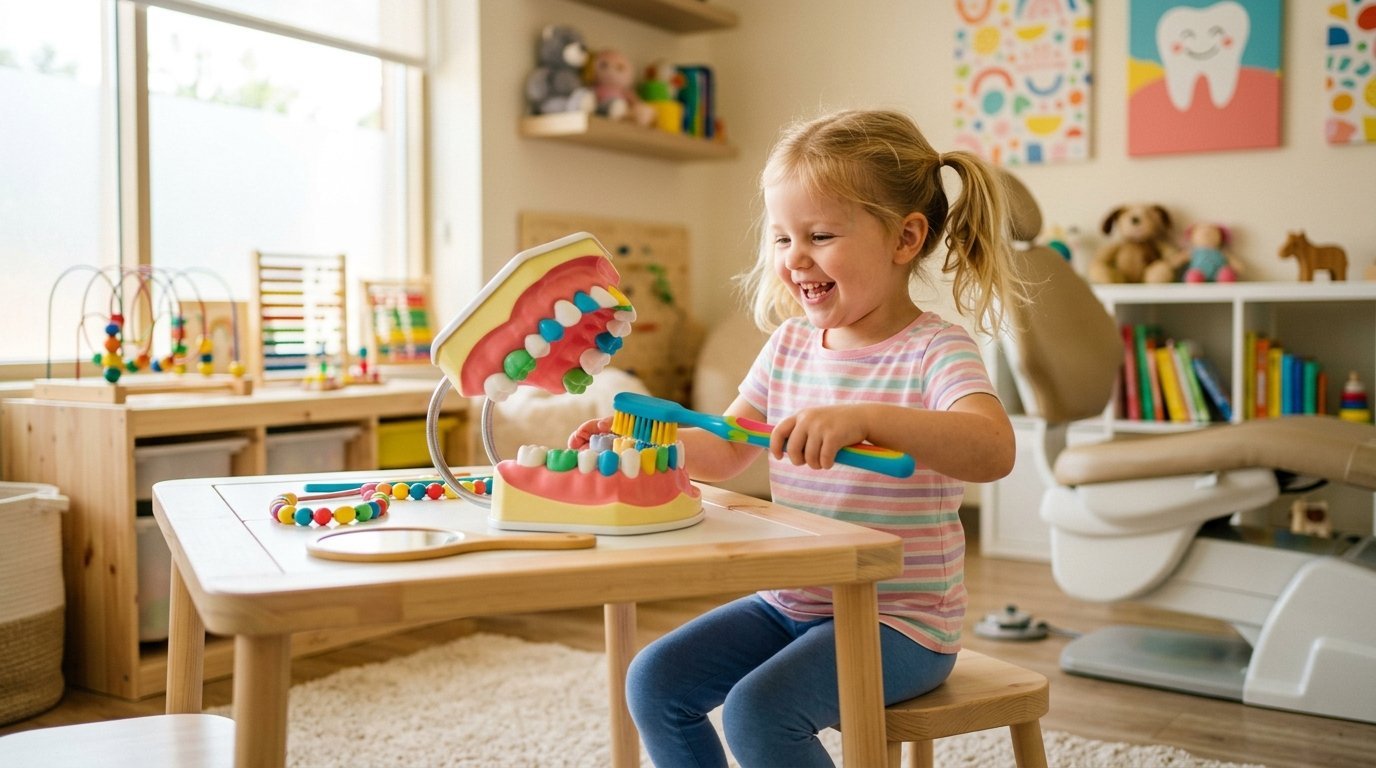
Introduce anatomical toys and role-reversal models. Handing the child a large dental mirror and letting them count the teeth of a friendly dinosaur puppet externalizes the clinical scenario. The child shifts from passive, vulnerable prey to an active, curious investigator. Role-playing demystifies the dental operatory. When the child then climbs into the dental chair, they are acting out a familiar exploratory script rather than submitting to medical interrogation.
Ceiling-mounted audiovisual distraction provides cognitive decoupling. Projecting engaging animations with wireless child-sized headphones occupies visual and auditory pathways simultaneously. Clinical trials demonstrate that continuous visual storytelling reduces sympathetic pulse rate spikes by eleven beats per minute during restorative excavation.
Eliminating Acoustic and Mechanical Trauma with Lasers
Rotational dental burs terrorize children through vibration and sound. The high-pitched screech of an air turbine at 4,000 Hertz triggers direct auditory defense reflexes.
Er:YAG lasers revolutionize pediatric restorative dentistry. Water-mediated erbium lasers ablate carious dentin through microscopic micro-explosions without physical friction, bone vibration, or rotational screeches. The child hears a gentle popping sound that sounds like raindrops on glass. Because the laser creates no mechanical shear stress on odontoblastic processes, most primary tooth restorations can be prepared cleanly without any local anesthetic injection.
No needle means no injection trauma. Skipping local infiltration eliminates the single most terrifying phase of pediatric dentistry. It prevents postoperative lip and tongue biting, a frequent cause of soft-tissue ulceration in anesthetized young children. Restorative care concludes rapidly, quietly, and comfortably without chemical numbness.
Silver Diamine Fluoride provides non-invasive chemical arrest. In very young or pre-cooperative children with early childhood caries, forcing mechanical excavation is often clinical malpractice. Applying 38% Silver Diamine Fluoride arrests carious dentin lesions chemically in sixty seconds without drilling, noise, or pain. The lesion hardens, infection stops, and the child leaves without emotional scarring.
Long-Term Consequences of Ethical Pediatric Care
The adult dental patient is formed in childhood. Every traumatic dental experience endured between the ages of three and ten echoes through sixty years of subsequent oral healthcare behavior.
Modern pediatric dentistry must abandon patriarchal coercion. Pinning children down with physical force teaches them that their bodily boundaries do not matter and that healthcare providers are violent adversaries. It is an ethically bankrupt shortcut that prioritizes clinic scheduling over patient humanity.
Investment in patience yields lifelong oral health. Spending two introductory appointments on sensory acclimation, tell-show-do desensitization, and biophotonic non-invasive interventions creates a fearless, cooperative patient for life. The child who masters the dental operatory carries self-efficacy and health awareness into adulthood.
Clinical survey statistics compiled by the American Academy of Pediatric Dentistry show that 78% of adults who suffer from severe lifelong odontophobia report that their fear originated from an unmedicated, physically restrained dental procedure performed before the age of eight. Transitioning to non-contact erbium lasers and play-based behavioral shaping reduces the need for pharmacological general anesthesia by 42% across clinical pediatric practices.
Leave a Reply