

Verbal framing and environmental cues in dental operatories exert quantifiable neurochemical modulations on patient pain perception prior to any pharmacological intervention. The human brain does not process nociceptive signals as passive sensory telemetry; instead, descending corticolimbic circuits actively filter incoming peripheral action potentials based on cognitive expectation, conditioned learning, and contextual cues. Placebo analgesia represents an active endogenous opioid mechanism capable of suppressing dorsal horn transmission. Conversely, the nocebo phenomenon provokes real, measurable hyperalgesia mediated by anxiety-driven cholecystokinin release. Routine clinical warnings such as announcing a sharp pinch or warning that an injection will sting inadvertently prime subcortical threat networks, converting neutral sensory stimuli into pronounced painful experiences. Humanized dental practice leverages affective neuroscience to systematically minimize nocebo induction while optimizing therapeutic alliance to activate endogenous analgesic cascades.
The Corticolimbic Architecture of Expectation and Nociception
Nociceptive transmission from trigeminal sensory afferents enters the brainstem through the spinal trigeminal nucleus before projecting upward to the thalamus, somatosensory cortex, insular cortex, and anterior cingulate cortex. While primary somatosensory areas map spatial localization and stimulus intensity, affective-evaluative structures dictate the subjective suffering associated with tissue trauma. The dorsolateral prefrontal cortex acts as the master coordinator of cognitive expectation, projecting dense excitatory connections to the rostral anterior cingulate cortex and the periaqueductal gray matter in the midbrain.
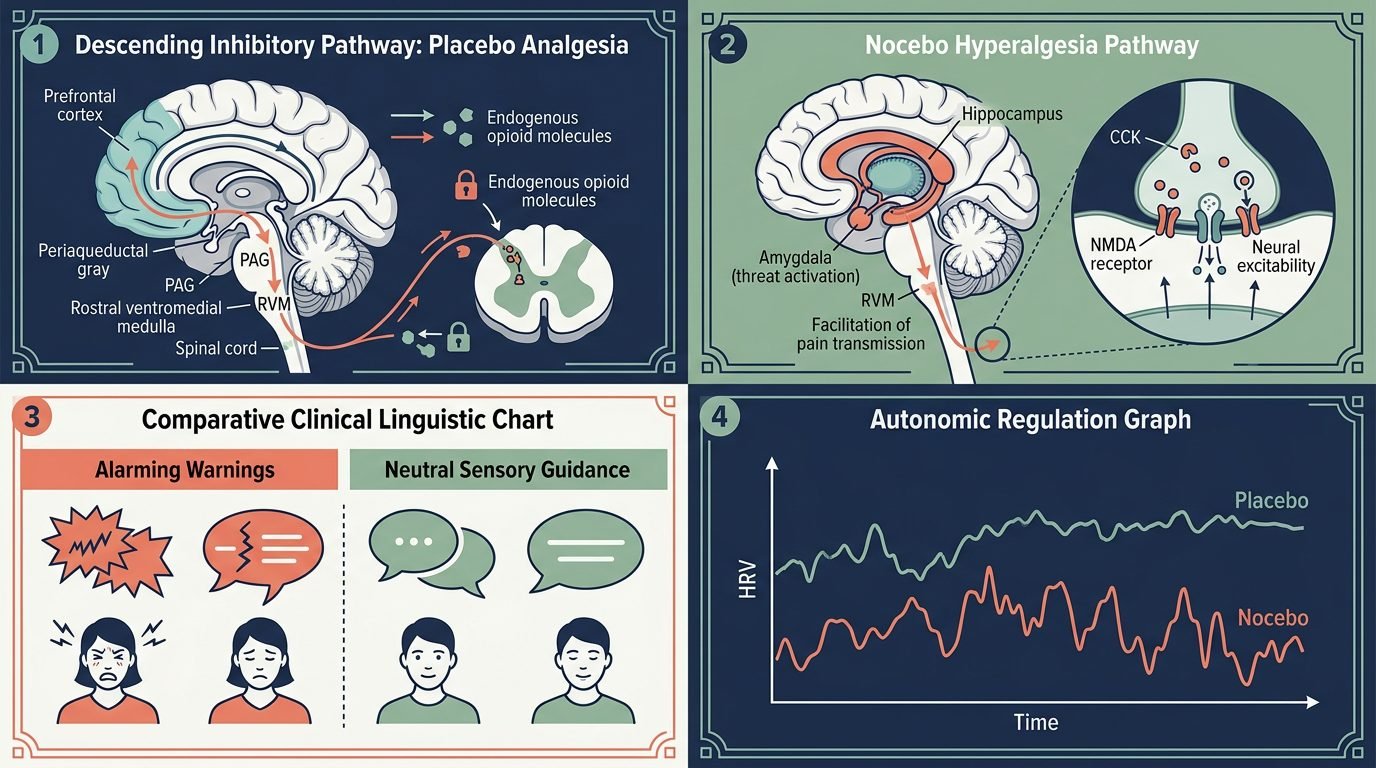
When a patient anticipates relief following verbal reassurance or therapeutic ritual, the dorsolateral prefrontal cortex engages the periaqueductal gray. This activation stimulates the rostral ventromedial medulla to deploy descending inhibitory projections to the spinal and trigeminal dorsal horns. Enkephalins, beta-endorphins, and dynorphins bind to presynaptic mu-opioid receptors on primary nociceptive afferents, blocking calcium influx and preventing glutamate and substance P exocytosis. Functional magnetic resonance imaging demonstrates that robust placebo analgesia achieves signal reductions in the dorsal horn comparable to moderate doses of systemic morphine.
The Nocebo Phenomenon and Cholecystokinin-Mediated Hyperalgesia
The neurobiology of nocebo hyperalgesia operates through distinct and aggressive biochemical pathways. When a clinician utilizes alarming language, exhibits signs of hesitation, or displays syringe hardware abruptly, the patient’s amygdala triggers an immediate autonomic threat response. Anticipatory anxiety stimulates the hypothalamus to release corticotropin-releasing hormone, activating ascending pain facilitation networks. Central to this process is the peptide neurotransmitter cholecystokinin, which antagonizes endogenous opioid function throughout the rostral anterior cingulate cortex and spinal dorsal horns.
Cholecystokinin facilitates nociceptive transmission by increasing spinal neuronal excitability and opening N-methyl-D-aspartate receptor channels. Laboratory trials demonstrate that administering proglumide, a non-selective cholecystokinin receptor antagonist, completely abolishes nocebo-induced hyperalgesia without altering baseline pain thresholds. In daily dental practice, unconsidered phrases such as warning the patient about intense stinging or asking if an extraction hurts inadvertently trigger immediate endogenous cholecystokinin release. Patients subjected to negative verbal priming experience significantly higher visual analog pain scores during identical needle penetrations compared to neutrally framed cohorts.
Conditioning and Contextual Operatory Cues
Expectation-driven pain modulation relies heavily on classical Pavlovian conditioning reinforced by past traumatic dental visits. A patient who previously suffered an excruciating pulpal extirpation develops persistent associative memory traces in the basolateral amygdala. In future visits, neutral contextual stimuli, such as the pungent odor of eugenol, the high-pitched acoustic resonance of an air turbine handpiece, or the clinical posture of a syringe-wielding operator, act as conditioned stimuli that trigger instantaneous somatic dread.
These conditioned environmental cues elevate baseline autonomic arousal, lowering central pain thresholds well before mucosal contact occurs. Salivary alpha-amylase and cortisol levels spike, inducing peripheral vasoconstriction, muscular hypertonicity, and cognitive hypervigilance. In this neurochemical state, light tactile sensation from a mirror or cotton roll is misinterpreted by the central nervous system as noxious tissue injury. Deconditioning this pathological hypervigilance requires deliberate environmental engineering, including noise reduction, olfactory masking, gentle sensory pacing, and absolute transparency in communication. Clinical trials confirm that neutralizing operatory sensory triggers restores resting heart rate variability and enhances local anesthetic depth.
Linguistic Engineering and Trauma-Informed Verbal Framing
Eliminating nocebo triggers requires systematic linguistic engineering by the entire clinical team. Clinicians must replace catastrophizing vocabulary with neutral, descriptive sensory terminology. Instead of telling a patient that a local anesthetic injection will sting or burn, the practitioner instructs the patient that they will feel a cold sensation accompanied by localized pressure. Describing mechanical sensations objectively engages sensory discrimination circuits in the parietal cortex while starving the amygdala of panic-inducing triggers.
Furthermore, verbal suggestions delivered with confidence strengthen descending placebo analgesia. Informing a patient that a topical anesthetic paste will make the mucosal surface profoundly numb before injection significantly increases pain thresholds through verified mu-opioid activation. The clinician must also abandon ambiguous interrogations such as asking if it hurts now, as this question directs attentional focus directly to nociceptive channels. Inquiring whether the patient feels pressure preserves sensory awareness while avoiding the cognitive activation of pain networks.
The Therapeutic Alliance as an Active Biochemical Modulator
The interpersonal relationship between practitioner and patient functions as a legitimate biological variable influencing clinical outcomes. Extensive randomized controlled trials demonstrate that identical pharmacological analgesics exhibit diminished efficacy when delivered covertly by automated infusion pumps compared to overt, face-to-face administration by an empathetic clinician. When a practitioner demonstrates emotional warmth, listens attentively, and maintains unhurried eye contact, the patient’s prefrontal cortex registers safety, down-regulating sympathetic outflow and facilitating endogenous oxytocin release.
Oxytocin acts centrally within the amygdala to suppress fear-related firing and promote social bonding, thereby reducing anxiety-driven pain amplification. Dental teams that cultivate genuine human connection convert the operatory environment from a site of biological threat into a therapeutic sanctuary. Integrating expectation neurobiology into chairside management does not substitute for sound pharmacological anesthesia, but rather optimizes the neurochemical substrate upon which dental therapeutics operate.
Scientific Implications for Clinical Excellence
Recognizing the neurochemistry of placebo and nocebo responses bridges the gap between technical dentistry and psychoneurobiology. Every interaction, phrase, and environmental cue in the operatory directly regulates neurochemical receptors within the central nervous system. Dental practitioners who master therapeutic expectation and eradicate negative verbal priming achieve superior patient comfort, heightened compliance, and predictable treatment outcomes. Humanized dentistry represents an evidence-based clinical discipline rooted in the biological realities of human nociception.
References
- Benedetti, F., et al. (2007). Conscious expectation and unconscious conditioning in analgesic, motor, and hormonal placebo/nocebo responses. Journal of Neuroscience, 27(41), 11090-11096.
- Colloca, L., & Miller, F. G. (2011). The role of the nurse-patient relationship in placebo and nocebo phenomena. International Journal of Nursing Studies, 48(9), 1139-1145.
- Bingel, U., et al. (2011). The effect of stopping a treatment: nocebo and the negative expectation. Science Translational Medicine, 3(70), 70ra14.
- Amanzio, M., et al. (2001). Response to nocebo in clinical trials: a meta-analysis. Pain, 90(3), 205-215.
- Wager, T. D., et al. (2004). Placebo-induced changes in FMRI in the anticipation and experience of pain. Science, 303(5661), 1162-1167.
Leave a Reply