

Dental disfigurement triggers profound psychiatric morbidity by corrupting the primary anatomical vehicle of human social engagement. Severe anterior tooth loss, advanced enamel discoloration, untreated periodontal breakdown, and pathological dental fluorosis do not remain isolated biological pathologies; they actively dismantle interpersonal agency. Clinicians frequently misjudge patients presenting with dental shame, interpreting years of treatment avoidance as personal indifference or oral hygiene negligence. In reality, the profound shame of exposing fractured, decayed dentition activates social avoidance mechanisms that frequently escalate into clinical agoraphobia and complete domestic confinement. When individuals cover their mouths with their hands while speaking or avoid smiling in public, they are exhibiting protective camouflage against social rejection. Humanized dentistry integrates psychological evaluation, ethical aesthetic communication, and graded transitional prosthodontics to rebuild oral health while restoring psychological agency.
The Social Brain and Orofacial Aesthetics: Evolution of Dental Shame
Evolutionarily, facial symmetry and healthy dentition signal vitality, whereas visible anterior destruction or necrotic margins trigger subconscious social aversion in observers within milliseconds.
Individuals with visible dental defects internalize this perceived or real social disgust, generating toxic dental shame. Unlike guilt, which is an emotional reaction to a specific negative behavior, shame is a devastating global condemnation of personal identity and bodily worth. Patients experience acute hypervigilance, anticipating mockery and disgust in professional and interpersonal encounters. Over time, constant social stress triggers sympathetic hyperactivity, social anxiety disorder, and depressive withdrawal. The individual begins avoiding public spaces, turning down employment opportunities, and isolating at home, cementing a state of secondary dental agoraphobia.
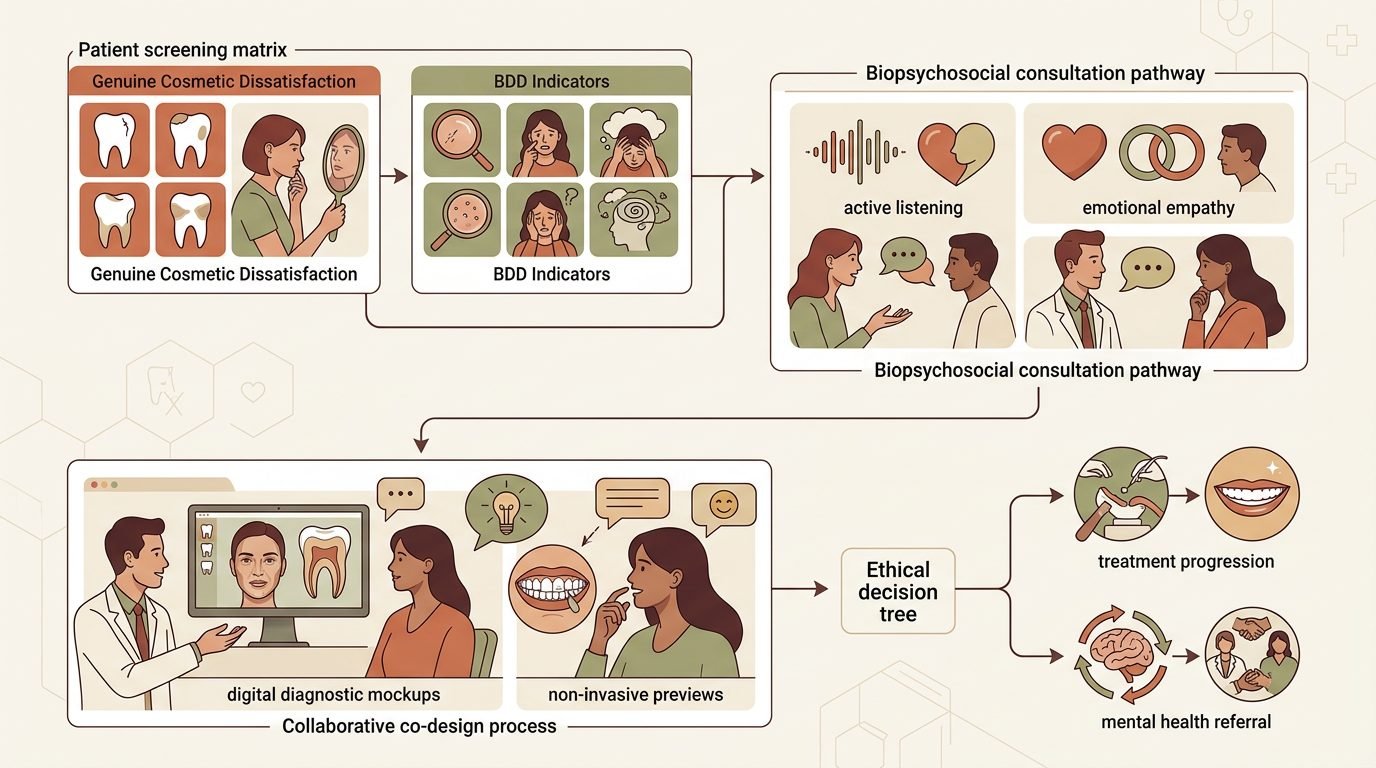
Diagnostic Differentiation: Genuine Dental Shame Versus Body Dysmorphic Disorder
The dental practitioner must distinguish between justifiable dental embarrassment caused by objective physical pathology and psychiatric body dysmorphic disorder. Body dysmorphic disorder involves an obsessive preoccupation with non-existent or minimal physical flaws, accompanied by repetitive mirror checking, severe distress, and persistent dissatisfaction with technical interventions.
Operating indiscriminately on patients with undiagnosed body dysmorphic disorder is a major iatrogenic hazard. These individuals frequently seek extensive veneer preps, aggressive crown lengthening, or complete extractions for microscopic asymmetries that healthy eyes barely perceive. No amount of aesthetic dentistry will satisfy a patient whose pathology is perceptual and psychiatric. Conversely, patients suffering from genuine dental shame display objective, severe dental destruction. They feel terrified of exposure and seek restorations not out of vanity, but to regain basic human anonymity. Screening tools such as the Body Dysmorphic Disorder Questionnaire for Dentistry protect clinicians from unethical overtreatment while ensuring compassionate care for genuine disfigurement.
The Clinical Consultation: Dismantling Shame and Creating Psychological Safety
The initial clinical encounter dictates whether an agoraphobic patient accepts care or retreats into domestic exile. Standard dental intake routines, where assistants demand medical history details across public waiting room desks, inflict humiliation. The clinic must provide total acoustic and visual privacy from the first moment of contact.
The dialogue should begin with the patient fully seated upright in a private consultation room, not reclined in an operative dental chair under surgical lights. Clinicians must establish a strict non-judgmental stance, eliminating patronizing lectures on plaque control or delayed visits. Opening inquiries should focus on life impact: “How has your smile affected your daily comfort and social activities, and what goals would make you feel at peace?” Validating that years of dental avoidance stemmed from fear rather than negligence lifts the burden of moral failure. The clinical examination must be performed without mirror handoffs until the patient explicitly requests to view their teeth.
Transitional Prosthodontics: Immediate Social Protection and Biological Pacing
Demanding that severely compromised patients endure lengthy, toothless healing intervals between surgical extractions and final restorations is clinically unacceptable. Fear of appearing toothless in front of family members represents the single greatest barrier preventing patients from accepting full-mouth rehabilitation.
Humanized clinical protocols mandate the delivery of same-day transitional aesthetics. Digital intraoral scanning and three-dimensional printing allow the fabrication of aesthetic immediate provisional prostheses or snap-on transitional splints before any irreversible surgical extractions take place. The patient never leaves the operatory without functional anterior teeth. Immediate transitional restorations provide psychological armor, shielding the patient from public visibility during long alveolar remodeling and osseointegration phases. Once basic facial dignity is secured on day one, systemic biological therapy, including periodontal scaling, endodontic therapy, and bone grafting, can proceed at a comfortable physiological pace.
Ethical Boundaries in Smile Design: Resisting Aesthetic Standardization
Contemporary aesthetic dentistry often promotes an aggressive, homogenized standard of unnatural whiteness and artificial symmetry. For a patient recovering from social agoraphobia, imposing ultra-white ceramic veneers creates aesthetic dysphoria, drawing excessive unwanted attention to a mouth they spent years concealing.
Ethical smile design respects patient identity, age, and individual facial character. The dental team must involve the patient in choosing tooth shade, length, and incisal characterization, avoiding coercive sales pressure for full-arch veneer preps. Natural chromatic gradation, subtle surface texture, and slight individual variations yield natural results that blend harmoniously with facial tissues. The ultimate objective is social restoration: enabling the patient to smile, speak, and interact without self-consciousness, restoring self-worth rather than manufacturing an artificial cosmetic mask.
Interprofessional Collaboration: Dental Teams and Mental Health Specialists
Rehabilitating patients with long-standing dental agoraphobia requires coordinated interprofessional cooperation between dental surgeons, restorative specialists, and clinical psychologists. Dental anxiety and social phobia do not instantly disappear when teeth are restored; neural pathways of avoidance remain conditioned in the brain.
Concurrent cognitive behavioral therapy helps patients unlearn safety behaviors, such as looking down while walking or covering the mouth during speech. Gradual in vivo exposure hierarchies guide the patient from solitary social encounters back into broader public settings as dental rehabilitation progresses. Documenting psychological progress alongside periodontal indices provides a comprehensive record of recovery, demonstrating how structural oral interventions rebuild psychosocial health.
Clinical Synthesis for the Dedicated Dental Team
Humanized dentistry approaches dental appearance through the lens of human dignity and psychological survival. Severe dental breakdown is not merely a localized calcified defect; it is a life-altering condition that compromises social connection. By understanding the neurobiology of social shame, providing same-day provisional protection, and conducting treatment with empathy, the dental team does not simply repair teeth; it frees human beings from isolation and restores their rightful place in society.
References
- Krochak, M., et al. (2007). Dental phobia, agoraphobia, and body dysmorphic disorder: clinical management. The New York State Dental Journal, 73(6), 46-51.
- Newton, J. T., et al. (2003). The impact of dental appearance on social perception. British Dental Journal, 195(1), 29-31.
- Veale, D. (2004). Body dysmorphic disorder. Postgraduate Medical Journal, 80(940), 67-71.
- Tristão, S. K., et al. (2012). Quality of life, anxiety, and depression in patients seeking aesthetic restorative dentistry. Journal of Esthetic and Restorative Dentistry, 24(5), 338-346.
- Armfield, J. M. (2010). Towards a better understanding of dental anxiety and dental phobia: a review of the literature. Community Dentistry and Oral Epidemiology, 38(5), 390-407.
Leave a Reply