

The hyperactive gag reflex represents an involuntary somatosensory and autonomic defense response that severely complicates clinical dental procedures and precipitates lifelong treatment avoidance. While the pharyngeal reflex prevents airway obstruction, an exaggerated gag response transforms routine clinical procedures into distressing encounters. Patients afflicted with severe gagging suffer acute embarrassment, helplessness, and loss of bodily control. The involuntary, violent spasmodic contractions of pharyngeal, laryngeal, and abdominal muscles cause significant distress and interrupt clinical procedures. Overcoming severe gagging requires dental practitioners to move beyond behavioral impatience or excessive reliance on general anesthesia. By understanding the brainstem neuroanatomy of the gag reflex arc, identifying sensory triggers, and applying evidence-based somatic neuromodulation and desensitization protocols, clinicians can manage hyper-reactive patients comfortably.
Neuroanatomy and Brainstem Circuitry of the Gag Reflex Arc
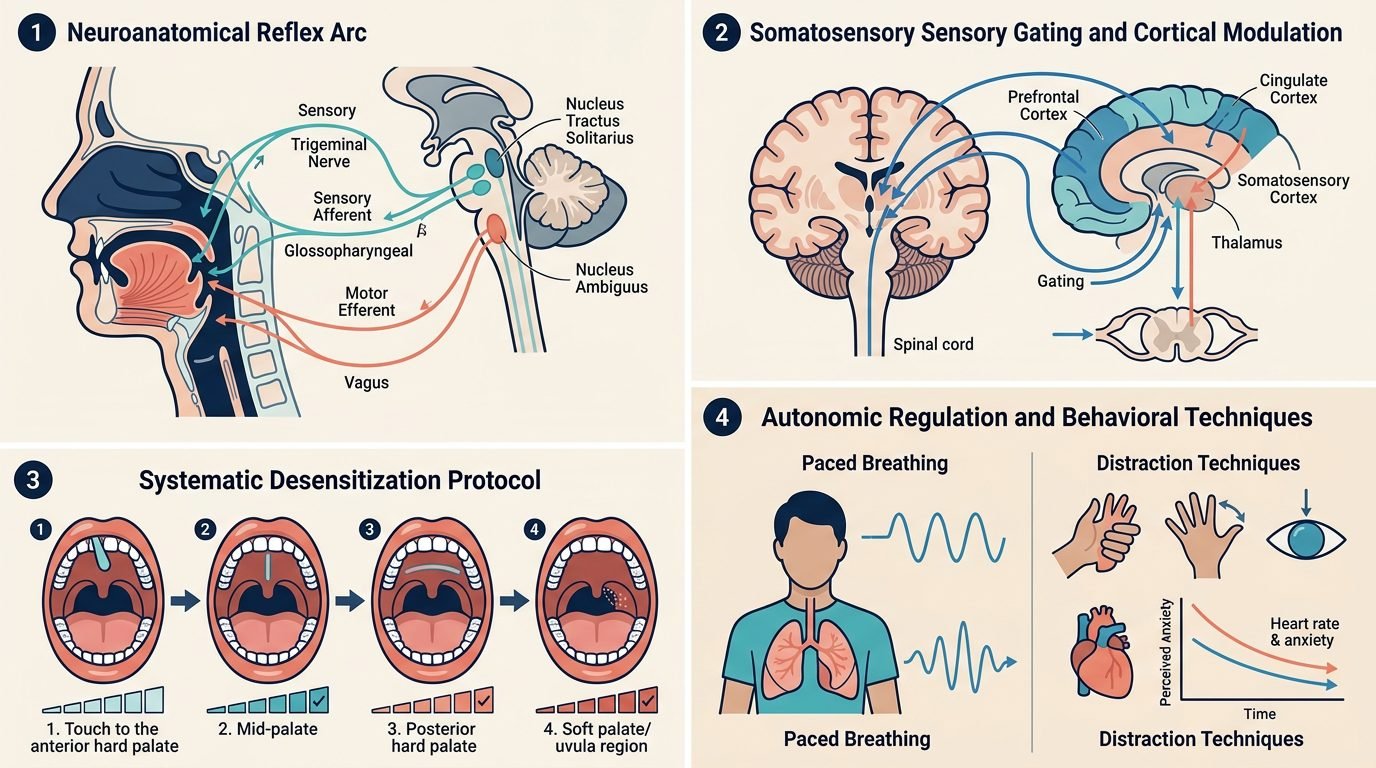
The gag reflex operates as a brainstem loop involving cranial nerves V, VII, IX, X, and XII. Sensory receptor fields triggering gagging are distributed across the posterior third of the tongue, the palatoglossal arches, the soft palate, the uvula, and the posterior pharyngeal wall. Somatosensory mechanical tactile impulses are transmitted primarily through visceral sensory branches of the glossopharyngeal nerve, with supplemental input from palatine branches of the maxillary trigeminal nerve.
These primary sensory afferents project directly into the nucleus tractus solitarius situated within the dorsal medulla oblongata. From there, dense interneuronal connections synapse upon the nucleus ambiguus, the dorsal motor nucleus of the vagus nerve, and the hypoglossal motor nucleus. When threshold is exceeded, motor efferents deploy through vagus and phrenic nerves, triggering spasmodic contractions of the diaphragm and abdominal wall, producing the characteristic retching heave.
Multimodal Sensory Triggers and Psychogenic Amplification
Although classified primarily as a somatic reflex, clinical dentistry exposes patients to multimodal sensory inputs that converge upon the vomiting center in the brainstem. Mechanical triggers include bulky impression trays, viscous alginate overflowing onto the soft palate, rigid radiography sensor holders, and pooling water during high-speed preparation. Olfactory stimuli from dental materials, acoustic triggers from suction tips, and visual sights of large instruments entering the mouth contribute substantially to sensory overload.
Furthermore, psychogenic conditioning dramatically amplifies physiological gagging. When a patient has previously experienced a traumatic choking incident in a dental chair, the amygdala encodes the operatory as a site of potential airway compromise. In subsequent visits, anticipatory anxiety activates descending corticolimbic pathways from the prefrontal cortex directly to the nucleus tractus solitarius, lowering the brainstem reflex threshold. In severe psychogenic gaggers, the mere thought of placing a dental mirror into the vestibule provokes spontaneous retching before intraoral contact occurs.
Neurosensory Inhibition: Gustatory and Acupressure Neuromodulation
Overcoming hyperactive gagging chairside requires deploying physiological mechanisms that inhibit the sensory transmission of the glossopharyngeal nerve. One reliable, scientifically verified sensory gating technique involves placing a small pinch of common table salt (sodium chloride) onto the anterior tip of the tongue. Sodium ions bind to epithelial sodium channels on taste receptor cells, generating rapid depolarizing impulses transmitted through the chorda tympani branch of the facial nerve (CN VII) directly to the rostral gustatory division of the nucleus tractus solitarius.
This intense, novel gustatory signal stimulates inhibitory interneurons that deploy gamma-aminobutyric acid (GABA) and glycine, functionally suppressing ascending mechanical inputs entering from the glossopharyngeal nerve (CN IX). The brainstem prioritizes gustatory decoding over mechanical tactile sensations, temporarily raising the gag reflex threshold for up to five minutes. Concurrently, applying firm, continuous acupressure to the Neiguan point (Pericardium 6, located on the volar forearm three finger-breadths proximal to the wrist crease between the flexor carpi radialis and palmaris longus tendons) stimulates the median nerve. Clinical neurophysiological investigations confirm that Pericardium 6 stimulation modulates autonomic brainstem networks, significantly dampening nausea and retching reflexes.
Digital Technology and Ergonomic Environmental Engineering
Modern clinical technology provides remarkable opportunities to eliminate the physical triggers responsible for severe gagging. Replacing conventional impression trays and alginate paste with compact optical digital intraoral scanners eliminates the single greatest cause of dental retching. Digital scanner wands can pause image acquisition instantly if the patient requires a swallowing break, resuming capture seamlessly without repeating the procedure. Furthermore, using pediatric-sized digital radiography sensors or adopting extraoral bitewing imaging completely circumvents intraoral floor and palatal impingement.
Ergonomic positioning also plays a vital role in preventing sensory overload. Highly reactive patients should never be placed in a fully supine position, as gravity pulls saliva and aerosol water backward against the posterior pharyngeal wall, activating the gag arc. Maintaining the patient in a semi-upright posture (forty-five to sixty degrees) with the chin tilted slightly downward allows oral fluids to pool comfortably in the anterior floor of the mouth, where high-speed evacuation can clear them efficiently. Providing the patient with a saliva ejector that they hold and control personally restores agency, eliminating the terrifying sensation of uncontrollable oral drowning.
Cognitive Distraction and Mind-Body Motor Anchoring
Actively occupying the patient’s attentional and motor processing networks serves as a powerful psychological antidote to involuntary gagging. The central nervous system possesses finite processing bandwidth; when cortical motor circuits are heavily engaged in deliberate physical tasks, subcortical sensory transmission is naturally dampened. The sustained leg-lift technique is an exceptionally effective chairside intervention: the patient is instructed to lift one leg a few inches off the dental chair and maintain it rigidly in the air while focusing intently on pointing their toes toward the ceiling.
Maintaining sustained isometric muscular contraction requires intense continuous prefrontal and primary motor cortex signaling, diverting attentional bandwidth away from pharyngeal tactile sensations. Pairing this motor task with rhythmic counting exercises or diaphragmatic resonance breathing (inhaling deeply through the nose and exhaling slowly while humming a low acoustic tone) keeps the soft palate elevated and vocal cords abduced, physically preventing the pharyngeal constriction required for the gag heave. Through patient guidance, empathetic pacing, and neurobiological understanding, clinicians convert clinical visits from terrifying struggles into comfortable, collaborative experiences.
Clinical Considerations for Restorative Comfort
Managing the hyperactive gag reflex requires viewing retching not as an inconvenient behavioral disruption, but as an autonomic neurosensory protective mechanism that has become dysregulated. By implementing non-invasive gustatory inhibition, utilizing compact digital diagnostic tools, and engaging active motor distraction protocols, dental teams provide compassionate, dignified care. Eliminating procedural retching restores patient comfort, protects clinical safety, and ensures that essential oral healthcare remains accessible to all individuals.
References
- Bassi, G. S., et al. (2004). The etiology and management of the normal and hyperactive gag reflex: a review. World Journal of Orthodontics, 5(2), 110-120.
- Dickinson, C. M., & Fiske, J. (2005). A review of gagging problems with particular reference to dental patients. International Dental Journal, 55(4), 223-229.
- Roper, S. D. (2007). Signal transduction and information processing in mammalian taste buds. Pflügers Archiv – European Journal of Physiology, 454(5), 759-776.
- Lu, D. P., et al. (2000). Acupressure for managing gagging in dental patients. General Dentistry, 48(4), 446-452.
- Saunders, R. M., & Cameron, J. (1997). Psychogenic gagging: identification and management. Compendium of Continuing Education in Dentistry, 18(5), 430-438.
Leave a Reply