

Dental treatment environments replicate the physical conditions of interpersonal violation with extraordinary neurobiological precision. The supine chair positioning, restriction of physical movement, sensory invasion of the oral cavity, and clinical power asymmetry reliably trigger severe autonomic nervous system dysregulation in survivors of physical and sexual abuse. Traditional dental behavior management strategies, which rely on authoritarian reassurance or dismissive minimization, fail completely in this clinical population. When patients exhibit sudden withdrawal or dissociative staring, clinicians often misinterpret these as non-compliance. Trauma-informed dentistry recognizes these as survival neurocircuits, requiring protocols that return physical control to the patient.
Neurobiological Mechanisms: Amygdala Hijack and Autonomic Decompensation
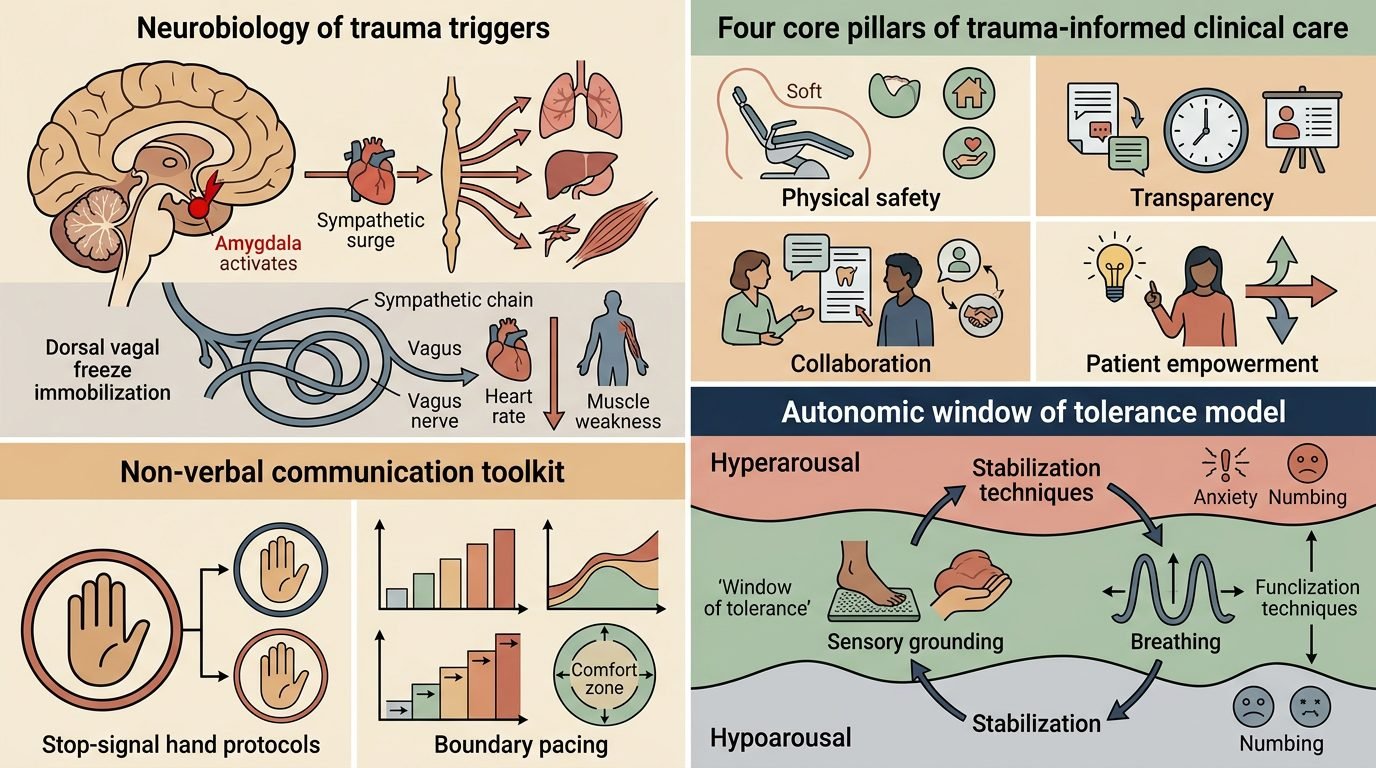
The human oral cavity possesses dense sensory innervation and unique psychological significance as a gateway for respiration, nourishment, and interpersonal speech. For adult survivors of domestic violence or sexual violation, instrumentation within the mouth directly engages the threat-detection circuitry of the limbic system. Vibrations of dental burs, chemical scents, overhead glare, and proximity of hands activate the amygdala before neocortical appraisal occurs.
According to polyvagal theory, when neuroception registers inescapable entrapment, the autonomic nervous system shifts from social engagement down into high-arousal sympathetic fight-or-flight, or further down into unmyelinated dorsal vagal shutdown. In sympathetic arousal, the patient experiences tachycardia, tachypnea, peripheral tremors, and acute panic attacks. In dorsal vagal freeze states, the patient undergoes profound down-regulation, exhibiting immobility, emotional numbness, and depersonalization. Operating during a dissociative freeze state constitutes a severe clinical failure.
Sensory Triggers in the Operatory Environment
The dental clinic contains an unusually dense concentration of environmental and sensory stimuli that act as conditioned triggers for trauma survivors. The supine posture places the patient in an evolutionarily vulnerable position with the neck and throat exposed, impeding spontaneous escape. Having a practitioner stand or sit directly behind the patient’s head eliminates direct eye contact, triggering intense hypervigilance.
Intraoral items produce distinct physiological alarms. Rubber dam isolation can generate sensations of airway occlusion, replicating memories of suffocation. Suction tips touching the soft palate trigger pharyngeal reflexes that represent protective autonomic defenses. Olfactory cues, specifically the volatile phenolic compounds found in eugenol and acrylic monomers, trigger visceral flash memories through direct olfactory bulb pathways to the limbic system. Identifying these environmental factors allows the clinical team to modify operatory arrangements before distress occurs.
Consent Architecture: The Transition from Compliance to Agency
Conventional dental treatment relies upon passive compliance, where the patient lies still while the clinician performs procedures according to an external schedule. For abuse survivors, this dynamic mirrors the powerlessness experienced during past victimizations. Trauma-informed care replaces passive compliance with continuous, explicit consent architecture. Consent is treated not as a single signature on a legal form, but as an ongoing negotiation of physical boundaries throughout the appointment.
The foundation of this architecture is the patient-controlled stop signal. The clinician establishes a clear rule during the initial dialogue: raising the left hand halts all instrumentation immediately, without hesitation or question. Clinicians must test this signal early in the appointment during non-painful examination to prove to the patient that their agency is respected. If the clinician hesitates or finishes a brief step after the signal is raised, trust evaporates instantly. Complete predictability and absolute respect for patient boundaries form the bedrock of clinical psychological safety.
Communication Strategies and Structural De-escalation
Effective clinical dialogue with trauma survivors requires transparent predictability and neutral, non-authoritarian terminology. Clinicians should use the Tell-Show-Do method with adult modifications. Every instrument must be described and shown to the patient before it enters the oral cavity. Sensory forecasts are provided in advance: “You will hear a vibration and feel water cooling the tooth for thirty seconds.”
Language must emphasize patient sovereignty and bodily ownership. Practitioners should avoid paternalistic commands such as “open wider” or “relax your jaw.” Instead, use invitational language: “Please open as far as comfortable,” or “Let me know if you need to adjust your neck support.” If a patient exhibits freezing, all work stops immediately. The chair is raised upright. The clinician steps back to restore personal space and offers grounding exercises, avoiding invasive touching.
Modifications in Clinical Technique and Equipment Usage
Standard operative routines must be modified to accommodate somatic vulnerabilities. The dental chair should be kept in a semi-supine position rather than fully reclined whenever clinically feasible, allowing the patient to retain visual control of the room. The clinician and dental assistant should position themselves within the patient’s line of sight, never hovering directly behind the headrest.
Rubber dam placement must be negotiated carefully. In cases where complete moisture control is mandatory, such as resin bonding or endodontic therapy, clear dams or split-dam techniques should be utilized, ensuring the nasal airway and corners of the mouth remain unobstructed. Alternative isolation devices like high-volume dry-shield systems can provide isolation while allowing the patient to swallow naturally. Local anesthesia protocols require meticulous attention; clinicians should provide profound pulpal and soft-tissue anesthesia to eliminate pain, but must warn patients that numbness can temporarily impair proprioception, preventing panic regarding swallowing capacity.
Interprofessional Boundaries and the Prevention of Secondary Retraumatization
A trauma-informed dentist is a clinician providing safe oral healthcare, not a psychotherapist conducting trauma processing. Dentists must never interrogate patients about the intimate details of past abuse. Clinical inquiries should focus strictly on triggers and somatic coping needs: “Are there specific positions, sounds, or sensations that cause you discomfort, and what can we do to make you feel more secure in the chair?”
Documenting these preferences in the clinical record ensures that the entire dental auxiliary team honors them consistently across visits. Knowing that a patient requires an upright chair angle, five-minute rest breaks, or unflavored prophylaxis paste prevents accidental retraumatization. The clinic acts as an environment of somatic healing by consistently demonstrating that healthcare providers can enter intimate physical space without violating autonomy or inflicting non-consensual pain.
Clinical Synthesis for the Contemporary Dental Team
Trauma-informed dental practice is not an optional emotional luxury; it is an evidence-based standard of care that dictates procedural success and patient safety. Approaching adult abuse survivors with neurobiological understanding transforms panic-driven dental avoidance into stable, trusting clinical relationships. By restructuring operatory dynamics around predictability, sensory calibration, and absolute patient agency, the dental profession fulfills its deepest ethical duty: treating vulnerable human beings with uncompromising technical skill and profound somatic respect.
References
- Raja, S., et al. (2014). Trauma-informed care in dentistry: what, why, and how. Journal of Dental Education, 78(11), 1548-1555.
- Porges, S. W. (2009). The polyvagal theory: new insights into adaptive reactions of the autonomic nervous system. Cleveland Clinic Journal of Medicine, 76(Suppl 2), S86-S90.
- Hmud, R., & Walsh, L. J. (2009). Dental anxiety: causes, complications and management approaches. Journal of Minimum Intervention in Dentistry, 2(1), 67-78.
- Briere, J., & Scott, C. (2014). Principles of Trauma Therapy: A Guide to Symptoms, Evaluation, and Treatment. Sage Publications.
- Armfield, J. M., & Heaton, L. J. (2013). Management of fear and anxiety in the dental clinic: a review. Australian Dental Journal, 58(4), 390-407.
Leave a Reply