

Interpersonal violence and developmental trauma leave profound neurobiological imprints that dramatically alter patient responses within the dental operatory. Survivors of sexual assault and domestic violence frequently experience extreme physiological distress during routine oral healthcare encounters. The standard dental environment presents an intense cluster of trauma-triggering stimuli: physical reclining into a vulnerable supine position, proximity of an authoritative figure hovering overhead, manual manipulation of the oral cavity, and temporary loss of verbal communication. Without specialized awareness, dental practitioners inadvertently trigger acute post-traumatic flashbacks, panic dissociation, or autonomic shutdown. Implementing trauma-informed care principles establishes a safe physiological and emotional environment that respects bodily autonomy, predicts visceral triggers, and prevents retraumatization during essential clinical interventions.
Neurobiology of Post-Traumatic Stress and Trigeminal Threat Detection
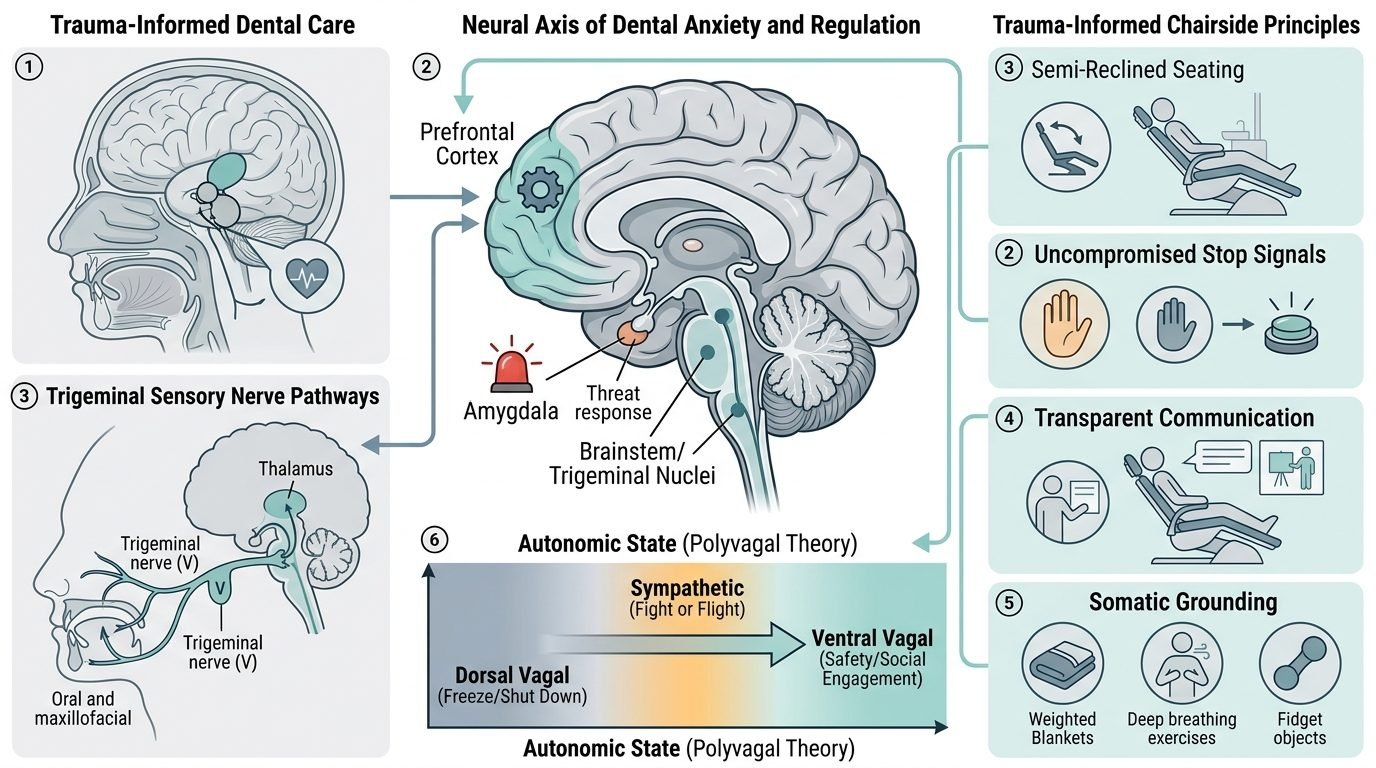
Trauma alters functional neural architecture, particularly across the amygdala, hippocampus, and prefrontal cortex. Chronic developmental or interpersonal abuse results in structural amygdalar hyper-reactivity alongside impaired prefrontal inhibitory control. The neuroception of safety, described in polyvagal neuroscience, is compromised in trauma survivors. In these patients, ambiguous sensory cues are automatically categorized as imminent mortal hazards. When a dental practitioner enters the intimate perioral boundary, sensory afferents travel through the trigeminal pathway directly into brainstem autonomic nuclei, bypassing slower cortical discrimination.
The oral cavity represents a deeply personal anatomical territory intimately tied to survival, nutrition, and self-expression. In survivors of sexual abuse, forced oral penetration or physical suffocation creates powerful conditioned associative links between oral manipulation and severe terror. Dental instruments, suction tips, or fingers placed inside the mouth stimulate glossopharyngeal and trigeminal sensory receptors, evoking sensations of choking and helplessness. Sympathetic fight-or-flight discharge accelerates heart rate and drives hyperventilation. If physical restraint or rapid procedure continuation occurs, the patient nervous system collapses into a dorsal vagal freeze state characterized by profound depersonalization, analgesic numbness, and psychomotor immobility.
Procedural Triggers and Ergonomic Adaptations
The physical positioning of the patient in the dental chair represents a potent procedural trigger. Placing a trauma survivor into a full horizontal or Trendelenburg position induces acute feelings of powerlessness and immobilization. Survivors often describe the supine position as replicating the posture of historical sexual or physical assaults. Ergonomic adaptation requires keeping the dental chair semi-reclined at a 45-degree angle whenever clinically feasible. Maintaining the patient head slightly elevated allows continuous visual orientation toward the operator, assisting staff, and room exits.
Lighting and auditory stimuli require intentional calibration. Direct overhead operatory lights shining into a patient eyes replicate interrogative or abusive atmospheres, predisposing the central nervous system to sensory overload. Clinicians should illuminate exclusively the oral field while offering protective tinted safety eyewear. Sudden unannounced sounds, such as pneumatic compressor cycles or ultrasonic scaling whines, trigger hyperstartle reflexes. Providing noise-canceling headphones or playing low-frequency ambient music masks sudden industrial noises, stabilizing auditory processing networks.
Restoring Patient Autonomy Through Non-Retractile Consent
Trauma inherently involves the non-consensual violation of physical boundaries and bodily autonomy. Consequently, restoring genuine autonomy serves as the central therapeutic foundation of trauma-informed dentistry. Informed consent cannot be treated as a static administrative document signed in the waiting area; it must function as a dynamic, continuous conversational contract. Practitioners must explain each physical step before making contact, explicitly describing what will be touched, which instrument will be used, and the expected sensation.
Establishing clear, non-retractile stop signals empowers the patient to retain control throughout the appointment. The standard recommendation of raising the left hand must be reinforced with absolute clinical fidelity: the moment the hand rises, all instruments must exit the oral cavity instantly without hesitation or pleading. If a clinician delays pausing to finish a restoration or complete an extraction pass, the patient trust is shattered, reinforcing historical traumas of helplessness. In addition to hand signals, providing the patient with a hand-held button that sounds a chime gives a tangible sense of agency over procedural pacing.
Verbal Communication Strategies and De-escalation
Linguistic precision plays a critical role in preventing post-traumatic hyperarousal. Clinicians should avoid command-oriented language such as open wider, sit still, or relax. Such phrases echo abusive imperatives and stimulate somatic resistance. Instead, practitioners should employ collaborative invitations: when you feel ready, please open your mouth, or feel free to adjust your position whenever necessary. Clinicians should announce physical touch before placing hands on the face or patient shoulder, avoiding unexpected tactile surprises that trigger defensive startle responses.
If a patient enters an acute dissociative state during treatment, characterized by blank staring, unresponsive silence, or trembling, the clinician must halt treatment immediately. Re-grounding protocols help bring the patient back into present sensory reality. The practitioner should speak in a calm, low-frequency tone, encouraging the patient to look around the room and identify five blue objects, feel their feet firmly planted on the floor, or hold a cool glass of water. Practitioners must never touch a dissociating patient without explicit permission, as physical contact can be misinterpreted as assault during acute flashbacks.
Institutional Culture and Clinical Best Practice
Trauma-informed care extends beyond individual operator behavior to encompass entire organizational systems. Administrative receptionists, dental hygienists, and chairside assistants require systematic education regarding trauma prevalence and behavioral manifestations. Clinical intake questionnaires should include gentle, non-invasive questions regarding comfort levels, physical boundaries, and preferred coping strategies without forcing disclosure of specific traumatic histories. Knowing that a patient requires frequent procedural pauses or prefers a female clinician suffices to tailor delivery without intrusive probing.
Providing trauma-informed dental care protects vulnerable populations from severe oral neglect. Many survivors avoid dental care for decades, presenting with rampant caries, severe periodontal destruction, and chronic infection due to crippling healthcare phobia. By cultivating an empathetic, transparent, and clinically predictable environment, dental professionals heal more than teeth. They restore faith in medical institutions, proving that clinical environments can be safe, respectful, and genuinely empowering. Emphasizing compassionate communication and uncompromised patient autonomy dismantles long-standing clinical barriers, creating sustainable pathways toward lifelong oral health. This ethical transformation humanizes operative dentistry while advancing clinical standards of care across all patient demographics.
References
- Raja, S., Hasnain, M., Hoersch, M., Gagliano, P. E., & Raja, S. (2015). Trauma-informed care in medicine: current knowledge and future research directions. Family & Community Health, 38(3), 216-226.
- Porges, S. W. (2009). The polyvagal theory: new insights into adaptive reactions of the autonomic nervous system. Cleveland Clinic Journal of Medicine, 76(Suppl 2), S86-S90.
- van der Kolk, B. A. (2014). The Body Keeps the Score: Brain, Mind, and Body in the Healing of Trauma. Viking.
- Kuzminski, R., et al. (2020). Trauma-informed dentistry: A review of current concepts and clinical strategies. Journal of Dental Hygiene, 94(4), 45-53.
- Hamblen, J. L., et al. (2019). Cognitive-behavioral strategies for managing PTSD-related anxiety in medical and dental settings. Psychiatric Annals, 49(8), 350-356.
Leave a Reply