

Dental-induced post-traumatic stress disorder represents a severe psychiatric sequela originating from historical traumatic dental interventions, childhood restraint, or procedural medical assault. While standard dental anxiety reflects moderate apprehension regarding anticipatory procedural discomfort, medical post-traumatic stress disorder in the dental setting manifests as involuntary sensory flashbacks, dissociative episodes, acute panic attacks, and profound autonomic dysregulation. Patients carrying these psychological injuries frequently experience the dental chair as a site of imminent physical violation rather than healthcare delivery. Reclining into a supine position, feeling hands or metal instruments in the oral cavity, or hearing high-frequency acoustic handpiece vibrations reactivates consolidated trauma networks within the limbic system, bypassing cognitive rationality entirely. Effectively treating these vulnerable individuals requires dental clinicians to understand the neurobiology of traumatic memory reconsolidation and implement structured, trauma-informed care protocols grounded in continuous consent, radical bodily autonomy, and somatic stabilizing interventions.
The Neurobiology of Traumatic Memory Consolidation and Flashbacks
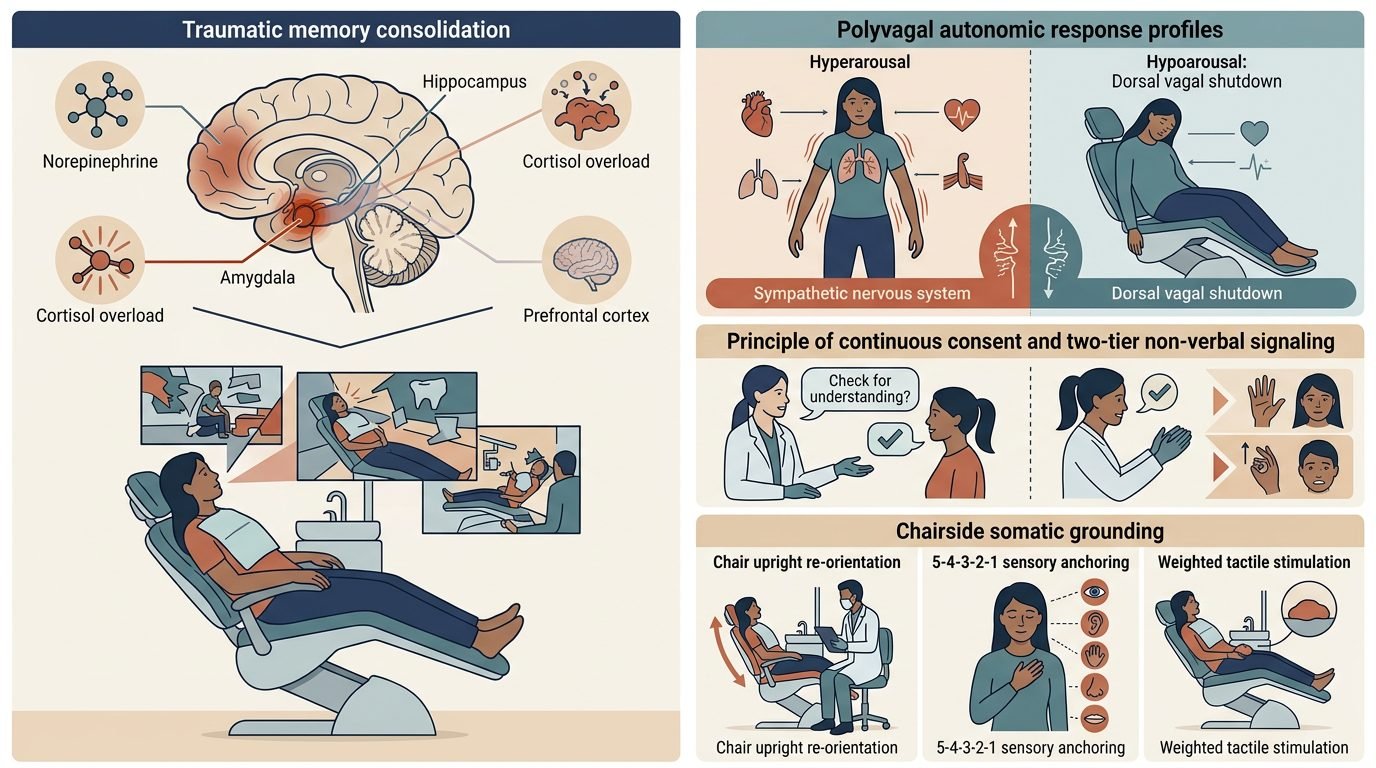
Under ordinary physiological conditions, emotional experiences are processed through the amygdala and integrated into contextual autobiographical memory by the hippocampus and medial prefrontal cortex. However, when an individual undergoes acute terror accompanied by helplessness, such as being forcibly held down during a pediatric dental extraction or enduring excruciating pain during pulpal extirpation without anesthesia, massive surges of norepinephrine and cortisol overwhelm hippocampal processing capacity.
This neurochemical storm prevents normal narrative memory integration. Instead, fragmented sensory impressions, including the specific metallic taste of dental instruments, the blinding glare of operatory illumination, the tactile sensation of suffocation from rubber dams or water spray, and the visceral smell of burning dentin, are etched directly into the basolateral amygdala as unintegrated, hyper-salient trauma engrams. Years or decades later, when the patient re-enters a dental operatory, these conditioned sensory cues trigger instantaneous amygdalar hyperactivation. Simultaneously, functional neuroimaging demonstrates that the medial prefrontal cortex and anterior cingulate cortex, which normally down-regulate fear responses, undergo functional shutdown. The patient relives the original traumatic event not as a historical memory, but as an immediate, life-threatening physical emergency.
Clinical Manifestations of Operatory Trauma: Panic and Dissociation
The clinical presentation of medical post-traumatic stress disorder in the dental chair falls primarily into two distinct autonomic profiles: hyperarousal panic or hypoarousal dissociation. In the hyperarousal profile, sympathetic nervous system overdrive produces sudden sinus tachycardia, tachypnea, peripheral vasoconstriction, uncontrollable motor tremors, and an intense urge to escape the operatory physically. Patients may exhibit involuntary gagging, claw at the operator’s hands, or experience severe emotional weeping.
Conversely, the hypoarousal dissociative profile is characterized by dorsal vagal shutdown. The patient becomes motionless, emotionally flat, non-verbal, and unresponsive to verbal queries. Dissociation represents the mammalian nervous system’s final defense against perceived inescapable physical destruction, functionally disconnecting conscious awareness from physical bodily sensations. Clinicians unfamiliar with trauma dynamics frequently mistake dissociative compliance for calm cooperation, continuing aggressive operative procedures while the patient experiences profound internal psychological disintegration. Recognizing glazed stares, shallow breathing, and muscular rigidity as signs of acute dissociation is essential for preventing re-traumatization.
Trauma-Informed Care and the Principle of Continuous Consent
Dismantling traumatic triggers requires replacing the traditional paternalistic clinical model with a framework of absolute transparent autonomy. The patient must understand that they maintain complete physical control over every micro-step of the appointment. Before any instrument is introduced into the mouth, the clinician must explicitly negotiate clear, unambiguous non-verbal communication systems. While raising a hand is the conventional signal, trauma survivors often freeze motorically when triggered. Establishing a two-tiered signaling protocol, such as raising a hand for a pause and dropping an acoustic clicker or squeeze-ball for an immediate emergency stop, provides accessible communication options during motor freezing.
Furthermore, consent must be treated as a dynamic, continuous process rather than a static signature on an intake form. The clinician must narrate each mechanical transition before touching the patient, verifying willingness to proceed at every milestone. For instance, the practitioner states clearly that they are about to place the mouth mirror, pausing to confirm non-verbal or verbal assent before advancing. If the patient exhibits subtle signs of sympathetic arousal or autonomic withdrawal, treatment pauses immediately without frustration, annoyance, or judgment from the clinical team.
Chairside Somatic Grounding Techniques
When a patient experiences an acute flashback or dissociative surge in the operatory chair, verbal cognitive reassurance alone is rarely effective, as language-processing areas in the left hemisphere (Broca’s area) are functionally inhibited during limbic hijacking. The clinician must guide the patient back into present-moment physiological safety through somatic sensory grounding. The first step involves returning the dental chair immediately to an upright seated position, restoring the patient’s visual orientation and vestibular balance.
The clinician can then guide the patient through the 5-4-3-2-1 sensory orientation technique, instructing them to name aloud five things they see in the room, touch four distinct physical textures (such as their clothing or chair armrests), identify three sounds, recognize two scents, and notice one taste. Additionally, tactical physical grounding objects, such as holding a weighted sensory lap pad, squeezing textured rubber spheres, or holding an ice pack against the palm or sternum, stimulate cutaneous thermoreceptors. This tactile stimulation activates ascending sensory pathways in the dorsal column-medial lemniscal system, re-anchoring cortical awareness to present physical safety.
Strategic Appointment Pacing and Operatory Engineering
Managing patients with medical post-traumatic stress disorder requires careful scheduling and environmental adaptations. Initial appointments should be strictly non-procedural consultations conducted in an ordinary meeting room without clinical hardware. The patient is encouraged to tour the facility, inspect instruments at their own pace, and discuss specific historical triggers openly. Clinical appointments must be scheduled in low-traffic morning hours, minimizing background operatory noise, acoustic chatter, and sudden environmental surprises.
The operatory should minimize sensory threat. Overhead lighting should be dimmed, electric micromotors preferred over turbines, and calming air purifiers used to mask medicinal odors, allowing the nervous system to regain physiological equilibrium.
Clinical Considerations for Restorative Reclamation
Providing dental care to individuals burdened by traumatic dental memories demands patience, neurological understanding, and unyielding respect for personal boundaries. By replacing historical coercion with transparent consent, clinicians dismantle conditioned fear networks and prevent psychiatric re-traumatization. Establishing emotional safety in the operatory chair enables patients to overcome debilitating avoidance and reclaim their oral and psychological health.
References
- De Jongh, A., et al. (2002). Treating dental phobia with education and cognitive behavioral therapy: a review. Journal of Clinical Psychology, 58(6), 723-736.
- Raja, S., et al. (2014). Trauma-informed care in dental practice: what, why, and how. Journal of Dental Education, 78(8), 1179-1188.
- Porges, S. W. (2009). The polyvagal theory: new insights into adaptive reactions of the autonomic nervous system. Cleveland Clinic Journal of Medicine, 76(Suppl 2), S86-S90.
- Lanius, R. A., et al. (2010). Emotion modulation in PTSD: Clinical and neurobiological evidence for a dissociative subtype. American Journal of Psychiatry, 167(6), 640-647.
- Armfield, J. M., & Heaton, L. J. (2013). Management of fear and anxiety in the dental clinic: a review. Australian Dental Journal, 58(4), 390-407.
Leave a Reply