

Erbium laser enamel conditioning combined with brief phosphoric acid application produces a durable adhesive substrate that enhances resin infiltration and acid resistance compared to traditional acid etching alone. For decades, adhesive dentistry relied on Buonocore’s technique of applying 37 percent phosphoric acid to dissolve enamel hydroxyapatite. Acid etching creates microporosities into which low-viscosity resin monomers flow to form micromechanical tags. However, acid conditioning removes minerals without altering the acid solubility of residual enamel. Erbium lasers (Er:YAG 2,940 nm and Er,Cr:YSGG 2,780 nm) condition enamel through thermomechanical micro-explosions under water spray. While early investigations questioned whether laser ablation could replace acid etching, contemporary research proves that combining laser preparation with short acid conditioning optimizes shear bond strength while increasing resistance to secondary marginal caries.
Physics of Erbium Laser Ablation in Enamel Prisms
Erbium wavelengths operate at peak optical absorption bands for both water and calcium hydroxyapatite. Human dental enamel consists of 96 percent inorganic mineral by weight, with approximately 4 percent water and organic matrix packed within inter-prismatic spaces. When an Er:YAG or Er,Cr:YSGG laser delivers sub-millisecond pulses onto water-moistened enamel, photon energy is absorbed by structural water molecules trapped within the crystalline lattice.
The absorbed energy instantly superheats water beyond its vaporization threshold, generating rapid volumetric expansion. This explosive pressure exceeds the ultimate tensile strength of the surrounding hydroxyapatite crystals, shattering and ejecting microscopic mineral fragments in a process known as thermomechanical micro-ablation. Because ablation occurs via mechanical fragmentation rather than thermal melting, the adjacent enamel structure remains thermally protected under continuous coaxial water spray. The resulting prepared surface exhibits micro-rough cratering, open enamel prism bundles, and zero organic smear layer deposition.
Micromorphological Comparison: Laser Micro-Cratering Versus Acid Dissolution
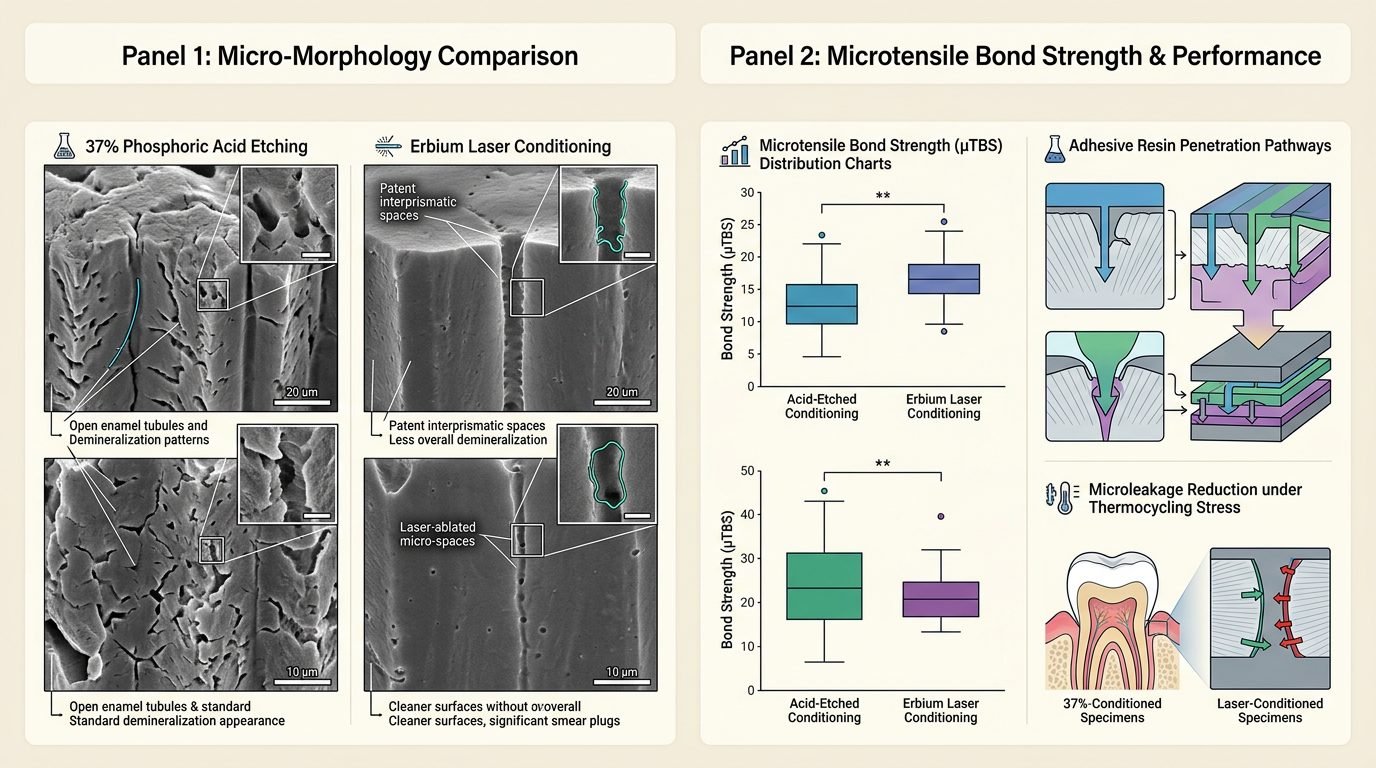
Scanning electron microscopy (SEM) reveals striking micromorphological differences between acid-etched and erbium-conditioned enamel surfaces. Phosphoric acid produces a uniform, honeycombed micro-retentive etching pattern. Acid selectively removes intra-prismatic minerals, creating clean micro-channels measuring five to twenty micrometers deep that permit deep resin monomer infiltration.
Conversely, erbium laser irradiation alone produces an irregular, macro-retentive surface characterized by mechanical micro-craters, step-like crystalline elevations, and exposed prism rods without a true demineralization pattern. Because the laser cleaves enamel along crystalline fracture lines rather than chemical dissolution planes, the surface lacks the ultra-fine nanometer-scale porosities characteristic of acid-etched prisms. Furthermore, high-power or water-deficient laser irradiation risks producing localized subsurface micro-fractures, melted crystalline droplets, and fused hydroxyapatite globules that prevent resin penetration. Consequently, adhesive restorations placed onto enamel conditioned solely by erbium lasers without subsequent acid etching consistently exhibit significantly lower initial microtensile bond strengths.
The Synergy of Laser and Acid Co-Conditioning
To overcome the adhesive limitations of laser-only preparation, biomaterials researchers developed the combined laser-acid co-conditioning protocol. In this dual approach, the clinician prepares or bevels the enamel margin using the erbium laser, followed by a brief application of 37 percent phosphoric acid for fifteen seconds.
This sequence creates an optimal microscopic substrate. The erbium laser provides macro-retentive surface roughness, removes contaminated outer prism layers, and eliminates the smear layer. The subsequent brief phosphoric acid rinse selectively dissolves prism cores across the laser-cleaved crystalline steps, generating microscopic and nanoscopic retentive networks. Laboratory microtensile bond strength testing demonstrates that enamel treated with laser-acid co-conditioning achieves bond strengths of 28 to 34 Megapascals, matching or exceeding pristine acid-etched controls. Furthermore, confocal laser scanning microscopy shows continuous, dense resin tag networks extending thirty to forty micrometers into enamel prisms, preventing adhesive interfacial gaps.
Chemical Alterations: Crystallinity and Acid-Resistance
A critical clinical advantage of erbium laser enamel conditioning lies in its chemical modification of the residual mineralized margin. During pulsed erbium ablation, low-level thermal transfer alters the crystallographic properties of remaining hydroxyapatite crystals.
Fourier-transform infrared spectroscopy (FTIR) and X-ray diffraction analyses reveal that laser irradiation reduces the carbonate-to-phosphate ratio within irradiated enamel. Carbonate ions represent structural defects in the hydroxyapatite lattice that elevate acid solubility. By purging carbonate and reducing organic matrix content, the laser converts labile carbonated hydroxyapatite into a more stable, crystalline fluorapatite-like mineral. Demineralization cycling assays confirm that enamel margins conditioned with erbium lasers exhibit up to fifty percent less subsurface mineral loss when exposed to lactic acid challenges (pH 4.5) compared to purely acid-etched enamel. This enhanced acid resistance shields restoration margins against secondary biofilm demineralization.
Clinical Protocol: Operative Parameters and Water-Spray Ratios
Achieving reproducible adhesive performance requires precise calibration of laser parameters and fluid delivery. Thermal overheating must be prevented to avoid crystalline carbonization or pulp irritation.
For enamel beveling and conditioning, an Er:YAG laser (2,940 nm) is operated with a sapphire or quartz tip measuring 600 to 800 micrometers in diameter. The optimal power setting is 2.0 to 2.5 Watts, utilizing a pulse energy of 100 to 125 millijoules and a repetition rate of 20 Hertz, delivering short pulse durations of fifty to one hundred microseconds. Coaxial water spray must be maintained at a high flow rate: seventy percent water and thirty percent air (approximately 5 to 8 milliliters of water per minute). The tip is moved in non-contact sweeping motions at a distance of one to two millimeters from the enamel surface. Following laser irradiation, 37 percent phosphoric acid gel is applied to the margins for fifteen seconds, rinsed thoroughly with water for fifteen seconds, dried gently, and coated with a universal adhesive bonding agent.
Marginal Integrity and Microleakage Mitigation
Marginal microleakage at the composite-enamel junction leads to marginal staining, restoration degradation, and secondary caries. Thermocycling dye penetration studies demonstrate that restorations bonded to laser-conditioned enamel with subsequent acid etching exhibit significantly lower microleakage scores than restorations placed with traditional rotary burs and acid etching alone.
The absence of an amorphous smear layer allows adhesive primers to bond directly to native crystalline hydroxyapatite. In addition, the increased surface area created by laser micro-cratering redistributes polymerization shrinkage stresses across multiple micro-planes, reducing stress concentrations along the cavosurface margin. Over long-term mechanical fatigue testing, the laser-conditioned adhesive interface demonstrates superior stability, preserving marginal adaptation and color stability in esthetic composite restorations and ceramic veneers.
Clinical Synthesis for Restorative and Esthetic Dentistry
Erbium laser conditioning represents a biological refinement of adhesive enamel preparation. By pairing thermomechanical micro-ablation with brief phosphoric acid etching, clinicians capitalize on the mechanical macro-roughness and crystallographic acid resistance of laser preparation while securing the nano-retentive bond strength of acid demineralization. Incorporating laser-acid co-conditioning into restorative protocols elevates bond longevity, prevents interfacial microleakage, and protects cavosurface margins against secondary decay in clinical practice.
References
- De Moor, R. J., et al. (2010). The use of lasers in adhesive dentistry. European Journal of Dental Education, 14(2), 79-88.
- Harashima, T., et al. (2005). Morphological changes of human enamel irradiated by Er:YAG laser. Journal of Clinical Laser Medicine & Surgery, 23(2), 52-56.
- Kornblit, R., et al. (2008). The effects of Er:YAG laser irradiation on enamel and dentin bond strength: a systematic review. Photomedicine and Laser Surgery, 26(4), 375-385.
- Ozel, E., et al. (2010). Shear bond strength of resin composite to enamel prepared with Er:YAG laser and acid etching. Operative Dentistry, 35(4), 415-422.
- Van Meerbeek, B., et al. (2010). State of the art of enamel and dentin bonding. Journal of Dentistry, 38(2), 100-112.
Leave a Reply